
Monthly Archives: January 2023

LHC Black Holes for the Terminally Un-Reassured

Could the LHC have killed us all?

No, no it could not.

But…

I’ve had this conversation a few times over the years. Usually, the people I’m talking to are worried about black holes. They’ve heard that the Large Hadron Collider speeds up particles to amazingly high energies before colliding them together. They worry that these colliding particles could form a black hole, which would fall into the center of the Earth and busily gobble up the whole planet.

This pretty clearly hasn’t happened. But also, physicists were pretty confident that it couldn’t happen. That isn’t to say they thought it was impossible to make a black hole with the LHC. Some physicists actually hoped to make a black hole: it would have been evidence for extra dimensions, curled-up dimensions much larger than the tiny ones required by string theory. They figured out the kind of evidence they’d see if the LHC did indeed create a black hole, and we haven’t seen that evidence. But even before running the machine, they were confident that such a black hole wouldn’t gobble up the planet. Why?

The best argument is also the most unsatisfying. The LHC speeds up particles to high energies, but not unprecedentedly high energies. High-energy particles called cosmic rays enter the atmosphere every day, some of which are at energies comparable to the LHC. The LHC just puts the high-energy particles in front of a bunch of sophisticated equipment so we can measure everything about them. If the LHC could destroy the world, cosmic rays would have already done so.

That’s a very solid argument, but it doesn’t really explain why. Also, it may not be true for future colliders: we could build a collider with enough energy that cosmic rays don’t commonly meet it. So I should give another argument.

The next argument is Hawking radiation. In Stephen Hawking’s most famous accomplishment, he argued that because of quantum mechanics black holes are not truly black. Instead, they give off a constant radiation of every type of particle mixed together, shrinking as it does so. The radiation is faintest for large black holes, but gets more and more intense the smaller the black hole is, until the smallest black holes explode into a shower of particles and disappear. This argument means that a black hole small enough that the LHC could produce it would radiate away to nothing in almost an instant: not long enough to leave the machine, let alone fall to the center of the Earth.

This is a good argument, but maybe you aren’t as sure as I am about Hawking radiation. As it turns out, we’ve never measured Hawking radiation, it’s just a theoretical expectation. Remember that the radiation gets fainter the larger the black hole is: for a black hole in space with the mass of a star, the radiation is so tiny it would be almost impossible to detect even right next to the black hole. From here, in our telescopes, we have no chance of seeing it.

So suppose tiny black holes didn’t radiate, and suppose the LHC could indeed produce them. Wouldn’t that have been dangerous?

Here, we can do a calculation. I want you to appreciate how tiny these black holes would be.

From science fiction and cartoons, you might think of a black hole as a kind of vacuum cleaner, sucking up everything nearby. That’s not how black holes work, though. The “sucking” black holes do is due to gravity, no stronger than the gravity of any other object with the same mass at the same distance. The only difference comes when you get close to the event horizon, an invisible sphere close-in around the black hole. Pass that line, and the gravity is strong enough that you will never escape.

We know how to calculate the position of the event horizon of a black hole. It’s the Schwarzchild radius, and we can write it in terms of Newton’s constant G, the mass of the black hole M, and the speed of light c, as follows:

\frac{2GM}{c^2}

The Large Hadron Collider’s two beams each have an energy around seven tera-electron-volts, or TeV, so there are 14 TeV of energy in total in each collision. Imagine all of that energy being converted into mass, and that mass forming a black hole. That isn’t how it would actually happen: some of the energy would create other particles, and some would give the black hole a “kick”, some momentum in one direction or another. But we’re going to imagine a “worst-case” scenario, so let’s assume all the energy goes to form the black hole. Electron-volts are a weird physicist unit, but if we divide them by the speed of light squared (as we should if we’re using E=mc^2 to create a mass), then Wikipedia tells us that each electron-volt will give us 1.78\times 10^{-36} kilograms. “Tera” is the SI prefix for 10^{12}. Thus our tiny black hole starts with a mass of

14\times 10^{12}\times 1.78\times 10^{-36} = 2.49\times 10^{-23} \textrm{kg}

Plugging in Newton’s constant (6.67\times 10^{-11} meters cubed per kilogram per second squared), and the speed of light (3\times 10^8 meters per second), and we get a radius of,

\frac{2\times 6.67\times 10^{-11}\times 14\times 10^{12}\times 1.78\times 10^{-36}}{\left(3\times 10^8\right)^2} = 3.7\times 10^{-50} \textrm{m}

That, by the way, is amazingly tiny. The size of an atom is about 10^{-10} meters. If every atom was a tiny person, and each of that person’s atoms was itself a person, and so on for five levels down, then the atoms of the smallest person would be the same size as this event horizon.

Now, we let this little tiny black hole fall. Let’s imagine it falls directly towards the center of the Earth. The only force affecting it would be gravity (if it had an electrical charge, it would quickly attract a few electrons and become neutral). That means you can think of it as if it were falling through a tiny hole, with no friction, gobbling up anything unfortunate enough to fall within its event horizon.

For our first estimate, we’ll treat the black hole as if it stays the same size through its journey. Imagine the black hole travels through the entire earth, absorbing a cylinder of matter. Using the Earth’s average density of 5515 kilograms per cubic meter, and the Earth’s maximum radius of 6378 kilometers, our cylinder adds a mass of,

\pi \times \left(3.7\times 10^{-50}\right)^2 \times 2 \times 6378\times 10^3\times 5515 = 3\times 10^{-88} \textrm{kg}

That’s absurdly tiny. That’s much, much, much tinier than the mass we started out with. Absorbing an entire cylinder through the Earth makes barely any difference.

You might object, though, that the black hole is gaining mass as it goes. So really we ought to use a differential equation. If the black hole travels a distance r, absorbing mass as it goes at average Earth density \rho, then we find,

\frac{dM}{dr}=\pi\rho\left(\frac{2GM(r)}{c^2}\right)^2

Solving this, we get

M(r)=\frac{M_0}{1- M_0 \pi\rho\left(\frac{2G}{c^2}\right)^2 r }

Where M_0 is the mass we start out with.

Plug in the distance through the Earth for r, and we find…still about 3\times 10^{-88} \textrm{kg}! It didn’t change very much, which makes sense, it’s a very very small difference!

But you might still object. A black hole falling through the Earth wouldn’t just go straight through. It would pass through, then fall back in. In fact, it would oscillate, from one side to the other, like a pendulum. This is actually a common problem to give physics students: drop an object through a hole in the Earth, neglect air resistance, and what does it do? It turns out that the time the object takes to travel through the Earth is independent of its mass, and equal to roughly 84.5 minutes.

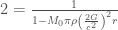
So let’s ask a question: how long would it take for a black hole, oscillating like this, to double its mass?

We want to solve,
2=\frac{1}{1- M_0 \pi\rho\left(\frac{2G}{c^2}\right)^2 r }

so we need the black hole to travel a total distance of

r=\frac{1}{2M_0 \pi\rho\left(\frac{2G}{c^2}\right)^2} = 5.3\times 10^{71} \textrm{m}

That’s a huge distance! The Earth’s radius, remember, is 6378 kilometers. So traveling that far would take

5.3\times 10^{71} \times 84.5/60/24/365 = 8\times 10^{67} \textrm{y}

Ten to the sixty-seven years. Our universe is only about ten to the ten years old. In another five times ten to the nine years, the Sun will enter its red giant phase, and swallow the Earth. There simply isn’t enough time for this tiny tiny black hole to gobble up the world, before everything is already gobbled up by something else. Even in the most pessimistic way to walk through the calculation, it’s just not dangerous.

I hope that, if you were worried about black holes at the LHC, you’re not worried any more. But more than that, I hope you’ve learned three lessons. First, that even the highest-energy particle physics involves tiny energies compared to day-to-day experience. Second, that gravitational effects are tiny in the context of particle physics. And third, that with Wikipedia access, you too can answer questions like this. If you’re worried, you can make an estimate, and check!
Cabinet of Curiosities: The Train-Ladder

I’ve got a new paper out this week, with Andrew McLeod, Roger Morales, Matthias Wilhelm, and Chi Zhang. It’s yet another entry in this year’s “cabinet of curiosities”, quirky Feynman diagrams with interesting traits.

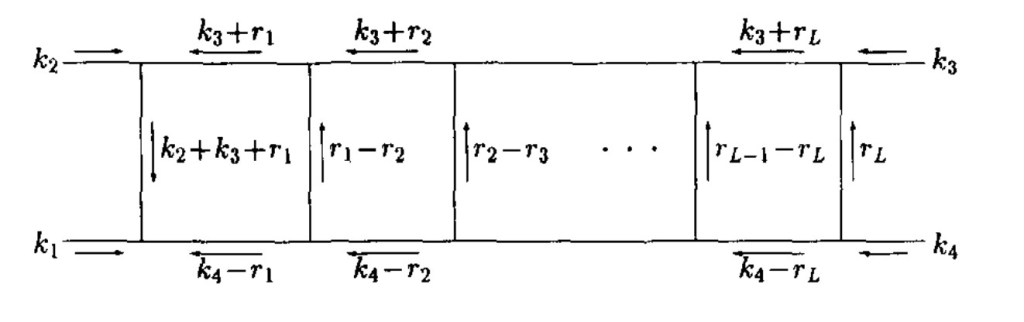
A while back, I talked about a set of Feynman diagrams I could compute with any number of “loops”, bypassing the approximations we usually need to use in particle physics. That wasn’t the first time someone did that. Back in the 90’s, some folks figured out how to do this for so-called “ladder” diagrams. These diagrams have two legs on one end for two particles coming in, two legs on the other end for two particles going out, and a ladder in between, like so:

There are infinitely many of these diagrams, but they’re all beautifully simple, variations on a theme that can be written down in a precise mathematical way.

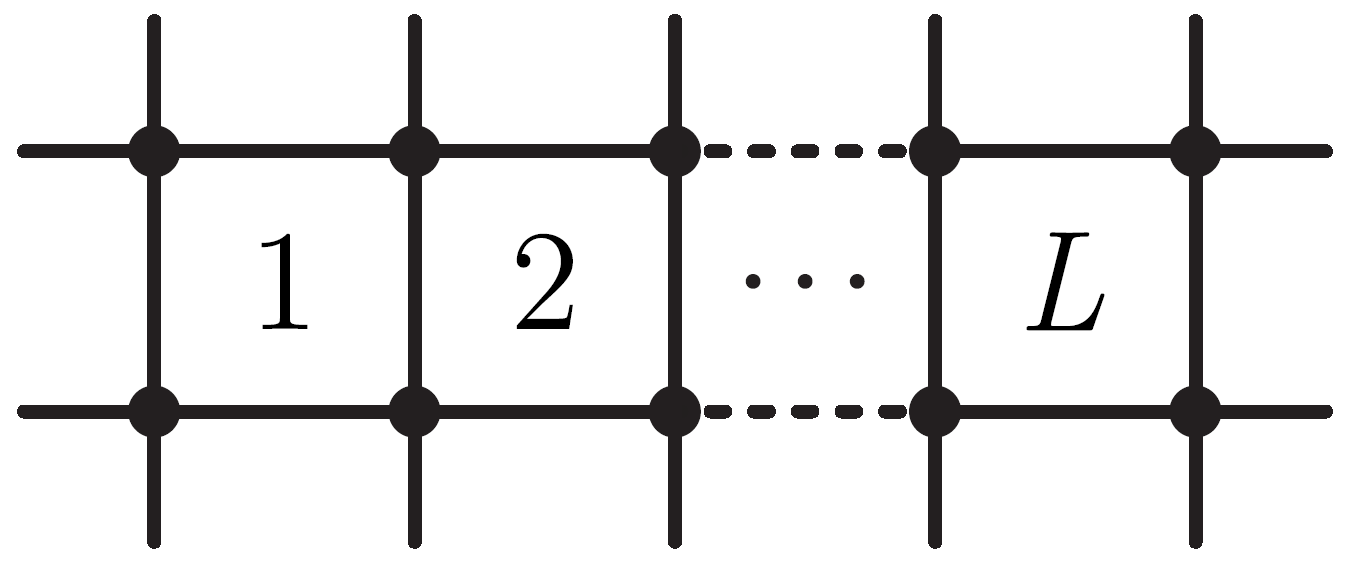
Change things a little bit, though, and the situation gets wildly more intractable. Let the rungs of the ladder peek through the sides, and you get something looking more like the tracks for a train:

These traintrack integrals are much more complicated. Describing them requires the mathematics of Calabi-Yau manifolds, involving higher and higher dimensions as the tracks get longer. I don’t think there’s any hope of understanding these things for all loops, at least not any time soon.

What if we aimed somewhere in between? A ladder that just started to turn traintrack?

Add just a single pair of rungs, and it turns out that things remain relatively simple. If we do this, it turns out we don’t need any complicated Calabi-Yau manifolds. We just need the simplest Calabi-Yau manifold, called an elliptic curve. It’s actually the same curve for every version of the diagram. And the situation is simple enough that, with some extra cleverness, it looks like we’ve found a trick to calculate these diagrams to any number of loops we’d like.

(Another group figured out the curve, but not the calculation trick. They’ve solved different problems, though, studying all sorts of different traintrack diagrams. They sorted out some confusion I used to have about one of those diagrams, showing it actually behaves precisely the way we expected it to. All in all, it’s been a fun example of the way different scientists sometimes hone in on the same discovery.)

These developments are exciting, because Feynman diagrams with elliptic curves are still tough to deal with. We still have whole conferences about them. These new elliptic diagrams can be a long list of test cases, things we can experiment with with any number of loops. With time, we might truly understand them as well as the ladder diagrams!

The Problem of Quantum Gravity Is the Problem of High-Energy (Density) Quantum Gravity

I’ve said something like this before, but here’s another way to say it.

The problem of quantum gravity is one of the most famous problems in physics. You’ve probably heard someone say that quantum mechanics and general relativity are fundamentally incompatible. Most likely, this was narrated over pictures of a foaming, fluctuating grid of space-time. Based on that, you might think that all we have to do to solve this problem is to measure some quantum property of gravity. Maybe we could make a superposition of two different gravitational fields, see what happens, and solve the problem that way.

I mean, we could do that, some people are trying to. But it won’t solve the problem. That’s because the problem of quantum gravity isn’t just the problem of quantum gravity. It’s the problem of high-energy quantum gravity.

Merging quantum mechanics and general relativity is actually pretty easy. General relativity is a big conceptual leap, certainly, a theory in which gravity is really just the shape of space-time. At the same time, though, it’s also a field theory, the same general type of theory as electromagnetism. It’s a weirder field theory than electromagnetism, to be sure, one with deeper implications. But if we want to describe low energies, and weak gravitational fields, then we can treat it just like any other field theory. We know how to write down some pretty reasonable-looking equations, we know how to do some basic calculations with them. This part is just not that scary.

The scary part happens later. The theory we get from these reasonable-looking equations continues to look reasonable for a while. It gives formulas for the probability of things happening: things like gravitational waves bouncing off each other, as they travel through space. The problem comes when those waves have very high energy, and the nice reasonable probability formula now says that the probability is greater than one.

For those of you who haven’t taken a math class in a while, probabilities greater than one don’t make sense. A probability of one is a certainty, something guaranteed to happen. A probability greater than one isn’t more certain than certain, it’s just nonsense.

So we know something needs to change, we know we need a new theory. But we only know we need that theory when the energy is very high: when it’s the Planck energy. Before then, we might still have a different theory, but we might not: it’s not a “problem” yet.

Now, a few of you understand this part, but still have a misunderstanding. The Planck energy seems high for particle physics, but it isn’t high in an absolute sense: it’s about the energy in a tank of gasoline. Does that mean that all we have to do to measure quantum gravity is to make a quantum state out of your car?

Again, no. That’s because the problem of quantum gravity isn’t just the problem of high-energy quantum gravity either.

Energy seems objective, but it’s not. It’s subjective, or more specifically, relative. Due to special relativity, observers moving at different speeds observe different energies. Because of that, high energy alone can’t be the requirement: it isn’t something either general relativity or quantum field theory can “care about” by itself.

Instead, the real thing that matters is something that’s invariant under special relativity. This is hard to define in general terms, but it’s best to think of it as a requirement for not energy, but energy density.

(For the experts: I’m justifying this phrasing in part because of how you can interpret the quantity appearing in energy conditions as the energy density measured by an observer. This still isn’t the correct way to put it, but I can’t think of a better way that would be understandable to a non-technical reader. If you have one, let me know!)

Why do we need quantum gravity to fully understand black holes? Not just because they have a lot of mass, but because they have a lot of mass concentrated in a small area, a high energy density. Ditto for the Big Bang, when the whole universe had a very large energy density. Particle colliders are useful not just because they give particles high energy, but because they give particles high energy and put them close together, creating a situation with very high energy density.

Once you understand this, you can use it to think about whether some experiment or observation will help with the problem of quantum gravity. Does the experiment involve very high energy density, much higher than anything we can do in a particle collider right now? Is that telescope looking at something created in conditions of very high energy density, or just something nearby?

It’s not impossible for an experiment that doesn’t meet these conditions to find something. Whatever the correct quantum gravity theory is, it might be different from our current theories in a more dramatic way, one that’s easier to measure. But the only guarantee, the only situation where we know we need a new theory, is for very high energy density.

The Many Varieties of Journal Club

Across disciplines, one tradition seems to unite all academics: the journal club. In a journal club, we gather together to discuss papers in academic journals. Typically, one person reads the paper in depth in advance, and comes prepared with a short presentation, then everyone else asks questions. Everywhere I’ve worked has either had, or aspired to have, a journal club, and every academic I’ve talked to recognizes the concept.

Beyond that universal skeleton, though, are a lot of variable details. Each place seems to interpret journal clubs just a bit differently. Sometimes a lot differently.

For example, who participates in journal clubs? In some places, journal clubs are a student thing, organized by PhD or Master’s students to get more experience with their new field. Some even have journal clubs as formal courses, for credit and everything. In other places, journal clubs are for everyone, from students up through the older professors.

What kind of papers? Some read old classic papers, knowing that without an excuse we’d never take the time to read them and would miss valuable insights. Some instead focus on the latest results, as a way to keep up with progress in the field.

Some variation is less intentional. Academics are busy, so it can be hard to find a volunteer to prepare a presentation on a paper every week. This leads journal clubs to cut corners, in once again a variety of ways. A journal club focused on the latest papers can sometimes only find volunteers interested in presenting their own work (which we usually already have a presentation prepared for). Sometimes this goes a step further, and the journal club becomes a kind of weekly seminar: a venue for younger visitors to talk about their work that’s less formal than a normal talk. Sometimes, instead of topic, the corner cut is preparation: people still discuss new papers, but instead of preparing a presentation they just come and discuss on the fly. This gets dangerous, because after a certain point people may stop reading the papers altogether, hoping that someone else will come having read it to explain it!

Journal clubs are tricky. Academics are curious, but we’re also busy and lazy. We know it would be good for us to discuss, to keep up with new papers or read the old classics… but actually getting organized, that’s another matter!
