Monthly Archives: September 2020

Which Things Exist in Quantum Field Theory

If you ever think metaphysics is easy, learn a little quantum field theory.

Someone asked me recently about virtual particles. When talking to the public, physicists sometimes explain the behavior of quantum fields with what they call “virtual particles”. They’ll describe forces coming from virtual particles going back and forth, or a bubbling sea of virtual particles and anti-particles popping out of empty space.

The thing is, this is a metaphor. What’s more, it’s a metaphor for an approximation. As physicists, when we draw diagrams with more and more virtual particles, we’re trying to use something we know how to calculate with (particles) to understand something tougher to handle (interacting quantum fields). Virtual particles, at least as you’re probably picturing them, don’t really exist.

I don’t really blame physicists for talking like that, though. Virtual particles are a metaphor, sure, a way to talk about a particular calculation. But so is basically anything we can say about quantum field theory. In quantum field theory, it’s pretty tough to say which things “really exist”.

I’ll start with an example, neutrino oscillation.

You might have heard that there are three types of neutrinos, corresponding to the three “generations” of the Standard Model: electron-neutrinos, muon-neutrinos, and tau-neutrinos. Each is produced in particular kinds of reactions: electron-neutrinos, for example, get produced by beta-plus decay, when a proton turns into a neutron, an anti-electron, and an electron-neutrino.

Leave these neutrinos alone though, and something strange happens. Detect what you expect to be an electron-neutrino, and it might have changed into a muon-neutrino or a tau-neutrino. The neutrino oscillated.

Why does this happen?

One way to explain it is to say that electron-neutrinos, muon-neutrinos, and tau-neutrinos don’t “really exist”. Instead, what really exists are neutrinos with specific masses. These don’t have catchy names, so let’s just call them neutrino-one, neutrino-two, and neutrino-three. What we think of as electron-neutrinos, muon-neutrinos, and tau-neutrinos are each some mix (a quantum superposition) of these “really existing” neutrinos, specifically the mixes that interact nicely with electrons, muons, and tau leptons respectively. When you let them travel, it’s these neutrinos that do the traveling, and due to quantum effects that I’m not explaining here you end up with a different mix than you started with.

This probably seems like a perfectly reasonable explanation. But it shouldn’t. Because if you take one of these mass-neutrinos, and interact with an electron, or a muon, or a tau, then suddenly it behaves like a mix of the old electron-neutrinos, muon-neutrinos, and tau-neutrinos.

That’s because both explanations are trying to chop the world up in a way that can’t be done consistently. There aren’t electron-neutrinos, muon-neutrinos, and tau-neutrinos, and there aren’t neutrino-ones, neutrino-twos, and neutrino-threes. There’s a mathematical object (a vector space) that can look like either.

Whether you’re comfortable with that depends on whether you think of mathematical objects as “things that exist”. If you aren’t, you’re going to have trouble thinking about the quantum world. Maybe you want to take a step back, and say that at least “fields” should exist. But that still won’t do: we can redefine fields, add them together or even use more complicated functions, and still get the same physics. The kinds of things that exist can’t be like this. Instead you end up invoking another kind of mathematical object, equivalence classes.

If you want to be totally rigorous, you have to go a step further. You end up thinking of physics in a very bare-bones way, as the set of all observations you could perform. Instead of describing the world in terms of “these things” or “those things”, the world is a black box, and all you’re doing is finding patterns in that black box.

Is there a way around this? Maybe. But it requires thought, and serious philosophy. It’s not intuitive, it’s not easy, and it doesn’t lend itself well to 3d animations in documentaries. So in practice, whenever anyone tells you about something in physics, you can be pretty sure it’s a metaphor. Nice describable, non-mathematical things typically don’t exist.

When and How Scientists Reach Out

You’ve probably heard of the myth of the solitary scientist. While Newton might have figured out calculus isolated on his farm, most scientists work better when they communicate. If we reach out to other scientists, we can make progress a lot faster.

Even if you understand that, you might not know what that reaching out actually looks like. I’ve seen far too many crackpots who approach scientific communication like a spammer: sending out emails to everyone in a department, commenting in every vaguely related comment section they can find. While commercial spammers hope for a few gullible people among the thousands they contact, that kind of thing doesn’t benefit crackpots. As far as I can tell, they communicate that way because they genuinely don’t know any better.

So in this post, I want to give a road map for how we scientists reach out to other scientists. Keep these steps in mind, and if you ever need to reach out to a scientist you’ll know what to do.

First, decide what you want to know. This may sound obvious, but sometimes people skip this step. We aren’t communicating just to communicate, but because we want to learn something from the other person. Maybe it’s a new method or idea, maybe we just want confirmation we’re on the right track. We don’t reach out just to “show our theory”, but because we hope to learn something from the response.

Then, figure out who might know it. To do this, we first need to decide how specialized our question is. We often have questions about specific papers: a statement we don’t understand, a formula that seems wrong, or a method that isn’t working. For those, we contact an author from that paper. Other times, the question hasn’t been addressed in a paper, but does fall under a specific well-defined topic: a particular type of calculation, for example. For those we seek out a specialist on that specific topic. Finally, sometimes the question is more general, something anyone in our field might in principle know but we happen not to. For that kind of question, we look for someone we trust, someone we have a prior friendship with and feel comfortable asking “dumb questions”. These days, we can supplement that with platforms like PhysicsOverflow that let us post technical questions and invite anyone to respond.

Note that, for all of these, there’s some work to do first. We need to read the relevant papers, bone up on a topic, even check Wikipedia sometimes. We need to put in enough work to at least try to answer our question, so that we know exactly what we need the other person for.

Finally, contact them appropriately. Papers will usually give contact information for one, or all, of the authors. University websites will give university emails. We’d reach out with something like that first, and switch to personal email (or something even more casual, like Skype or social media) only for people we already have a track record of communicating with in that way.

By posing and directing our questions well, scientists can reach out and get help when we struggle. Science is a team effort, we’re stronger when we work together.

To Elliptics and Beyond!

I’ve been busy running a conference this week, Elliptics and Beyond.

After Amplitudes was held online this year, a few of us at the Niels Bohr Institute were inspired. We thought this would be the perfect time to hold a small online conference, focused on the Calabi-Yaus that have been popping up lately in Feynman diagrams. Then we heard from the organizers of Elliptics 2020. They had been planning to hold a conference in Mainz about elliptic integrals in Feynman diagrams, but had to postpone it due to the pandemic. We decided to team up and hold a joint conference on both topics: the elliptic integrals that are just starting to be understood, and the mysterious integrals that lie beyond. Hence, Elliptics and Beyond.

I almost suggested Buzz Lightyear for the logo but I chickened out

The conference has been fun thus far. There’s been a mix of review material bringing people up to speed on elliptic integrals and exciting new developments. Some are taking methods that have been successful in other areas and generalizing them to elliptic integrals, others have been honing techniques for elliptics to make them “production-ready”. A few are looking ahead even further, to higher-genus amplitudes in string theory and Calabi-Yaus in Feynman diagrams.

We organized the conference along similar lines to Zoomplitudes, but with a few experiments of our own. Like Zoomplitudes, we made a Slack space for the conference, so people could chat physics outside the talks. Ours was less active, though. I suspect that kind of space needs a critical mass of people, and with a smaller conference we may just not have gotten there. Having fewer people did allow us a more relaxed schedule, which in turn meant we could mostly keep things on-time. We had discussion sessions in the morning (European time), with talks in the afternoon, so almost everyone could make the talks at least. We also had a “conference dinner”, which went much better than I would have expected. We put people randomly into Zoom Breakout Rooms of five or six, to emulate the tables of an in-person conference, and folks chatted while eating their (self-brought of course) dinner. People seemed to really enjoy the chance to just chat casually with the other folks at the conference. If you’re organizing an online conference soon, I’d recommend trying it!

Holding a conference online means that a lot of people can attend who otherwise couldn’t. We had over a hundred people register, and while not all of them showed up there were typically fifty or sixty people on the Zoom session. Some of these were specialists in elliptics or Calabi-Yaus who wouldn’t ordinarily make it to a conference like this. Others were people from the rest of the amplitudes field who joined for parts of the conference that caught their eye. But surprisingly many weren’t even amplitudeologists, but students and young researchers in a variety of topics from all over the world. Some seemed curious and eager to learn, others I suspect just needed to say they had been to a conference. Both are responding to a situation where suddenly conference after conference is available online, free to join. It will be interesting to see if, and how, the world adapts.

Zero-Point Energy, Zero-Point Diagrams

Listen to a certain flavor of crackpot, or a certain kind of science fiction, and you’ll hear about zero-point energy. Limitless free energy drawn from quantum space-time itself, zero-point energy probably sounds like bullshit. Often it is. But lurking behind the pseudoscience and the fiction is a real physics concept, albeit one that doesn’t really work like those people imagine.

In quantum mechanics, the zero-point energy is the lowest energy a particular system can have. That number doesn’t actually have to be zero, even for empty space. People sometimes describe this in terms of so-called virtual particles, popping up from nothing in particle-antiparticle pairs only to annihilate each other again, contributing energy in the absence of any “real particles”. There’s a real force, the Casimir effect, that gets attributed to this, a force that pulls two metal plates together even with no charge or extra electromagnetic field. The same bubbling of pairs of virtual particles also gets used to explain the Hawking radiation of black holes.

I’d like to try explaining all of these things in a different way, one that might clear up some common misconceptions. To start, let’s talk about, not zero-point energy, but zero-point diagrams.

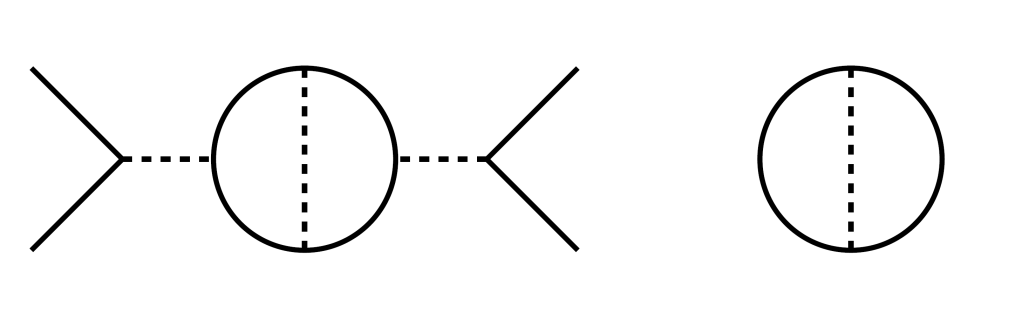
Feynman diagrams are a tool we use to study particle physics. We start with a question: if some specific particles come together and interact, what’s the chance that some (perhaps different) particles emerge? We start by drawing lines representing the particles going in and out, then connect them in every way allowed by our theory. Finally we translate the diagrams to numbers, to get an estimate for the probability. In particle physics slang, the number of “points” is the total number of particles: particles in, plus particles out. For example, let’s say we want to know the chance that two electrons go in and two electrons come out. That gives us a “four-point” diagram: two in, plus two out. A zero-point diagram, then, means zero particles in, zero particles out.

A four-point diagram and a zero-point diagram

(Note that this isn’t why zero-point energy is called zero-point energy, as far as I can tell. Zero-point energy is an older term from before Feynman diagrams.)

Remember, each Feynman diagram answers a specific question, about the chance of particles behaving in a certain way. You might wonder, what question does a zero-point diagram answer? The chance that nothing goes to nothing? Why would you want to know that?

To answer, I’d like to bring up some friends of mine, who do something that might sound equally strange: they calculate one-point diagrams, one particle goes to none. This isn’t strange for them because they study theories with defects.

For some reason, they didn’t like my suggestion to use this stamp on their papers

Normally in particle physics, we think about our particles in an empty, featureless space. We don’t have to, though. One thing we can do is introduce features in this space, like walls and mirrors, and try to see what effect they have. We call these features “defects”.

If there’s a defect like that, then it makes sense to calculate a one-point diagram, because your one particle can interact with something that’s not a particle: it can interact with the defect.

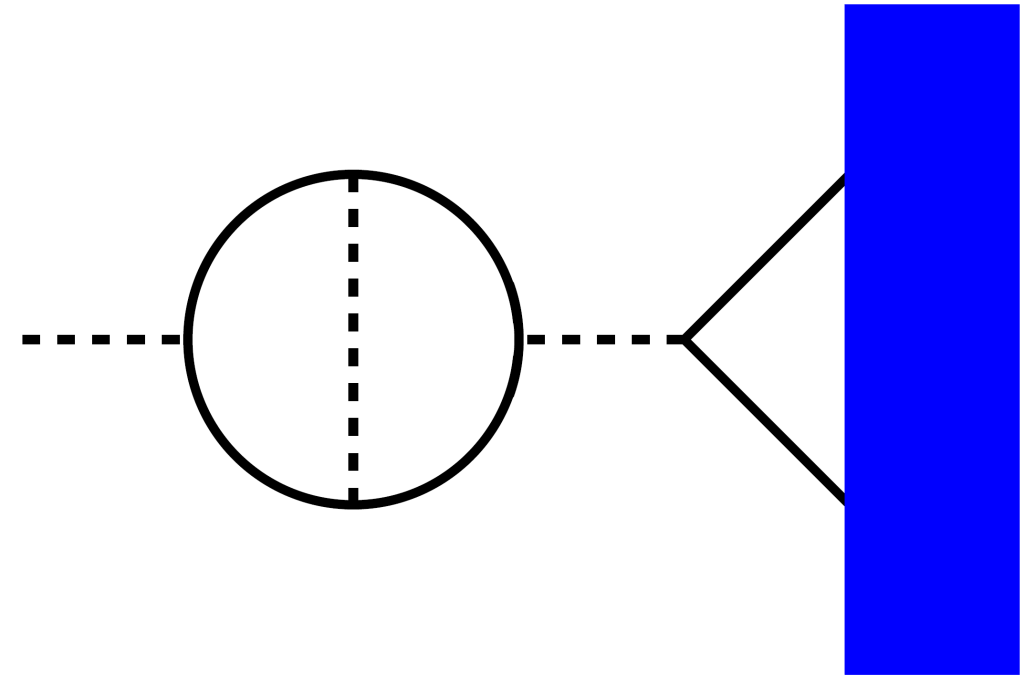
A one-point diagram with a wall, or “defect”

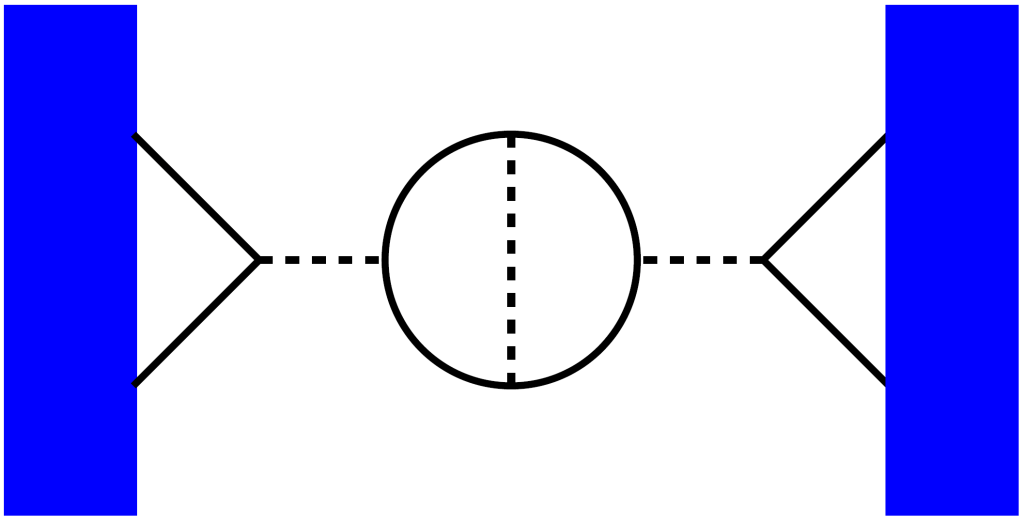
You might see where this is going: let’s say you think there’s a force between two walls, that comes from quantum mechanics, and you want to calculate it. You could imagine it involves a diagram like this:

A “zero-point diagram” between two walls

Roughly speaking, this is the kind of thing you could use to calculate the Casimir effect, that mysterious quantum force between metal plates. And indeed, it involves a zero-point diagram.

Here’s the thing, though: metal plates aren’t just “defects”. They’re real physical objects, made of real physical particles. So while you can think of the Casimir effect with a “zero-point diagram” like that, you can also think of it with a normal diagram, more like the four-point diagram I showed you earlier: one that computes, not a force between defects, but a force between the actual electrons and protons that make up the two plates.

A lot of the time when physicists talk about pairs of virtual particles popping up out of the vacuum, they have in mind a picture like this. And often, you can do the same trick, and think about it instead as interactions between physical particles. There’s a story of roughly this kind for Hawking radiation: you can think of a black hole event horizon as “cutting in half” a zero-point diagram, and see pairs of particles going out from the black hole…but you can also do a calculation that looks more like particles interacting with a gravitational field.

This also might help you understand why, contra the crackpots and science fiction writers, zero-point energy isn’t a source of unlimited free energy. Yes, a force like the Casimir effect comes “from the vacuum” in some sense. But really, it’s a force between two particles. And just like the gravitational force between two particles, this doesn’t give you unlimited free power. You have to do the work to move the particles back over and over again, using the same amount of power you gained from the force to begin with. And unlike the forces you’re used to, these are typically very small effects, as usual for something that depends on quantum mechanics. So it’s even less useful than more everyday forces for this.

Why do so many crackpots and authors expect zero-point energy to be a massive source of power? In part, this is due to mistakes physicists made early on.

Sometimes, when calculating a zero-point diagram (or any other diagram), we don’t get a sensible number. Instead, we get infinity. Physicists used to be baffled by this. Later, they understood the situation a bit better, and realized that those infinities were probably just due to our ignorance. We don’t know the ultimate high-energy theory, so it’s possible something happens at high energies to cancel those pesky infinities. Without knowing exactly what happened, physicists would estimate by using a “cutoff” energy where they expected things to change.

That kind of calculation led to an estimate you might have heard of, that the zero-point energy inside single light bulb could boil all the world’s oceans. That estimate gives a pretty impressive mental image…but it’s also wrong.

This kind of estimate led to “the worst theoretical prediction in the history of physics”, that the cosmological constant, the force that speeds up the expansion of the universe, is 120 orders of magnitude higher than its actual value (if it isn’t just zero). If there really were energy enough inside each light bulb to boil the world’s oceans, the expansion of the universe would be quite different than what we observe.

At this point, it’s pretty clear there is something wrong with these kinds of “cutoff” estimates. The only unclear part is whether that’s due to something subtle or something obvious. But either way, this particular estimate is just wrong, and you shouldn’t take it seriously. Zero-point energy exists, but it isn’t the magical untapped free energy you hear about in stories. It’s tiny quantum corrections to the forces between particles.