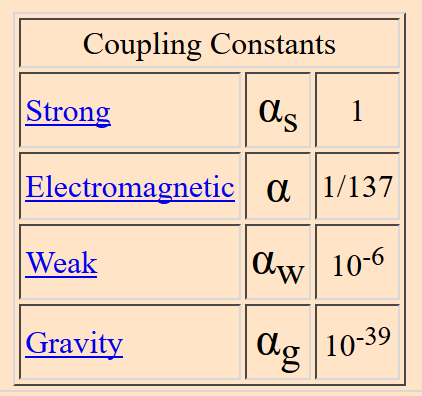
If you’ve heard a bit about physics, you might have heard that each of the fundamental forces (electromagnetism, the weak nuclear force, the strong nuclear force, and gravity) has a coupling constant, a number, handed down from nature itself, that determines how strong of a force it is. Maybe you’ve seen them in a table, like this:
If you’ve heard a bit more about physics, though, you’ll have heard that those coupling constants aren’t actually constant! Instead, they vary with energy. Maybe you’ve seen them plotted like this:
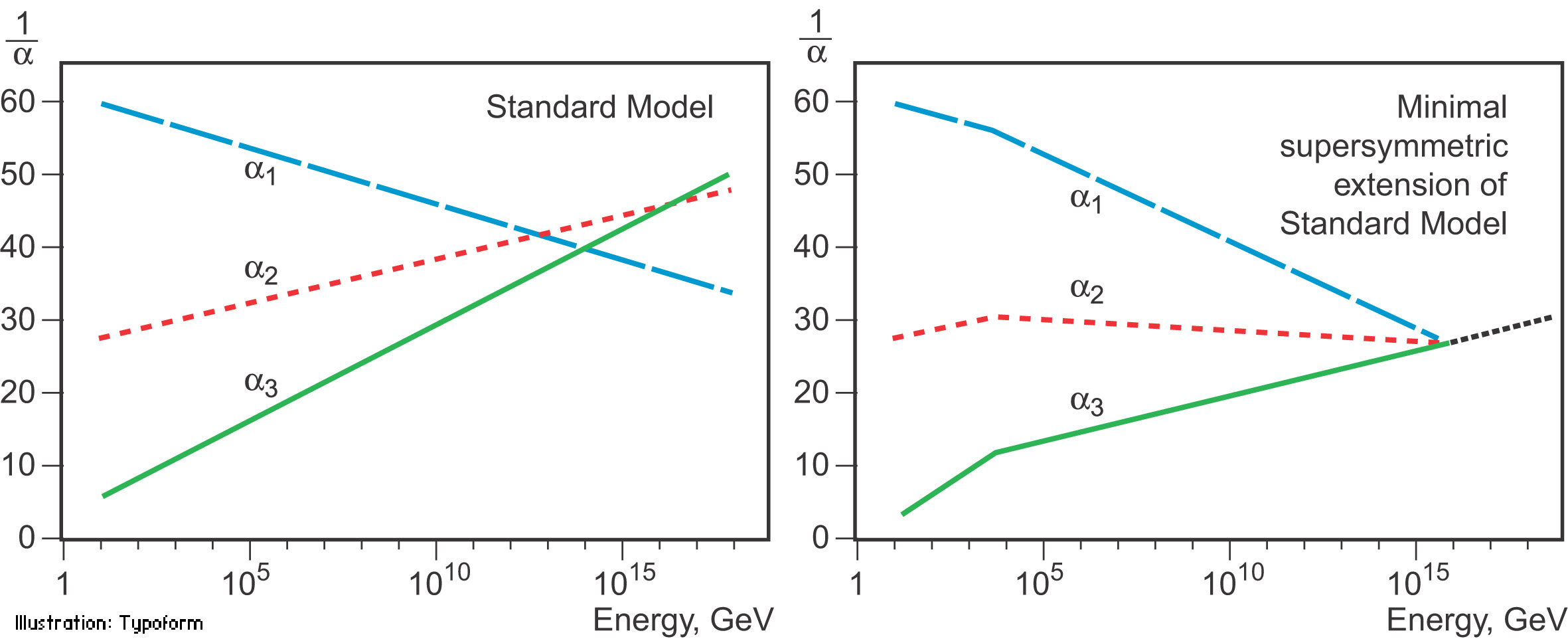
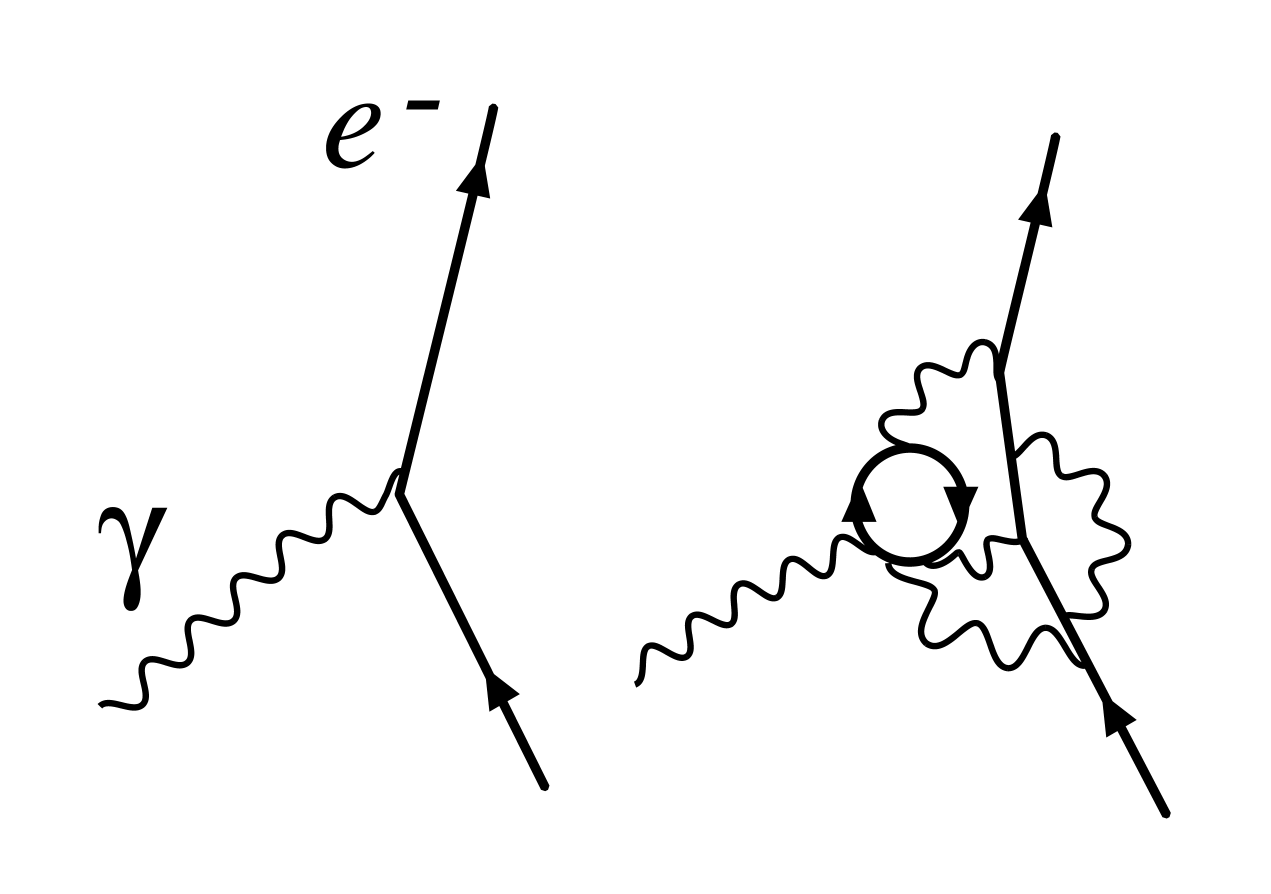
The usual way physicists explain this is in terms of quantum effects. We talk about “virtual particles”, and explain that any time particles and forces interact, these virtual particles can pop up, adding corrections that change with the energy of the interacting particles. The coupling constant includes all of these corrections, so it can’t be constant, it has to vary with energy.
Maybe you’re happy with this explanation. But maybe you object:
“Isn’t there still a constant, though? If you ignore all the virtual particles, and drop all the corrections, isn’t there some constant number you’re correcting? Some sort of `bare coupling constant’ you could put into a nice table for me?”
There are two reasons I can’t do that. One is an epistemological reason, that comes from what we can and cannot know. The other is practical: even if I knew the bare coupling, most of the time I wouldn’t want to use it.
Let’s start with the epistemology:
The first thing to understand is that we can’t measure the bare coupling directly. When we measure the strength of forces, we’re always measuring the result of quantum corrections. We can’t “turn off” the virtual particles.
You could imagine measuring it indirectly, though. You’d measure the end result of all the corrections, then go back and calculate. That calculation would tell you how big the corrections were supposed to be, and you could subtract them off, solve the equation, and find the bare coupling.
And this would be a totally reasonable thing to do, except that when you go and try to calculate the quantum corrections, instead of something sensible, you get infinity.
We think that “infinity” is due to our ignorance: we know some of the quantum corrections, but not all of them, because we don’t have a final theory of nature. In order to calculate anything we need to hedge around that ignorance, with a trick called renormalization. I talk about that more in an older post. The key message to take away there is that in order to calculate anything we need to give up the hope of measuring certain bare constants, even “indirectly”. Once we fix a few constants that way, the rest of the theory gives reliable predictions.
So we can’t measure bare constants, and we can’t reason our way to them. We have to find the full coupling, with all the quantum corrections, and use that as our coupling constant.
Still, you might wonder, why does the coupling constant have to vary? Can’t I just pick one measurement, at one energy, and call that the constant?
This is where pragmatism comes in. You could fix your constant at some arbitrary energy, sure. But you’ll regret it.
In particle physics, we usually calculate in something called perturbation theory. Instead of calculating something exactly, we have to use approximations. We add up the approximations, order by order, expecting that each time the corrections will get smaller and smaller, so we get closer and closer to the truth.
And this works reasonably well if your coupling constant is small enough, provided it’s at the right energy.
If your coupling constant is at the wrong energy, then your quantum corrections will notice the difference. They won’t just be small numbers anymore. Instead, they end up containing logarithms of the ratio of energies. The more difference between your arbitrary energy scale and the correct one, the bigger these logarithms get.
This doesn’t make your calculation wrong, exactly. It makes your error estimate wrong. It means that your assumption that the next order is “small enough” isn’t actually true. You’d need to go to higher and higher orders to get a “good enough” answer, if you can get there at all.
Because of that, you don’t want to think about the coupling constants as actually constant. If we knew the final theory then maybe we’d know the true numbers, the ultimate bare coupling constants. But we still would want to use coupling constants that vary with energy for practical calculations. We’d still prefer the plot, and not just the table.


 , and a circle of radius
  , where
  is the length of the string.
 4 gravitons