Monthly Archives: February 2018

At Least One Math Term That Makes Sense

I’ve complained before about how mathematicians name things. Mathematicans seem to have a knack for taking an ordinary bland word that’s almost indistinguishable from the other ordinary, bland words they’ve used before and assigning it an incredibly specific mathematical concept. Varieties and forms, motives and schemes, in each case you end up wishing they picked a word that was just a little more descriptive.

Sometimes, though, a word may seem completely out of place when it actually has a fairly reasonable explanation. Such is the case for the word “period“.

Suppose you want to classify numbers. You have the integers, and the rational numbers. A bigger class of numbers are “algebraic”, in that you can get them “from algebra”: more specifically, as solutions of polynomial equations with rational coefficients. Numbers that aren’t algebraic are “transcendental”, a popular example being \pi.

Periods lie in between: a set that contains algebraic numbers, but also many of the transcendental numbers. They’re numbers you can get, not from algebra, but from calculus: they’re integrals over rational functions. These numbers were popularized by Kontsevich and Zagier, and they’ve led to a lot of fruitful inquiry in both math and physics.

But why the heck are they called periods?

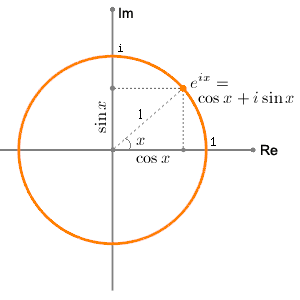
Think about e^{i x}.

euler13

Or if you prefer, think about a circle

e^{i x} is a periodic function, with period 2\pi.  Take x from 0 to 2\pi and the function repeats, you’ve traveled in a circle.

Thought of another way, 2\pi is the volume of the circle. It’s the integral, around the circle, of \frac{dz}{z}. And that integral nicely matches Kontsevich and Zagier’s definition of a period.

The idea of a period, then, comes from generalizing this. What happens when you only go partway around the circle, to some point z in the complex plane? Then you need to go to a point x=-i \ln z. So a logarithm can also be thought of as measuring the period of e^{i x}. And indeed, since a logarithm can be expressed as \int\frac{dz}{z}, they count as periods in the Kontsevich-Zagier sense.

Starting there, you can loosely think about the polylogarithm functions I like to work with as collections of logs, measuring periods of interlocking circles.

And if you need to go beyond polylogarithms, when you can’t just go circle by circle?

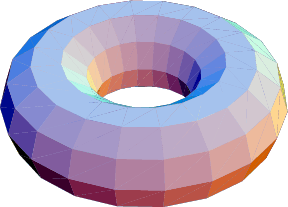
Then you need to think about functions with two periods, like Weierstrass’s elliptic function. Just as you can think about e^{i x} as a circle, you can think of Weierstrass’s function in terms of a torus.
torus_1000

Obligatory donut joke here

The torus has two periods, corresponding to the two circles you can draw around it. The periods of Weierstrass’s function are transcendental numbers, and they fit Kontsevich and Zagier’s definition of periods. And if you take the inverse of Weierstrass’s function, you get an elliptic integral, just like taking the inverse of e^{i x} gives a logarithm.

So mathematicians, I apologize. Periods, at least, make sense.

I’m still mad about “varieties” though.

Valentine’s Day Physics Poem 2018

Valentine’s Day was this week, so long-time readers should know what to expect. To continue this blog’s tradition, I’m posting another one of my old physics poems.


Winding Number One


When you feel twisted up inside, you may be told to step back

That after a long time, from a long distance

All things fall off.


So I stepped back.


But looking in from a distance

On the border (at infinity)

A shape remained

Etched deep

In the equation of my being


A shape that wouldn’t fall off

Even at infinity.


And they may tell you to wait and see,

That you will evolve in time

That all things change, continuously.


So I let myself change.


But no matter how long I waited

How much I evolved

I could not return

My new state cannot be deformed

To what I was before.


The shape at my border

Is basic, immutable.


Faced with my thoughts

I try to draw a map

And run out of space.


I need two selves

Two lives

To map my soul.


A double cover.


And now, faced by my dual

Tracing each index

Integrated over manifold possibilities

We do not vanish

We have winding number one.


Why Your Idea Is Bad

By A. Physicist


Your idea is bad…


…because it disagrees with precision electroweak measurements

…………………………………..with bounds from ATLAS and CMS

…………………………………..with the power spectrum of the CMB

…………………………………..with Eötvös experiments

…because it isn’t gauge invariant

………………………….Lorentz invariant

………………………….diffeomorphism invariant

………………………….background-independent, whatever that means

…because it violates unitarity

…………………………………locality

…………………………………causality

…………………………………observer-independence

…………………………………technical naturalness

…………………………………international treaties

…………………………………cosmic censorship

…because you screwed up the calculation

…because you didn’t actually do the calculation

…because I don’t understand the calculation

…because you predict too many magnetic monopoles

……………………………………too many proton decays

……………………………………too many primordial black holes

…………………………………..remnants, at all

…because it’s fine-tuned

…because it’s suspiciously finely-tuned

…because it’s finely tuned to be always outside of experimental bounds

…because you’re misunderstanding quantum mechanics

…………………………………………………………..black holes

………………………………………………………….effective field theory

…………………………………………………………..thermodynamics

…………………………………………………………..the scientific method

…because Condensed Matter would contribute more to Chinese GDP

…because the approximation you’re making is unjustified

…………………………………………………………………………is not valid

…………………………………………………………………………is wildly overoptimistic

………………………………………………………………………….is just kind of lazy

…because there isn’t a plausible UV completion

…because you care too much about the UV

…because it only works in polynomial time

…………………………………………..exponential time

…………………………………………..factorial time

…because even if it’s fast it requires more memory than any computer on Earth

…because it requires more bits of memory than atoms in the visible universe

…because it has no meaningful advantages over current methods

…because it has meaningful advantages over my own methods

…because it can’t just be that easy

…because it’s not the kind of idea that usually works

…because it’s not the kind of idea that usually works in my field

…because it isn’t canonical

…because it’s ugly

…because it’s baroque

…because it ain’t baroque, and thus shouldn’t be fixed

…because only a few people work on it

…because far too many people work on it

…because clearly it will only work for the first case

……………………………………………………………….the first two cases

……………………………………………………………….the first seven cases

……………………………………………………………….the cases you’ve published and no more

…because I know you’re wrong

…because I strongly suspect you’re wrong

…because I strongly suspect you’re wrong, but saying I know you’re wrong looks better on a grant application

…….in a blog post

…because I’m just really pessimistic about something like that ever actually working

…because I’d rather work on my own thing, that I’m much more optimistic about

…because if I’m clear about my reasons

……and what I know

…….and what I don’t

……….then I’ll convince you you’re wrong.


……….or maybe you’ll convince me?


Unreasonably Big Physics

The Large Hadron Collider is big, eight and a half kilometers across. It’s expensive, with a cost to construct and operate in the billions. And with an energy of 6.5 TeV per proton, it’s the most powerful collider in the world, accelerating protons to 0.99999999 of the speed of light.

The LHC is reasonable. After all, it was funded, and built. What does an unreasonable physics proposal look like?

It’s probably unfair to call the Superconducting Super Collider unreasonable, after all, it did almost get built. It would have been a 28 kilometer-wide circle in the Texas desert, accelerating protons to an energy of 20 TeV, three times the energy of the LHC. When it was cancelled in 1993, it was projected to cost twelve billion dollars, and two billion had already been spent digging the tunnel. The US hasn’t invested in a similarly sized project since.

A better example of an unreasonable proposal might be the Collider-in-the-Sea. (If that link is paywalled, this paper covers most of the same information.)

mcint2-2656157-large

If you run out of room on land, why not build your collider underwater?

Ok, there are pretty obvious reasons why not. Surprisingly, the people proposing the Collider-in-the-Sea do a decent job of answering them. They plan to put it far enough out that it won’t disrupt shipping, and deep enough down that it won’t interfere with fish. Apparently at those depths even a hurricane barely ripples the water, and they argue that the technology exists to keep a floating ring stable under those conditions. All in all, they’re imagining a collider 600 kilometers in diameter, accelerating protons to 250 TeV, all for a cost they claim would be roughly comparable to the (substantially smaller) new colliders that China and Europe are considering.

I’m sure that there are reasons I’ve overlooked why this sort of project is impossible. (I mean, just look at the map!) Still, it’s impressive that they can marshal this much of an argument.

Besides, there are even more impossible projects, like this one, by Sugawara, Hagura, and Sanami. Their proposal for a 1000 TeV neutrino beam isn’t intended for research: rather, the idea is a beam powerful enough to send neutrinos through the Earth to destroy nuclear bombs. Such a beam could cause the bombs to detonate prematurely, “fizzling” with about 3% the explosion they would have normally.

In this case, Sugawara and co. admit that their proposal is pure fantasy. With current technology they would need a ring larger than the Collider-in-the-Sea, and the project would cost hundreds of billions of dollars. It’s not even clear who would want to build such a machine, or who could get away with building it: the authors imagine a science fiction-esque world government to foot the bill.

There’s a spectrum of papers that scientists write, from whimsical speculation to serious work. The press doesn’t always make the difference clear, so it’s a useful skill to see the clues in the writing that show where a given proposal lands. In the case of the Sugawara and co. proposal, the paper is littered with caveats, explicitly making it clear that it’s just a rough estimate. Even the first line, dedicating the paper to another professor, should get you to look twice: while this sometimes happens on serious papers, often it means the paper was written as a fun gift for the professor in question. The Collider-in-the-Sea doesn’t have these kinds of warning signs, and it’s clear its authors take it a bit more seriously. Nonetheless, comparing the level of detail to other accelerator proposals, even those from the same people, should suggest that the Collider-in-the-Sea isn’t entirely on the same level. As wacky as it is to imagine, we probably won’t get a collider that takes up most of the Gulf of Mexico, or a massive neutrino beam capable of blowing up nukes around the world.