Monthly Archives: October 2017

The opposite of Witches

On Halloween I have a tradition of posts about spooky topics, whether traditional Halloween fare or things that spook physicists. This year it’s a little of both.

Mage: The Ascension is a role-playing game set in a world in which belief shapes reality. Players take the role of witches and warlocks, casting spells powered by their personal paradigms of belief. The game allows for pretty much any modern-day magic-user you could imagine, from Wiccans to martial artists.

wicked_witch

Even stereotypical green witches, probably

Despite all the options, I was always more interested in the game’s villains, the witches’ opposites, the Technocracy.

The Technocracy answer an inevitable problem with any setting involving modern-day magic: why don’t people notice? If reality is powered by belief, why does no-one believe in magic?

In the Technocracy’s case, the answer is a vast conspiracy of mages with a scientific bent, manipulating public belief. Much like the witches and warlocks of Mage are a grab-bag of every occult belief system, the Technocracy combines every oppressive government conspiracy story you can imagine, all with the express purpose of suppressing the supernatural and maintaining scientific consensus.

This quote is from another game by the same publisher, but it captures the attitude of the Technocracy, and the magnitude of what is being claimed here:

Do not believe what the scientists tell you. The natural history we know is a lie, a falsehood sold to us by wicked old men who would make the world a dull gray prison and protect us from the dangers inherent to freedom. They would have you believe our planet to be a lonely starship, hurtling through the void of space, barren of magic and in need of a stern hand upon the rudder.

Close your mind to their deception. The time before our time was not a time of senseless natural struggle and reptilian rage, but a time of myth and sorcery. It was a time of legend, when heroes walked Creation and wielded the very power of the gods. It was a time before the world was bent, a time before the magic of Creation lessened, a time before the souls of men became the stunted, withered things they are today.

It can be a fun exercise to see how far doubt can take you, how much of the scientific consensus you can really be confident of and how much could be due to a conspiracy. Believing in the Technocracy would be the most extreme version of this, but Flat-Earthers come pretty close. Once you’re doubting whether the Earth is round, you have to imagine a truly absurd conspiracy to back it up.

On the other extreme, there are the kinds of conspiracies that barely take a conspiracy at all. Big experimental collaborations, like ATLAS and CMS at the LHC, keep a tight handle on what their members publish. (If you’re curious how much of one, here’s a talk by a law professor about, among other things, the Constitution of CMS. Yes, it has one!) An actual conspiracy would still be outed in about five minutes, but you could imagine something subtler, the experiment sticking to “safe” explanations and refusing to publish results that look too unusual, on the basis that they’re “probably” wrong. Worries about that sort of thing can make actual physicists spooked.

There’s an important dividing line with doubt: too much and you risk invoking a conspiracy more fantastical than the science you’re doubting in the first place. The Technocracy doesn’t just straddle that line, it hops past it off into the distance. Science is too vast, and too unpredictable, to be controlled by some shadowy conspiracy.

519tdxeawyl

Or maybe that’s just what we want you to think!
A LIGO in the Darkness

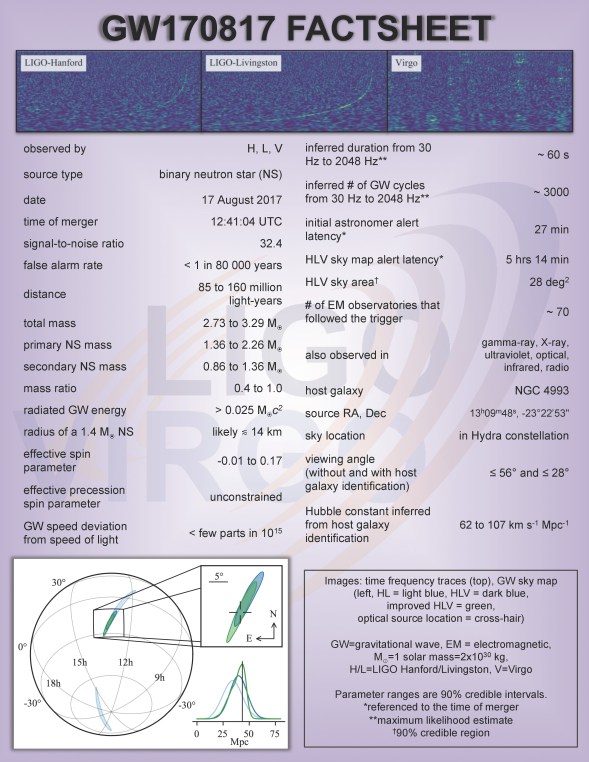
For the few of you who haven’t yet heard: LIGO has detected gravitational waves from a pair of colliding neutron stars, and that detection has been confirmed by observations of the light from those stars.

gw170817_factsheet

They also provide a handy fact sheet.

This is a big deal! On a basic level, it means that we now have confirmation from other instruments and sources that LIGO is really detecting gravitational waves.

The implications go quite a bit further than that, though. You wouldn’t think that just one observation could tell you very much, but this is an observation of an entirely new type, the first time an event has been seen in both gravitational waves and light.

That, it turns out, means that this one observation clears up a whole pile of mysteries in one blow. It shows that at least some gamma ray bursts are caused by colliding neutron stars, that neutron star collisions can give rise to the high-power “kilonovas” capable of forming heavy elements like gold…well, I’m not going to be able to give justice to the full implications in this post. Matt Strassler has a pair of quite detailed posts on the subject, and Quanta magazine’s article has a really great account of the effort that went into the detection, including coordinating the network of telescopes that made it possible.

I’ll focus here on a few aspects that stood out to me.

One fun part of the story behind this detection was how helpful “failed” observations were. VIRGO (the European gravitational wave experiment) was running alongside LIGO at the time, but VIRGO didn’t see the event (or saw it so faintly it couldn’t be sure it saw it). This was actually useful, because VIRGO has a blind spot, and VIRGO’s non-observation told them the event had to have happened in that blind spot. That narrowed things down considerably, and allowed telescopes to close in on the actual merger. IceCube, the neutrino observatory that is literally a cubic kilometer chunk of Antarctica filled with sensors, also failed to detect the event, and this was also useful: along with evidence from other telescopes, it suggests that the “jet” of particles emitted by the merged neutron stars is tilted away from us.

One thing brought up at LIGO’s announcement was that seeing gravitational waves and electromagnetic light at roughly the same time puts limits on any difference between the speed of light and the speed of gravity. At the time I wondered if this was just a throwaway line, but it turns out a variety of proposed modifications of gravity predict that gravitational waves will travel slower than light. This event rules out many of those models, and tightly constrains others.

The announcement from LIGO was screened at NBI, but they didn’t show the full press release. Instead, they cut to a discussion for local news featuring NBI researchers from the various telescope collaborations that observed the event. Some of this discussion was in Danish, so it was only later that I heard about the possibility of using the simultaneous measurement of gravitational waves and light to measure the expansion of the universe. While this event by itself didn’t result in a very precise measurement, as more collisions are observed the statistics will get better, which will hopefully clear up a discrepancy between two previous measures of the expansion rate.

A few news sources made it sound like observing the light from the kilonova has let scientists see directly which heavy elements were produced by the event. That isn’t quite true, as stressed by some of the folks I talked to at NBI. What is true is that the light was consistent with patterns observed in past kilonovas, which are estimated to be powerful enough to produce these heavy elements. However, actually pointing out the lines corresponding to these elements in the spectrum of the event hasn’t been done yet, though it may be possible with further analysis.

A few posts back, I mentioned a group at NBI who had been critical of LIGO’s data analysis and raised doubts of whether they detected gravitational waves at all. There’s not much I can say about this until they’ve commented publicly, but do keep an eye on the arXiv in the next week or two. Despite the optimistic stance I take in the rest of this post, the impression I get from folks here is that things are far from fully resolved.

One, Two, Infinity

Physicists and mathematicians count one, two, infinity.

We start with the simplest case, as a proof of principle. We take a stripped down toy model or simple calculation and show that our idea works. We count “one”, and we publish.

Next, we let things get a bit more complicated. In the next toy model, or the next calculation, new interactions can arise. We figure out how to deal with those new interactions, our count goes from “one” to “two”, and once again we publish.

By this point, hopefully, we understand the pattern. We know what happens in the simplest case, and we know what happens when the different pieces start to interact. If all goes well, that’s enough: we can extrapolate our knowledge to understand not just case “three”, but any case: any model, any calculation. We publish the general case, the general method. We’ve counted one, two, infinity.

200px-infinite-svg

Once we’ve counted “infinity”, we don’t have to do any more cases. And so “infinity” becomes the new “zero”, and the next type of calculation you don’t know how to do becomes “one”. It’s like going from addition to multiplication, from multiplication to exponentiation, from exponentials up into the wilds of up-arrow notation. Each time, once you understand the general rules you can jump ahead to an entirely new world with new capabilities…and repeat the same process again, on a new scale. You don’t need to count one, two, three, four, on and on and on.

Of course, research doesn’t always work out this way. My last few papers counted three, four, five, with six on the way. (One and two were already known.) Unlike the ideal cases that go one, two, infinity, here “two” doesn’t give all the pieces you need to keep going. You need to go a few numbers more to get novel insights. That said, we are thinking about “infinity” now, so look forward to a future post that says something about that.

A lot of frustration in physics comes from situations when “infinity” remains stubbornly out of reach. When people complain about all the models for supersymmetry, or inflation, in some sense they’re complaining about fields that haven’t taken that “infinity” step. One or two models of inflation are nice, but by the time the count reaches ten you start hoping that someone will describe all possible models of inflation in one paper, and see if they can make any predictions from that.

(In particle physics, there’s an extent to which people can actually do this. There are methods to describe all possible modifications of the Standard Model in terms of what sort of effects they can have on observations of known particles. There’s a group at NBI who work on this sort of thing.)

The gold standard, though, is one, two, infinity. Our ability to step back, stop working case-by-case, and move on to the next level is not just a cute trick: it’s a foundation for exponential progress. If we can count one, two, infinity, then there’s nowhere we can’t reach.

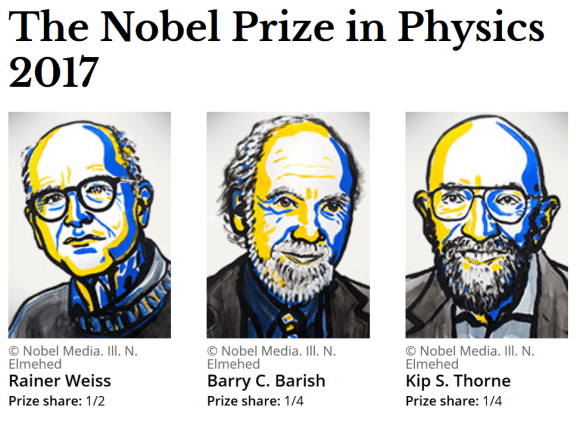
Congratulations to Rainer Weiss, Barry Barish, and Kip Thorne!

The Nobel Prize in Physics was announced this week, awarded to Rainer Weiss, Kip Thorne, and Barry Barish for their work on LIGO, the gravitational wave detector.

Nobel2017

Many expected the Nobel to go to LIGO last year, but the Nobel committee waited. At the time, it was expected the prize would be awarded to Rainer Weiss, Kip Thorne, and Ronald Drever, the three founders of the LIGO project, but there were advocates for Barry Barish was well. Traditionally, the Nobel is awarded to at most three people, so the argument got fairly heated, with opponents arguing Barish was “just an administrator” and advocates pointing out that he was “just the administrator without whom the project would have been cancelled in the 90’s”.

All of this ended up being irrelevant when Drever died last March. The Nobel isn’t awarded posthumously, so the list of obvious candidates (or at least obvious candidates who worked on LIGO) was down to three, which simplified thing considerably for the committee.

LIGO’s work is impressive and clearly Nobel-worthy, but I would be remiss if I didn’t mention that there is some controversy around it. In June, several of my current colleagues at the Niels Bohr Institute uploaded a paper arguing that if you subtract the gravitational wave signal that LIGO claims to have found then the remaining data, the “noise”, is still correlated between LIGO’s two detectors, which it shouldn’t be if it were actually just noise. LIGO hasn’t released an official response yet, but a LIGO postdoc responded with a guest post on Sean Carroll’s blog, and the team at NBI had responses of their own.

I’d usually be fairly skeptical of this kind of argument: it’s easy for an outsider looking at the data from a big experiment like this to miss important technical details that make the collaboration’s analysis work. That said, having seen some conversations between these folks, I’m a bit more sympathetic. LIGO hadn’t been communicating very clearly initially, and it led to a lot of unnecessary confusion on both sides.

One thing that I don’t think has been emphasized enough is that there are two claims LIGO is making: that they detected gravitational waves, and that they detected gravitational waves from black holes of specific masses at a specific distance. The former claim could be supported by the existence of correlated events between the detectors, without many assumptions as to what the signals should look like. The team at NBI seem to have found a correlation of that sort, but I don’t know if they still think the argument in that paper holds given what they’ve said elsewhere.

The second claim, that the waves were from a collision of black holes with specific masses, requires more work. LIGO compares the signal to various models, or “templates”, of black hole events, trying to find one that matches well. This is what the group at NBI subtracts to get the noise contribution. There’s a lot of potential for error in this sort of template-matching. If two templates are quite similar, it may be that the experiment can’t tell the difference between them. At the same time, the individual template predictions have their own sources of uncertainty, coming from numerical simulations and “loops” in particle physics-style calculations. I haven’t yet found a clear explanation from LIGO of how they take these various sources of error into account. It could well be that even if they definitely saw gravitational waves, they don’t actually have clear evidence for the specific black hole masses they claim to have seen.

I’m sure we’ll hear more about this in the coming months, as both groups continue to talk through their disagreement. Hopefully we’ll get a clearer picture of what’s going on. In the meantime, though, Weiss, Barish, and Thorne have accomplished something impressive regardless, and should enjoy their Nobel.