
Monthly Archives: July 2016

arXiv, Our Printing Press

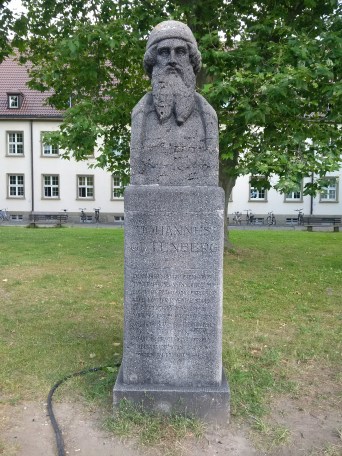
IMG_20160714_091400

Johannes Gutenberg, inventor of the printing press, and possibly the only photogenic thing on the Mainz campus

I’ve had a few occasions to dig into older papers recently, and I’ve noticed a trend: old papers are hard to read!

Ok, that might not be surprising. The older a paper is, the greater the chance it will use obsolete notation, or assume a context that has long passed by. Older papers have different assumptions about what matters, or what rigor requires, and their readers cared about different things. All this is to be expected: a slow, gradual approach to a modern style and understanding.

I’ve been noticing, though, that this slow, gradual approach doesn’t always hold. Specifically, it seems to speed up quite dramatically at one point: the introduction of arXiv, the website where we store all our papers.

Part of this could just be a coincidence. As it happens, the founding papers in my subfield, those that started Amplitudes with a capital “A”, were right around the time that arXiv first got going. It could be that all I’m noticing is the difference between Amplitudes and “pre-Amplitudes”, with the Amplitudes subfield sharing notation more than they did before they had a shared identity.

But I suspect that something else is going on. With arXiv, we don’t just share papers (that was done, piecemeal, before arXiv). We also share LaTeX.

LaTeX is a document formatting language, like a programming language for papers. It’s used pretty much universally in physics and math, and increasingly in other fields. As it turns out, when we post a paper to arXiv, we don’t just send a pdf: we include the raw LaTeX code as well.

Before arXiv, if you wanted to include an equation from another paper, you’d format it yourself. You’d probably do it a little differently from the other paper, in accord with your own conventions, and just to make it easier on yourself. Over time, more and more differences would crop up, making older papers harder and harder to read.

With arXiv, you can still do all that. But you can also just copy.

Since arXiv makes the LaTeX code behind a paper public, it’s easy to lift the occasional equation. Even if you’re not lifting it directly, you can see how they coded it. Even if you don’t plan on copying, the default gets flipped around: instead of having to try to make your equation like the one in the previous paper and accidentally getting it wrong, every difference is intentional.

This reminds me, in a small-scale way, of the effect of the printing press on anatomy books.

Before the printing press, books on anatomy tended to be full of descriptions, but not illustrations. Illustrations weren’t reliable: there was no guarantee the monk who copied them would do so correctly, so nobody bothered. This made it hard to tell when an anatomist (fine it was always Galen) was wrong: he could just be using an odd description. It was only after the printing press that books could actually have illustrations that were reliable across copies of a book. Suddenly, it was possible to point out that a fellow anatomist had left something out: it would be missing from the illustration!

In a similar way, arXiv seems to have led to increasingly standard notation. We still aren’t totally consistent…but we do seem a lot more consistent than older papers, and I think arXiv is the reason why.

Thought Experiments, Minus the Thought

My second-favorite Newton fact is that, despite inventing calculus, he refused to use it for his most famous work of physics, the Principia. Instead, he used geometrical proofs, tweaked to smuggle in calculus without admitting it.

Essentially, these proofs were thought experiments. Newton would start with a standard geometry argument, one that would have been acceptable to mathematicians centuries earlier. Then, he’d imagine taking it further, pushing a line or angle to some infinite point. He’d argue that, if the proof worked for every finite choice, then it should work in the infinite limit as well.

These thought experiments let Newton argue on the basis of something that looked more rigorous than calculus. However, they also held science back. At the time, only a few people in the world could understand what Newton was doing. It was only later, when Newton’s laws were reformulated in calculus terms, that a wider group of researchers could start doing serious physics.

What changed? If Newton could describe his physics with geometrical thought experiments, why couldn’t everyone else?

The trouble with thought experiments is that they require careful setup, setup that has to be thought through for each new thought experiment. Calculus took Newton’s geometrical thought experiments, and took out the need for thought: the setup was automatically a part of calculus, and each new researcher could build on their predecessors without having to set everything up again.

This sort of thing happens a lot in science. An example from my field is the scattering matrix, or S-matrix.

The S-matrix, deep down, is a thought experiment. Take some particles, and put them infinitely far away from each other, off in the infinite past. Then, let them approach, close enough to collide. If they do, new particles can form, and these new particles will travel out again, infinite far away in the infinite future. The S-matrix then is a metaphorical matrix that tells you, for each possible set of incoming particles, what the probability is to get each possible set of outgoing particles.

In a real collider, the particles don’t come from infinitely far away, and they don’t travel infinitely far before they’re stopped. But the distances are long enough, compared to the sizes relevant for particle physics, that the S-matrix is the right idea for the job.

Like calculus, the S-matrix is a thought experiment minus the thought. When we want to calculate the probability of particles scattering, we don’t need to set up the whole thought experiment all over again. Instead, we can start by calculating, and over time we’ve gotten very good at it.

In general, sub-fields in physics can be divided into those that have found their S-matrices, their thought experiments minus thought, and those that have not. When a topic has to rely on thought experiments, progress is much slower: people argue over the details of each setup, and it’s difficult to build something that can last. It’s only when a field turns the corner, removing the thought from its thought experiments, that people can start making real collaborative progress.

Still Traveling

I’m still traveling this week, so this will  be a short post.

Last year, when I went to Amplitudes I left Europe right after. This felt like a bit of a waste: an expensive, transcontinental flight, and I was only there for a week?

So this year, I resolved to visit a few more places. I was at the Niels Bohr Institute in Copenhagen earlier this week.

IMG_20160712_205034_hdr

Where the live LHC collisions represented as lights shining on the face of the building are rather spoiled by the lack of any actual darkness to see them by.

Now, I’m at Mainz, visiting Johannes Henn.

Oddly enough, I’ve got family connections to both places. My great-grandfather spent some time at the Niels Bohr Institute on his way out of Europe, and I have a relative who works at Mainz. So while the primary purpose of this trip was research, I’ve gotten to learn a little family history in the process.

Amplitudes 2016

I’m at Amplitudes this week, in Stockholm.

IMG_20160704_225049

The land of twilight at 11pm

Last year, I wrote a post giving a tour of the field. If I had to write it again this year most of the categories would be the same, but the achievements listed would advance in loops and legs, more complicated theories and more insight.

The ambitwistor string now goes to two loops, while my collaborators and I have pushed the polylogarithm program to five loops (dedicated post on that soon!) A decent number of techniques can now be applied to QCD, including a differential equation-based method that was used to find a four loop, three particle amplitude. Others tied together different approaches, found novel structures in string theory, or linked amplitudes techniques to physics from other disciplines. The talks have been going up on YouTube pretty quickly, due to diligent work by Nordita’s tech guy, so if you’re at all interested check it out!

The (but I’m Not a) Crackpot Style Guide

Ok, ok, I believe you. You’re not a crackpot. You’re just an outsider, one with a brilliant new idea that would overturn the accepted paradigms of physics, if only someone would just listen.

Here’s the problem: you’re not alone. There are plenty of actual crackpots. We get contacted by them fairly regularly. And most of the time, they’re frustrating and unpleasant to deal with.

If you want physicists to listen to you, you need to show us you’re not one of those people. Otherwise, most of us won’t bother.

I can’t give you a foolproof way to do that. But I can give some suggestions that will hopefully make the process a little less frustrating for everyone involved.

Don’t spam:

Nobody likes spam. Nobody reads spam. If you send a mass email to every physicist whose email address you can find, none of them will read it. If you repeatedly post the same thing in a comment thread, nobody will read it. If you want people to listen to you, you have to show that you care about what they have to say, and in order to do that you have to tailor your message. This leads in to the next point,

Ask the right people:

Before you start reaching out, you should try to get an idea of who to talk to. Physics is quite specialized, so if you’re taking your ideas seriously you should try to contact people with a relevant specialization.

Now, I know what you’re thinking: your ideas are unique, no-one in physics is working on anything similar.

Here, it’s important to distinguish the problem you’re trying to solve with how you’re trying to solve it. Chances are, no-one else is working on your specific idea…but plenty of people are interested in the same problems.

Think quantum mechanics is built on shoddy assumptions? There are people who spend their lives trying to modify quantum mechanics. Have a beef against general relativity? There’s a whole sub-field of people who modify gravity.

These people are a valuable resource for you, because they know what doesn’t work. They’ve been trying to change the system, and they know just how hard it is to change, and just what evidence you need to be consistent with.

Contacting someone whose work just uses quantum mechanics or relativity won’t work. If you’re making elementary mistakes, we can put you on the right track…but if you think you’re making elementary mistakes, you should start out by asking help from a forum or the like, not contacting a professional. If you think you’ve really got a viable replacement to an established idea, you need to contact people who work on overturning established ideas, since they’re most aware of the complicated webs of implications involved. Relatedly,

Take ownership of your work:

I don’t know how many times someone has “corrected” something in the comments, and several posts later admitted that the “correction” comes from their own theory. If you’re arguing from your own work, own it! If you don’t, people will assume you’re trying to argue from an established theory, and are just confused about how that theory works. This is a special case of a broader principle,

Epistemic humility:

I’m not saying you need to be humble in general, but if you want to talk productively you need to be epistemically humble. That means being clear about why you know what you know. Did you get it from a mathematical proof? A philosophical argument? Reading pop science pieces? Something you remember from high school? Being clear about your sources makes it easier for people to figure out where you’re coming from, and avoids putting your foot in your mouth if it turns out your source is incomplete.

Context is crucial:

If you’re commenting on a blog like this one, pay attention to context. Your comment needs to be relevant enough that people won’t parse it as spam.

If all a post does is mention something like string theory, crowing about how your theory is a better explanation for quantum gravity isn’t relevant. Ditto for if all it does is mention a scientific concept that you think is mistaken.

What if the post is promoting something that you’ve found to be incorrect, though? What if someone is wrong on the internet?

In that case, it’s important to keep in mind the above principles. A popularization piece will usually try to present the establishment view, and merits a different response than a scientific piece arguing something new. In both cases, own your own ideas and be specific about how you know what you know. Be clear on whether you’re talking about something that’s controversial, or something that’s broadly agreed on.

You can get an idea of what works and what doesn’t by looking at comments on this blog. When I post about dark matter, or cosmic inflation, there are people who object, and the best ones are straightforward about why. Rather than opening with “you’re wrong”, they point out which ideas are controversial. They’re specific about whose ideas they’re referencing, and are clear about what is pedagogy and what is science.

Those comments tend to get much better responses than the ones that begin with cryptic condemnations, follow with links, and make absolute statements without backing them up.

On the internet, it’s easy for misunderstandings to devolve into arguments. Want to avoid that? Be direct, be clear, be relevant.