
Monthly Archives: February 2015

Pics or It Didn’t Happen

I got a tumblr recently.

One thing I’ve noticed is that tumblr is a very visual medium. While some people can get away with massive text-dumps, they’re usually part of specialized communities. The content that’s most popular with a wide audience is, almost always, images. And that’s especially true for science-related content.

This isn’t limited to tumblr either. Most of my most successful posts have images. Most successful science posts in general involve images. Think of the most interesting science you’ve seen on the internet: chances are, it was something visual that made it memorable.

The problem is, I’m a theoretical physicist. I can’t show you pictures of nebulae in colorized glory, or images showing the behavior of individual atoms. I work with words, equations, and, when I’m lucky, diagrams.

Diagrams tend to work best, when they’re an option. I have no doubt that part of the Amplituhedron‘s popularity with the press owes to Andy Gilmore’s beautiful illustration, as printed in Quanta Magazine’s piece:

Gotta get me an artist.

The problem is, the nicer one of these illustrations is, the less it actually means. For most people, the above is just a pretty picture. Sometimes it’s possible to do something more accurate, like a 3d model of one of string theory’s six-dimensional Calabi-Yau manifolds:

What, you expected a six-dimensional intrusion into our world *not* to look like Yog-Sothoth?

A lot of the time, though, we don’t even have a diagram!

In those sorts of situations, it’s tempting to show an equation. After all, equations are the real deal, the stuff we theorists are actually manipulating.

Unless you’ve got an especially obvious equation, though, there’s basically only one thing the general public will get out of it. Either the equation is surprisingly simple,

Isn’t it cute?

Or it’s unreasonably complicated,
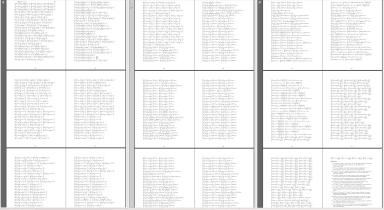
Why yes, this is one equation that covers seventeen pages. You're lucky I didn't post the eight-hundred page one.

Why yes, this is one equation that covers seventeen pages. You’re lucky I didn’t post the eight-hundred page one.

This is great for first impressions, but it’s not very repeatable. Show people one giant equation, and they’ll be impressed. Show them two, and they won’t have any idea what the difference is supposed to be.

If you’re not showing diagrams or equations, what else can you show?

The final option is, essentially, to draw a cartoon. Forget about showing what’s “really going on”, physically or mathematically. That’s what the article is for. For an image, just pick something cute and memorable that references the topic.

When I did an article for Ars Technica back in 2013, I didn’t have any diagrams to show, or any interesting equations. Their artist, undeterred, came up with a cute picture of sushi with an N=4 on it.

That sort of thing really helps! It doesn’t tell you anything technical, it doesn’t explain what’s going on…but it does mean that every time I think of the article, that image pops into my head. And in a world where nothing lasts without a picture to document it, that’s a job well done.

Explanations of Phenomena Are All Alike; Every Unexplained Phenomenon Is Unexplained in Its Own Way

Vladimir Kazakov began his talk at ICTP-SAIFR this week with a variant of Tolstoy’s famous opening to the novel Anna Karenina: “Happy families are all alike; every unhappy family is unhappy in its own way.” Kazakov flipped the order of the quote, stating that while “Un-solvable models are each un-solvable in their own way, solvable models are all alike.”

In talking about solvable and un-solvable models, Kazakov was referring to a concept called integrability, the idea that in certain quantum field theories it’s possible to avoid the messy approximations of perturbation theory and instead jump straight to the answer. Kazakov was observing that these integrable systems seem to have a deep kinship: the same basic methods appear to work to understand all of them.

I’d like to generalize Kazakov’s point, and talk about a broader trend in physics.

Much has been made over the years of the “unreasonable effectiveness of mathematics in the natural sciences”, most notably in physicist Eugene Wigner’s famous essay, The Unreasonable Effectiveness of Mathematics in the Natural Sciences. There’s a feeling among some people that mathematics is much better at explaining physical phenomena than one would expect, that the world appears to be “made of math” and that it didn’t have to be.

On the surface, this is a reasonable claim. Certain mathematical ideas, group theory for example, seem to pop up again and again in physics, sometimes in wildly different contexts. The history of fundamental physics has tended to see steady progress over the years, from clunkier mathematical concepts to more and more elegant ones.

Some physicists tend to be dismissive of this. Lee Smolin in particular seems to be under the impression that mathematics is just particularly good at providing useful approximations. This perspective links to his definition of mathematics as “the study of systems of evoked relationships inspired by observations of nature,” a definition to which Peter Woit vehemently objects. Woit argues what I think any mathematician would when presented by a statement like Smolin’s: that mathematics is much more than just a useful tool for approximating observations, and that contrary to physicists’ vanity most of mathematics goes on without any explicit interest in observing the natural world.

While it’s generally rude for physicists to propose definitions for mathematics, I’m going to do so anyway. I think the following definition is one mathematicians would be more comfortable with, though it may be overly broad: Mathematics is the study of simple rules with complex consequences.

We live in a complex world. The breadth of the periodic table, the vast diversity of life, the tangled webs of galaxies across the sky, these are things that display both vast variety and a sense of order. They are, in a rather direct way, the complex consequences of rules that are at heart very very simple.

Part of the wonder of modern mathematics is how interconnected it has become. Many sub-fields, once distinct, have discovered over the years that they are really studying different aspects of the same phenomena. That’s why when you see a proof of a three-hundred-year-old mathematical conjecture, it uses terms that seem to have nothing to do with the original problem. It’s why Woit, in an essay on this topic, quotes Edward Frenkel’s description of a particular recent program as a blueprint for a “Grand Unified Theory of Mathematics”. Increasingly, complex patterns are being shown to be not only consequences of simple rules, but consequences of the same simple rules.

Mathematics itself is “unreasonably effective”. That’s why, when faced with a complex world, we shouldn’t be surprised when the same simple rules pop up again and again to explain it. That’s what explaining something is: breaking down something complex into the simple rules that give rise to it. And as mathematics progresses, it becomes more and more clear that a few closely related types of simple rules lie behind any complex phenomena. While each unexplained fact about the universe may seem unexplained in its own way, as things are explained bit by bit they show just how alike they really are.

Valentine’s Day Physics Poem 2015

In the third installment of an ongoing tradition (wow, this blog is old enough to have traditions!), I present 2015’s Valentine’s Day Physics Poem. Like the others, I wrote this one a long time ago. I’ve polished it up a bit since.


Perturbation Theory


When you’ve been in a system a long time, your state tends to settle

Time-energy uncertainty

That unrigorous interloper

Means the longer you wait, the more fixed you are

And I’ve been stuck

In a comfy eigenstate

Since what I might as well call t=0.


Yesterday though,

Out of the ether

Like an electric field

New potential entered my Hamiltonian.


And my state was perturbed.


Just a small, delicate perturbation

And an infinite series scrolls out

Waves from waves from waves

It’s a new system now

With new, unrealized energy

And I might as well

Call yesterday

t=0.


Our old friend

Time-energy uncertainty

Tells me not to change,

Not to worry.

Soon, probability thins

The Hamiltonian pulls us back

And we all return

Closer and closer

To a fixed, settled, normal state.


This freedom

This uncertainty

This perturbation

Is limited by Planck’s constant

Is vanishingly small.


Yet rigor

        And happiness

                Demand I include it.

All Is Dust

Joke stolen from some fellow PI postdocs.

The BICEP2 and Planck experiment teams have released a joint analysis of their data, discovering what many had already suspected: that the evidence for primordial gravitational waves found by BICEP2 can be fully explained by interstellar dust.

For those who haven’t been following the story, BICEP2 is a telescope in Antarctica. Last March, they told the press they had found evidence of primordial gravitational waves, ripples in space-time caused by the exponential expansion of the universe shortly after the Big Bang. Soon after, though, doubts were raised. It appeared that the BICEP2 team hadn’t taken proper account of interstellar dust, and in particular had mis-used some data they scraped from a presentation by larger experiment Planck. After Planck released the correct version of their dust data, BICEP2’s predictions were even more evidently premature.

Now, the Planck team has exhaustively gone over their data and BICEP2’s, and done a full analysis. The result is a pretty thorough statement: everything BICEP2 observed can be explained by interstellar dust.

A few news outlets have been describing this as “ruling out inflation” or “ruling out gravitational waves”, both of which are misunderstandings. What Planck has ruled out are inflation (and gravitational waves caused by inflation) powerful enough to have been observed by BICEP2.

To an extent, this was something Planck had already predicted before BICEP2 made their announcement. BICEP2 announced a value for a parameter r, called the tensor-scalar ratio, of 0.2. This parameter r is a way to measure the strength of the gravitational waves (if you want to know what gravitational waves have to do with tensors, this post might help), and thus indirectly the strength of inflation in the early universe.

Trouble is, Planck had already released results arguing that r had to be below 0.11! So a lot of people were already rather skeptical.

With the new evidence, Planck’s bound is relaxed slightly. They now argue that r should be below 0.13, so BICEP2’s evidence was enough to introduce some fuzziness into their measurements when everything was analyzed together.

I’ve complained before about the bad aspects of BICEP2’s announcement, how releasing their data prematurely hurt the public’s trust in science and revealed the nasty side of competition for funding on massive projects. In this post, I’d like to talk a little about the positive side of the publicity around BICEP2.

Lots of theorists care about physics at very very high energies. The scale of string theory, or the Planck mass (no direct connection to the experiment, just the energy where one expects quantum gravity to be relevant), or the energy at which the fundamental forces might unify, are all much higher than any energy we can explore with a particle collider like the LHC. If you had gone out before BICEP2’s announcement and asked physicists whether we would ever see direct evidence for physics at these kinds of scales, they would have given you a resounding no. Maybe we could see indirect evidence, but any direct consequences would be essentially invisible.

All that changed with BICEP2. Their announcement of an r of 0.2 corresponds to very strong inflation, inflation of higher energy than the Planck mass!

Suddenly, there was hope that, even if we could never see such high-energy physics in a collider, we could see it out in the cosmos. This falls into a wider trend. Physicists have increasingly begun to look to the stars as the LHC continues to show nothing new. But the possibility that the cosmos could give us data that not only meets LHC energies, but surpasses them so dramatically, is something that very few people had realized.

The thing is, that hope is still alive and kicking. The new bound, restricting r to less than 0.13, still allows enormously powerful inflation. (If you’d like to work out the math yourself, equation (14) here relates the scale of inflation \Delta \phi to the Planck mass M_{\textrm{Pl}} and the parameter r.)

This isn’t just a “it hasn’t been ruled out yet” claim either. Cosmologists tell me that new experiments coming online in the next decade will have much more precision, and much better ability to take account of dust. These experiments should be sensitive to an r as low as 0.001!

With that kind of sensitivity, and the new mindset that BICEP2 introduced, we have a real chance of seeing evidence of Planck-scale physics within the next ten or twenty years. We just have to wait and see if the stars are right…