Monthly Archives: September 2014

(Interstellar) Dust In The Wind…

The news has hit the blogosphere: the team behind the Planck satellite has released new dust measurements, and they seem to be a nail in the coffin of BICEP2’s observation of primordial gravitational waves.

Some background for those who haven’t been following the story:

BICEP2, a telescope in Antarctica, is set up to observe the Cosmic Microwave Background, light left over from the very early universe. Back in March, they announced that they had seen characteristic ripples in that light, ripples that they believed were caused by gravitational waves in the early universe. By comparing the size of these gravitational waves to their (quantum-small) size when they were created, they could make statements about the exponential expansion of the early universe (called inflation). This amounted to better (and more specific) evidence about inflation than anyone else had ever found, so naturally people were very excited about it.

However, doubt was rather quickly cast on these exciting results. Like all experimental science, BICEP2 needed to estimate the chance that their observations could be caused by something more mundane. In particular, interstellar dust can cause similar “ripples” to those they observed. They argued that dust would have contributed a much smaller effect, so their “ripples” must be the real deal…but to make this argument, they needed an estimate of how much dust they should have seen. They had several estimates, but one in particular was based on data “scraped” off of a slide from a talk by the Planck collaboration.

Unfortunately, it seems that the BICEP2 team misinterpreted this “scraped” data. Now, Planck have released the actual data, and it seems like dust could account for BICEP2’s entire signal.

I say “could” because more information is needed before we know for sure. The BICEP2 and Planck teams are working together now, trying to tease out whether BICEP2’s observations are entirely dust, or whether there might still be something left.

I know I’m not the only person who wishes that this sort of collaboration could have happened before BICEP2 announced their discovery to the world. If Planck had freely shared their early data with BICEP2, they would have had accurate dust estimates to begin with, and they wouldn’t have announced all of this prematurely.

Of course, expecting groups to freely share data when Nobel prizes and billion-dollar experiments are on the line is pretty absurdly naive. I just wish we lived in a world where none of this was at issue, where careers didn’t ride on “who got there first”.

I’ve got no idea how to bring about such a world, of course. Any suggestions?

So the Higgs is like, everywhere, right?

When I tell people I do particle physics, they generally jump to the first thing they’ve heard of, the Higgs boson. Unfortunately, what most people have heard about the Higgs boson is misleading.

The problem is the “crowded room” metaphor, a frequent favorite of people trying to describe the Higgs. The story goes that the Higgs works like trying to walk through a crowded room: an interesting person (massive particle) will find that the crowd clusters around them, so it becomes harder to make progress, while a less interesting person (less massive or massless particle) will have an easier time traveling through the crowd.

This metaphor gives people the impression that each of us is surrounded by an invisible sea of particles, like an invisible crowd constantly jostling us.

I see Higgs people!

People get very impressed by the idea of some invisible, newly discovered stuff that extends everywhere and surrounds everything. The thing is, this really isn’t the unique part of the Higgs. In fact, every fundamental particle works like this!

In physics, we describe the behavior of fundamental particles (like the Higgs, but also everything from electrons to photons) with a framework called Quantum Field Theory. In Quantum Field Theory, each particle has a corresponding field, and each field extends everywhere, over all space and time. There’s an electron field, and the electron field is absolutely everywhere. The catch is, most of the time, most of these fields are at zero. The electron field tells you that there are zero electrons in a generic region of space.

Particles are ripples in these fields. If the electron field wobbles a bit higher than normal somewhere, that means there’s an electron there. If it wobbles a bit lower than normal instead, then it’s an anti-electron. (Note: this is a very fast-and-loose way to describe how antimatter works, don’t take it for more than it’s worth.)

When the Higgs field ripples, you get a Higgs particle, the one discovered at the LHC. The “crowd” surrounding us isn’t these ripples (which are rare and hard to create), but the field itself, which surrounds us in the same way every other field does.

With all that said, there is a difference between the Higgs field and other fields. The Higgs field is the only field we’ve discovered (so far) that isn’t usually zero. This is because the Higgs is the only field we’ve discovered that is allowed to be something other than zero.

Symmetry is a fundamental principle in physics. At its simplest, symmetry is the idea that nothing should be special for no good reason. One consequence is that there are no special directions. Up, down, right, left, the laws of physics don’t care which one you choose. Only the presence of some object (like the Earth) can make differences like up versus down relevant.

What does that have to do with fields?

Think about a magnetic field. A magnetic field pulls in a specific direction.

So far, so good…

Now imagine a magnetic field everywhere. Which way would it point? If it was curved like the one in the picture, what would it be curved around?

There isn’t a good choice. Any choice would single out one direction, making it special. But nothing should be special for no good reason, and unless there was an object out there releasing this huge magnetic field there would be no good reason for it to be pointed that way. Because of that, the default value of the magnetic field over all space has to be zero.

You can make a similar argument for fields like the electron field. It’s even harder to imagine a way for electrons to be everywhere and not pick some “special” direction.

The Higgs, though, is special. The Higgs is what’s known as a scalar field. That means that it doesn’t have a direction. At any specific point it’s just a number, a scalar quantity. The Higgs doesn’t have to be zero everywhere because even if it isn’t, no special direction is singled out. One metaphor I’ve used before is colored construction paper: the paper can be blue or red, and either way it will still be empty until someone draws on it.

A bit less exciting than ghosts, huh?

The Higgs is special because it’s the first fundamental scalar field we’ve been able to detect, but there are probably others. Most explanations of cosmic inflation, for example, rely on one or more new scalar fields. (Just like “mass of the fundamental particles” is just a number, “rate the universe is inflating” is also just a number, and can also be covered by a scalar field.) It’s not special just because it’s “everywhere”, and imagining it as a bunch of invisible particles careening about around you isn’t going to get you anywhere useful.

Now, if you find the idea of being surrounded by invisible particles interesting, you really ought to read up on neutrinos….

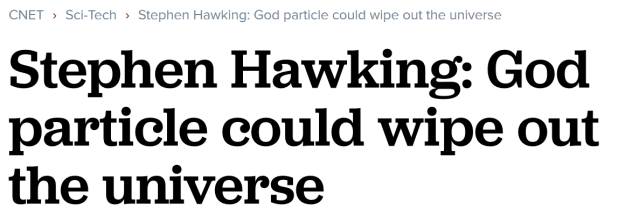
No, Hawking didn’t say that a particle collider could destroy the universe

So apparently Hawking says that the Higgs could destroy the universe.

HawkingHiggs

I’ve covered this already, right? No need to say anything more?

Ok, fine, I’ll write a real blog post.

The Higgs is a scalar field: a number, sort of like temperature, that can vary across space and time. In the case of the Higgs this number determines the mass of almost every fundamental particle (the jury is still somewhat out on neutrinos). The Higgs doesn’t vary much at all, in fact it takes an enormous (Large Hadron Collider-sized) amount of energy to get it to wobble even a little bit. That is because the Higgs is in a very very stable state.

Hawking was pointing out that, given our current model of the Higgs, there’s actually another possible state for the Higgs to be in, one that’s even more stable (because it takes less energy, essentially). In that state, the number the Higgs corresponds to is much larger, so everything would be much more massive, with potentially catastrophic results. (Matt Strassler goes into some detail about the assumptions behind this.)

For those who have been following my blog for a while, you may find these “stable states” familiar. They’re vacua, different possible ways to set up “empty” space. In that post, I may have given the impression that there’s no way to change from one stable state, one “vacuum”, to another. In the case of the Higgs, the state it’s in is so stable that vast amounts of energy (again, a Large Hadron Collider-worth) only serve to create a small, unstable fluctuation, the Higgs boson, which vanishes in a fraction of a second.

And that would be the full story, were it not for a curious phenomenon called quantum tunneling.

If you’ve heard someone else describe quantum tunneling, you’ve probably heard that quantum particles placed on one side of a wall have a very small chance of being found later on the other side of the wall, as if they had tunneled there.

Using their incredibly tiny shovels.

However, quantum tunneling applies to much more than just walls. In general, a particle in an otherwise stable state (whether stable because there are walls keeping it in place, or for other reasons) can tunnel into another state, provided that the new state is “more stable” (has lower energy).

The chance of doing this is small, and it gets smaller the more “stable” the particle’s initial state is. Still, if you apply that logic to the Higgs, you realize there’s a very very very small chance that one day the Higgs could just “tunnel” away from its current stable state, destroying the universe as we know it in the process.

If that happened, everything we know would vanish at the speed of light, and we wouldn’t see it coming.

While that may sound scary, it’s also absurdly unlikely, to the extent that it probably won’t happen until the universe is many times older than it is now. It’s not the sort of thing anybody should worry about, at least on a personal level.

Is Hawking fear-mongering, then, by pointing this out? Hardly. He’s just explaining science. Pointing out the possibility that the Higgs could spontaneously change and end the universe is a great way to emphasize the sheer scale of physics, and it’s pretty common for science communicators to mention it. I seem to recall a section about it in Particle Fever, and Sean Carroll even argues that it’s a good thing, due to killing off spooky Boltzmann Brains.

What do particle colliders have to do with all this? Well, apart from quantum tunneling, just inputting enough energy in the right way can cause a transition from one stable state to another. Here “enough energy” means about a million times that produced by the Large Hadron Collider. As Hawking jokes, you’d need a particle collider the size of the Earth to get this effect. I don’t know whether he actually ran the numbers, but if anything I’d guess that a Large Earth Collider would actually be insufficient.

Either way, Hawking is just doing standard science popularization, which isn’t exactly newsworthy. Once again, “interpret something Hawking said in the most ridiculous way possible” seems to be the du jour replacement for good science writing.

The Near and the Far: Motivations for Physics

When I introduce myself, I often describe my job like this:

“I develop mathematical tools to make calculations in particle physics easier and more efficient.”

However, I could equally well describe my job like this:

“I’m looking for a radical new way to reformulate particle physics in order to solve fundamental problems in space and time.”

These may sound very different, but they’re both correct. That’s because in theoretical physics, like in many branches of science, we have two types of goals: near-term and far-term.

In the near-term, I develop mathematical tools and tricks, which let me calculate things I (and others) couldn’t calculate before. Pushing the tricks to their limits gives me more proficiency, making the tools I develop more robust. In the future, I can imagine applying the tools to more types of calculations, and specifically to more “important” calculations.

All of that still involves relatively near-term goals, though. Develop a new trick, and you can already envision what it might be used for. The far-term goals are generally deeper.

End of the road, not just the next tree.

In the far term, the new techniques that I and others develop might lead to fundamentally new ways to understand particle physics. That’s because a central feature of most of the tricks we develop is that they rephrase the calculation in a way that leaves out something that used to be thought of as fundamental. They’re “revolutions”, overthrowing some basic principle of how we do things. The hope is that the right “revolution” will help us solve problems that our current understanding of physics seems incapable of solving.

Most scientists have both sorts of goals. Someone who studies quantum mechanics might talk about developing a quantum computer, but in the near-term be interested in perfecting some algorithm. A biologist might study how information is stored in a cell, but introduce themself as someone trying to cure cancer.

For some people, the far-term goals are a big component of how they view themselves. Nima Arkani-Hamed, for example, has joked that believing that “spacetime is doomed” is what allows him to get out of bed in the morning. (For a transcript of the relevant parts, see here.) There are plenty of others with similar perspectives, people who need a “big” goal to feel motivated.

Myself, I find it harder to identify with these kinds of goals, because the payoff is so uncertain. Rephrasing particle physics in a new way might be the solution to a fundamental problem…but it could also just be another way to say the same thing. There’s no guarantee that any one project will be that one magical solution. In contrast, for me, near term goals are something I can feel confident I’m making real progress on. I can envision each step along the way, and see the part my work plays in a larger picture, led along by the satisfaction of solving each puzzle as it comes.

Neither way is better than the other, and both are important parts of science. Some people do better with one, some do better with the other, and in the end, everyone can view themselves as accomplishing something they care about.