
Monthly Archives: August 2014

What’s an Amplitude? Just about everything.

I am an Amplitudeologist. In other words, I study scattering amplitudes. I’ve explained bits and pieces of what scattering amplitudes are in other posts, but I ought to give a short definition here so everyone’s on the same page:

A scattering amplitude is the formula used to calculate the probability that some collection of particles will “scatter”, emerging as some (possibly different) collection of particles.

Note that I’m using some weasel words here. The scattering amplitude is not a probability itself, but “the formula used to calculate the probability”. For those familiar with the mathematics of waves, the scattering amplitude gives the amplitude of a “probability wave” that must be squared to get the probability. (Those familiar with waves might also ask: “If this is the amplitude, what about the period?” The truth is that because scattering amplitudes are calculated using complex numbers, what we call the “amplitude” also contains information about the wave’s “period”. It may seem like an inconsistent way to name things from the perspective of a beginning student, but it is actually consistent with the terminology in a large chunk of physics.)

In some of the simplest scattering amplitudes particles literally “scatter”, with two particles “colliding” and emerging traveling in different directions.

A scattering amplitude can also describe a more complicated situation, though. At particle colliders like the Large Hadron Collider, two particles (a pair of protons for the LHC) are accelerated fast enough that when they collide they release a whole slew of new particles. Since it still fits the “some particles go in, some particles go out” template, this is still described by a scattering amplitude.

It goes even further than that, though, because “some particles” could also just be “one particle”. If you’re dealing with something unstable (the particle equivalent of radioactive, essentially) then one particle can decay into two or more particles. There’s a whole slew of questions that require that sort of calculation. For example, if unstable particles were produced in the early universe, how many of them would be left around today? If dark matter is unstable (and some possible candidates are), when it decays it might release particles we could detect. In general, this sort of scattering amplitude is often of interest to astrophysicists when they happen to get involved in particle physics.

You can even use scattering amplitudes to describe situations that, at first glance, don’t sound like collisions of particles at all. If you want to find the effect of a magnetic field on an electron to high accuracy, the calculation also involves a scattering amplitude. A magnetic field can be thought of in terms of photons, particles of light, because light is a vibration in the electro-magnetic field. This means that the effect of a magnetic field on an electron can be calculated by “scattering” an electron and a photon.
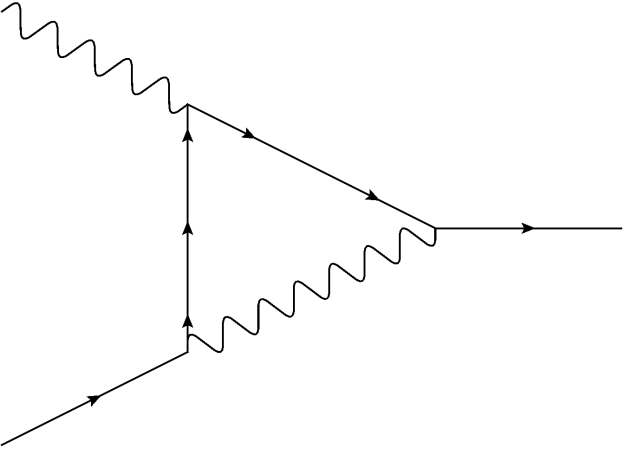
4gravanom

If this looks familiar, check the handbook section.

In fact, doing the calculation in this way leads to what is possibly the most accurately predicted number in all of science.

Scattering amplitudes show up all over the place, from particle physics at the Large Hadron Collider to astrophysics to delicate experiments on electrons in magnetic fields. That said, there are plenty of things people calculate in theoretical physics that don’t use scattering amplitudes, either because they involve questions that are difficult to answer from the scattering amplitude point of view, or because they invoke different formulas altogether. Still, scattering amplitudes are central to the work of a large number of physicists. They really do cover just about everything.

Am I a String Theorist?

Perimeter, like most institutes of theoretical physics, divides their researchers into semi-informal groups. At Perimeter, these are:

  • Condensed Matter
  • Cosmology
  • Mathematical Physics
  • Particle Physics
  • Quantum Fields and Strings
  • Quantum Foundations
  • Quantum Gravity
  • Quantum Information
  • Strong Gravity

I’m in the Quantum Fields and Strings group, which many people seem to refer to simply as the String Theory group. So for the past week or so, I’ve been introducing myself as a String Theorist. As I briefly mention in my Who Am I? post, this isn’t completely accurate.

Am I a String Theorist?

The theories that I study do derive from string theory. They were first framed by string theorists, and research into them is still deeply intertwined with string theory research. I’ve definitely had occasion to compare my results to those of string theorists, or to bring in calculations by string theorists to advance my work.

And if you’re the kind of person who views the world as a competition between string theory and its rivals (like Loop Quantum Gravity) then I suppose I’m on the string theory “side”. I’m optimistic, at least, that the reason why string theory research is so much more common than any other approach to quantum gravity is simply because string theory provides many more interesting and viable projects for researchers.

On the other hand, though, there’s the basic fact that the theories I work with are not, themselves, string theories. They’re quantum field theories, the broader class that encompasses the modern synthesis of quantum mechanics and special relativity. The theories I work with are often reasonably close to the well-tested theories of the real world, close enough that the calculations are more “particle physics” than the they are “string theory”.

Of course, all of that could change. One of the great things about string theory is the way it connects lots of different interesting quantum field theories together. There’s a “string”, the “GKP string”, involved in the work of Basso, Sever, and Vieira, work that I will probably get involved with here at Perimeter. The (2,0) theory is a quantum field theory, but it’s much closer to string theory than to particle physics, so if I get more involved with the (2,0) theory would that make me a string theorist?

The fact is, these days string theory is so ubiquitous that the question “Am I a String Theorist?” doesn’t actually mean anything. String theory is there, lurking in the background, able to get involved at any time even if it’s not directly involved at present. Theoretical physicists don’t fall into neat categories.

I am a String Theorist. Also, I am not.

Perimeter!

I’m moving in at Perimeter this week, so I don’t have time to write a long post. For those who aren’t familiar with it, the Perimeter Institute for Theoretical Physics is an independent research institute, not affiliated with any university. Instead, it’s funded by a combination of government and private sources (for why private sources might fund theoretical physics, read my discussion here). Because it’s not a university they have budgets to do things like hire people to make the transition process easier, so everything has been really nice and well-organized.

The postdoc offices are really nice, with a view of the nearby park, shown below.

On the Perimeter...of Waterloo Park

On the Perimeter…of Waterloo Park

Hexagon Functions II: Lost in (super)Space

My new paper went up last night.

It’s on a very similar topic to my last paper, actually. That paper dealt with a specific process involving six particles in my favorite theory, N=4 super Yang-Mills. Two particles collide, and after the metaphorical dust settles four particles emerge. That means six “total” particles, if you add the two in with the four out, for a “hexagon” of variables. To understand situations like that, my collaborators and I created “hexagon functions”, formulas that depended on the states of the six particles.

One thing I didn’t emphasize then was that that calculation only applied to one specific choice of particles, one in which all of the particles are Yang-Mills bosons, particles (like photons) created by the fundamental forces. There are lots of other particles in N=4 super Yang-Mills, though. What happens when they collide?

That question is answered by my new paper. Though it may sound surprising, all of the other particles can be taken into account with a single formula. In order to explain why, I have to tell you about something called superspace.

A while back I complained about a blog post by George Musser about the (2,0) theory. One of the things that irked me about that post was his attempt to explain superspace:

Supersymmetry is the idea that spacetime, in addition to its usual dimensions of space and time, has an entirely different type of dimension—a quantum dimension, whose coordinates are not ordinary real numbers but a whole new class of number that can be thought of as the square roots of zero.

This is actually a great way to think about superspace…if you’re already a physicist. If you’re not, it’s not very informative. Here’s a better way to think about it:

As I’ve talked about before, supersymmetry is a relationship between different types of particles. Two particles related by supersymmetry have the same mass, and the same charge. While they can be very different in other ways (specifically, having different spin), supersymmetric particles are described by many of the same equations as each-other. Rather than writing out those equations multiple times, it’s often nicer to write them all in a unified way, and that’s where superspace comes in.

At its simplest, superspace is just a trick used to write equations in a simpler way. Instead of writing down a different equation for each particle we write one equation with an extra variable, representing a “dimension” of supersymmetry. Traveling in that dimension takes you from particle to particle, in the same way that “turning” the theory (as I phrase it here) does, but it does it within the space of a single equation.

That, essentially, is the trick that we use. With four “superspace dimensions”, we can include the four supersymmetries of N=4 super Yang-Mills, showing how the formulas vary when you go beyond the equation from our first paper.

So far, you may be wondering why I’m calling superspace a “dimension”, when it probably sounds like more of a label. I’ve mentioned before that, just because something is a variable, doesn’t mean it counts as a real dimension.

The key difference is that superspace dimensions are related to regular dimensions in a precise way. In a sense, they’re the square roots of regular dimensions. (Though independently, as George Musser described, they’re the square roots of zero: go in the same direction twice in supersymmetry, and you get back where you’re started, going zero distance.) The coexistence of these two seemingly contradictory statements isn’t some sort of quantum mystery, it’s just a consequence of the fact that, mathematically, I’m saying two very different things. I just can’t think of a way to explain them differently without math.

Superspace isn’t a real place…but it can often be useful to think of it that way. In theories with supersymmetry, it can unify the world, putting disparate particles together into a single equation.

Stop! Impostor!

Ever felt like you don’t belong? Like you don’t deserve to be where you are, that you’re just faking competence you don’t really have?

If not, it may surprise you to learn that this is a very common feeling among successful young academics. It’s called impostor syndrome, and it happens to some very talented people.

It’s surprisingly easy to rationalize success as luck, to assume praise comes from people who don’t know the full story. In science, we’re surrounded by people who seem to come up with brilliant insights on a regular basis. We see others’ successes far more often than we see their failures, and often we forget that science is at its heart a process of throwing ideas against a wall until something sticks. Hyper-aware of our own failures, when we present ourselves as successful we can feel like we’re putting on a paper-thin disguise, constantly at risk that someone will see through it.

As paper-thin disguises go, I prefer the classics.

In my experience, theoretical physics is especially heavy on impostor syndrome, for a number of reasons.

First, there’s the fact that beginning grad students really don’t know all they need to. Theoretical physics requires a lot of specialized knowledge, and most grad students just have the bare bones basics of a physics undergrad degree. On the strength of those basics, you’re somehow supposed to convince a potential advisor, an established, successful scientist, that you’re worth paying attention to.

Throw in the fact that many people have a little more than the basics, whether from undergrad research projects or grad-level courses taken early, and you have a group where everyone is trying to seem more advanced than they are. There’s a very real element of fake it till you make it, of going to talks and picking up just enough of the lingo to bluff your way through a conversation.

And the thing is, even after you make it, you’ll probably still feel like you’re faking it.

As I’ve mentioned before, there’s an enormous amount of jury-rigging that goes into physics research. There are a huge number of side-disciplines that show up at one point or another, from numerical methods to programming to graphic design. We can’t hire a professional to handle these things, we have to learn them ourselves. As such, we become minor dabblers in a whole mess of different fields. Work on something enough and others will start looking to you for help. It won’t feel like you’re an expert, though, because you know in the back of your mind that the real experts know so much more.

In the end, the best approach I’ve found is simply to keep saying yes. Keep using what you know, going to talks and trying new things. The more you “pretend” to know what you’re doing, the more experience you’ll get, until you really do know what you’re doing. There’s always going to be more to learn, but chances are if you’re feeling impostor syndrome you’ve already learned a lot. Take others’ opinions of you at face value, and see just how far you can go.