Monthly Archives: February 2014

Why we Physics

There are a lot of good reasons to study theories in theoretical physics, even the ones that aren’t true. They teach us how to do calculations in other theories, including those that do describe reality, which lets us find out fundamental facts about nature. They let us hone our techniques, developing novel methods that often find use later, in some cases even spinoff technology. (Mathematica came out of the theoretical physics community, while experimental high energy physics led to the birth of the modern internet.)

Of course, none of this is why physicists actually do physics. Sure, Nima Arkani-Hamed might need to tell himself that space-time is doomed to get up in the morning, but for a lot of us, it isn’t about proving any wide-ranging point about the universe. It’s not even all about the awesome, as some would have it: most of what we do on a day-to-day basis isn’t especially awesome. It goes a bit deeper than that.

Science, in the end, is about solving puzzles. And solving puzzles is immensely satisfying, on a deep, fundamental level.

There’s a unique feeling that you get when all the pieces come together, when you’re calculating something and everything cancels and you’re left with a simple answer, and for some people that’s the best thing in existence.

It’s especially true when you’re working with an ansatz or using some other method where you fix parameters and fill in uncertainties, one by one. You can see how close you are to the answer, which means each step gives you that little thrill of getting just that much closer. One of my colleagues describes the calculations he does in supergravity as not tedious but “delightful” for precisely this reason: a calculation where every step puts another piece in the right place just feels good.

Theoretical physicists are the kind of people who would get a Lego set for their birthday, build it up to completion, and then never play with it again (unless it was to take it apart and make something else). We do it for the pure joy of seeing something come together and become complete. Save what it’s “for” for the grant committees, we’ve got a different rush in mind.

The Royal We of Theoretical Physics

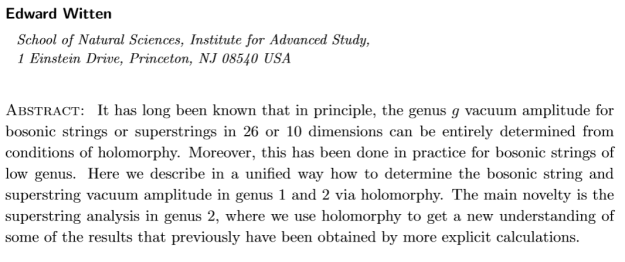
I’m about to show you an abstract from a theoretical physics paper. Don’t worry about what it says, just observe the grammar.

wittenabstract

Notice anything? Here, I’ll zoom in:

wittenwe

This paper has one author, Edward Witten. So who’s “we”?

As it turns out, it is actually quite common in theoretical physics for a paper to use the word “we”, even when it is written by a single author. While this tradition has been called stilted, pompous, and just plain bad writing, there is a legitimate reason behind it. “We” is convenient, because it represents several different important things.

While the paper I quoted was written by only one author, many papers are collaborative efforts. For a collaboration, depending on collaboration style, it is often hard to distinguish who did what in a consistent way. As such, “we” helps smooth over different collaboration styles in a consistent way.

What about single-authored papers, though? For a single author, and often even for multiple authors, “we” means the author plus the reader.

In principle, anyone reading a paper in theoretical physics should be able to follow along, doing the calculations on their own, and replicate the paper’s results. In practice this can often be difficult to impossible, but it’s still true that if you want to really retain what you read in theoretical physics, you need to follow along and do some of the calculation yourself. As a nod to this, it is conventional to write theoretical physics papers as if the reader was directly participating, leading them through the results point by point like exercises in a textbook. “We” do one calculation, then “we” use the result to derive the next point, and so on.

There are other meanings that “we” can occasionally serve, such as referring to everyone in a particular field, or a group in a hypothetical example.

While each of these meanings of “we” could potentially use a different word, that tends to make a paper feel cluttered, with jarring transitions between different subjects. Using “we” for everything gives the paper a consistent voice and feel, though it does come at the cost of obscuring some of the specific details of who did what. Especially for collaborations, the “we the collaborators” and “we the author plus reader” meanings can overlap and blur together. This usually isn’t a problem, but as I’ve been finding out recently it does make things tricky when writing for people who aren’t theoretical physicists, such as universities with guidelines that require a thesis to clearly specify who in a collaboration did what.

On an unrelated note, two papers went up this week pushing the hexagon function story to new and impressive heights. I wasn’t directly involved in either, I’ve been attacking a somewhat different part of the problem, and you can look forward to something on that in a few months.

Caltech Amplitudes Workshop, and Valentines Poem 2014

This week’s post will be a short one. I’m at a small workshop for young amplitudes-folks at Caltech, so I’m somewhat busy.

(What we call a workshop is a small conference focused on fostering discussion and collaboration. While there are a few talks to give the workshop structure, most of the time is spent in more informal discussions between the participants.)

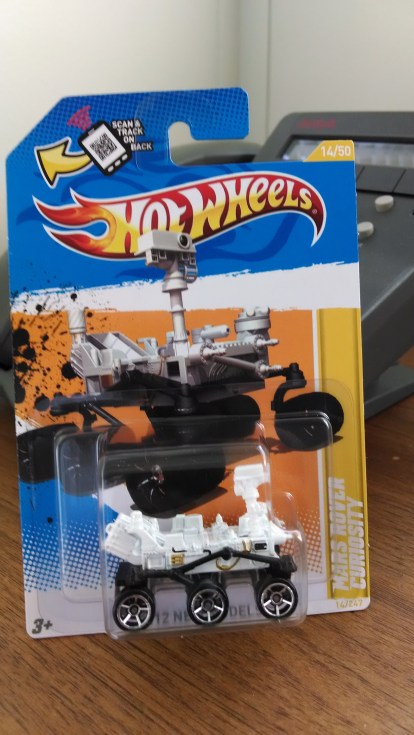
There have been a lot of great talks, and a lot of great opportunities to bond with fellow young amplitudeologists. Also, great workshop swag!

Yes, that is a Hot Wheels Mars Rover

Yes, that is a Hot Wheels Mars Rover

Unrelatedly, to continue a tradition from last year, and since it’s Valentine’s Day, allow me to present a short physics-themed poem I wrote a long time ago, this one about the sometimes counter-intuitive laws of thermodynamics:

Thermodynamic Hypothesis

A cold object, like a hot one, must be insulated

Cut off from interaction

Immerse the subject in a bath of warmth

And I reach equilibrium

What’s in a Thesis?

As I’ve mentioned before, I’m graduating this spring, which means I need to write that most foreboding of documents, the thesis. As I work on it, I’ve been thinking about how the nature of the thesis varies from field to field.

If you don’t have much experience with academics, you probably think of a thesis as a single, overarching achievement that structures a grad student’s career. A student enters grad school, designs an experiment, performs it, collects data, analyzes the data, draws some conclusion, then writes a thesis about it and graduates.

In some fields, the thesis really does work that way. In biology for example, the process of planning an experiment, setting it up, and analyzing and writing up the data can be just the right size so that, a reasonable percentage of the time, it really can all be done over the course of a PhD.

Other fields tend more towards smaller, faster-paced projects. In theoretical physics, mathematics, and computer science, most projects don’t have the same sort of large experimental overhead that psychologists or biologists have to deal with. The projects I’ve worked on are large-scale for theoretical physics, and I’ll still likely have worked on three distinct things before I graduate. Others, with smaller projects, will often have covered more.

In this situation, a thesis isn’t one overarching idea. Rather, it’s a compilation of work from past projects, sewed together with a pretense of an overall theme. It’s a bit messy, but because it’s the way things are expected to be done in these fields, no-one minds particularly much.

The other end of the spectrum is potentially much harder to deal with. For those who work on especially big experiments, the payoff might take longer to arrive than any reasonable degree. Big machines like colliders and particle detectors can take well over a decade before they start producing data, while longitudinal studies that follow a population as they grow and age take a long time no matter how fast you work.

In cases like this, the challenge is to chop off a small enough part of the project to make it feel like a thesis. A thesis could be written about designing one component for the eventual machine, or analyzing one part of the vast sea of data it produces. Preliminary data from a longitudinal study could be analyzed, even when the final results are many years down the line.

People in these fields have to be flexible and creative when it comes to creating a thesis, but usually the thesis committee is reasonable. In the end, a thesis is what you need to graduate, whatever that actually is for you.