Monthly Archives: December 2013

Four Gravitons and a…Postdoc?

As a few of you already know, it’s looking increasingly certain that I will be receiving my Ph.D. in the spring. I’ll graduate, ceasing to be a grad student and becoming that most mysterious of academic entities, a postdoc.

When describing graduate school before, I compared it to an apprenticeship. (I expanded on that analogy more here.) Let’s keep pursuing that analogy. If a graduate student is like an apprentice, then a Postdoctoral Scholar, or Postdoc, is like a journeyman.

In Medieval Europe, once an apprenticeship was completed the apprentice was permitted to work independently, earning a wage for their own labors. However, they still would not have their own shop. Instead, they would work for a master craftsman. Such a person was called a journeyman, after the French work journée, meaning a day’s work.

Similarly, once a graduate student gets their Ph.D., they are able to do scientific research independently. However, most graduate students are not ready to be professors when fresh out of their Ph.D. Instead, they become postdocs, working in an established professor’s group. Like a journeyman, a postdoc is nominally independent, but in practice works under loose supervision from the more mature members of their field.

Another similarity between postdocs and journeymen is their tendency to travel. Historically, a journeyman would spend several years traveling, studying in the workshops of several masters. Similarly, a postdoc will often (especially in today’s interconnected world) travel far from where they began in order to broaden their capabilities.

A postdoctoral job generally lasts two or three years, one for particularly short positions. Most scientists will go through at least one postdoctoral position after achieving their Ph.D. In some fields (theoretical physics in particular), a scientist will have two or three such positions in different places before finding a job as a professor. Postdocs are paid significantly better than grad students, but generally significantly worse than professors. They don’t (typically) teach, but depending on the institution and field they may do some TA work.

Being still a grad student, my blog is titled “4 gravitons and a grad student”. That could change, though. Once I become a postdoc, I have three options:

  1. Keep the old title. Keeping the same title and domain name makes it easier for people to find the blog. It also maintains the alliteration, which I think is fun. On the other hand, it would be hard to justify, and I’d likely have to write something silly about taking a grad student perspective or the like.
  2. Change to “4 gravitons and a postdoc”. I’d lose the fun alliteration, but the title would accurately represent my current state. However, I might lose a few readers who don’t expect the change.
  3. Cut it down to “4 gravitons”. This matches the blog’s twitter handle (@4gravitons). It’s quick, it’s recognizable, and it keeps the memorable part of the old title without adding anything new to remember. However, it would be less unique in google searches.

What do you folks think? I’ve still got a while to decide, and I’d love to hear your opinions!

Amplitudes on Paperscape

Paperscape is a very cool tool developed by Damien George and Rob Knegjens. It analyzes papers from arXiv, the paper repository where almost all physics and math papers live these days. By putting papers that cite each other closer together and pushing papers that don’t cite each other further apart, Paperscape creates a map of all the papers on arXiv, arranged into “continents” based on the links between them. Papers with more citations are shown larger, newer papers are shown brighter, and subject categories are indicated by color-coding.

Here’s a zoomed-out view:

PaperscapeFullMap

Already you can see several distinct continents, corresponding to different arXiv categories like high energy theory and astrophysics.

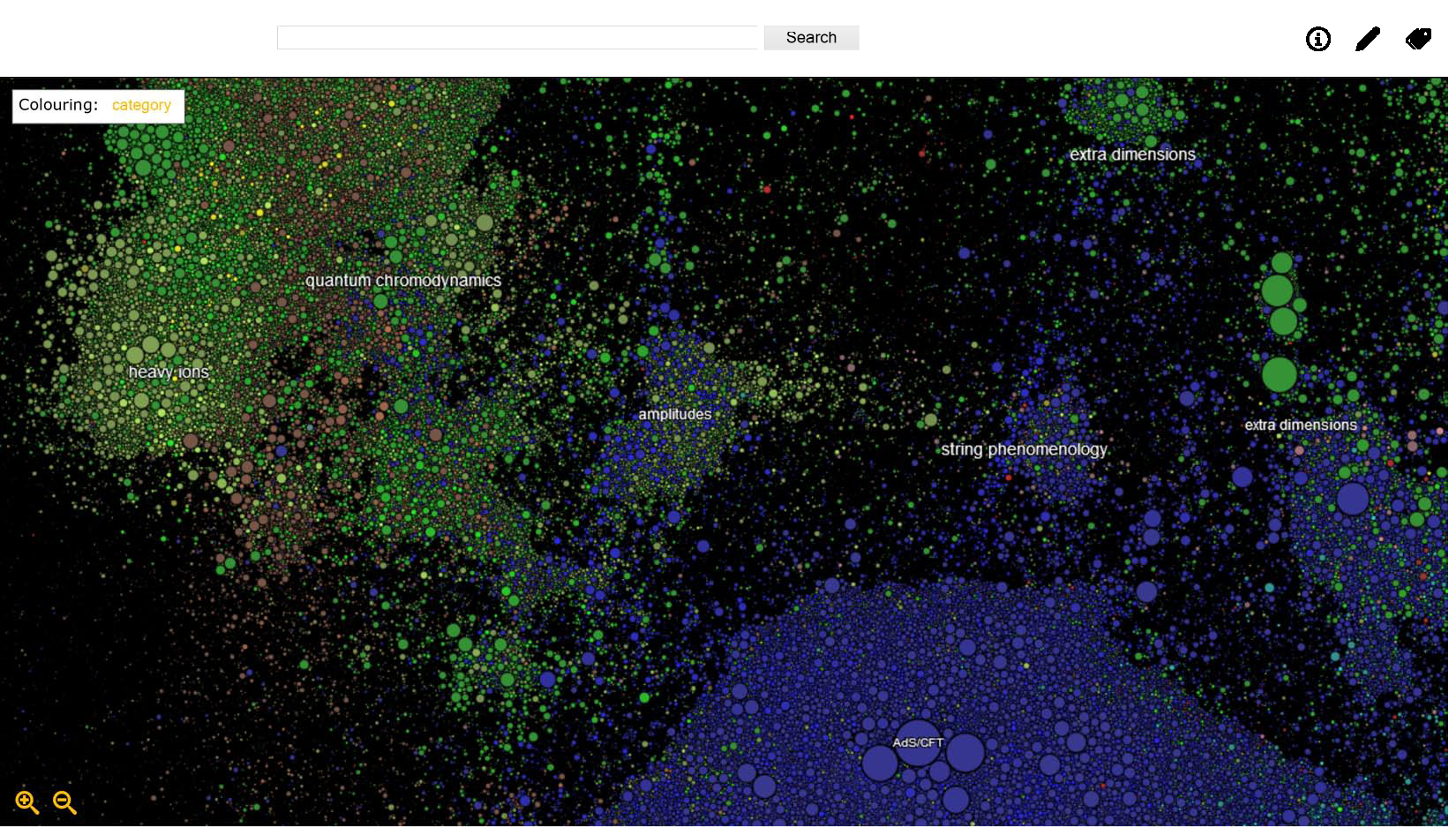
If you want to find amplitudes on this map, just zoom in between the purple continent (high energy theory, much of which is string theory) and the green one (high energy lattice, nuclear experiment, high energy experiment, and high energy phenomenology, broadly speaking these are all particle physics).

PaperscapeAmplitudesMap

When you zoom in, Paperscape shows words that commonly appear in a given region of papers. Zoomed in this far, you can see amplitudes!

Amplitudeologists like me live on an island between particle physics and string theory. We’re connected on both sides by bridges of citations and shared terms, linking us to people who study quarks and gluons on one side to people who study strings and geometry on the other. Think of us like Manhattan, an island between two shores, densely networked in to the surroundings.

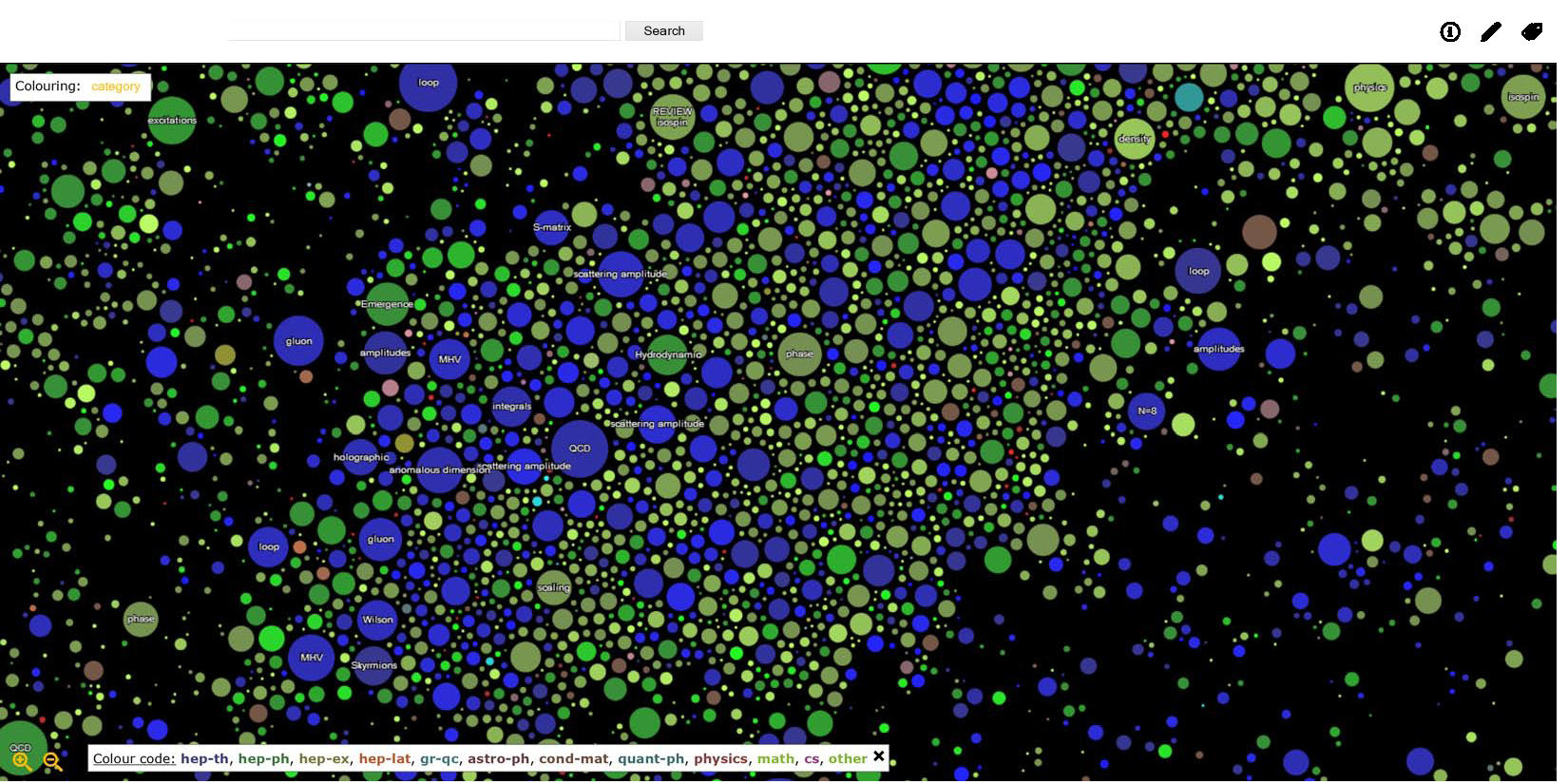
PaperscapeZoomedMap

Zoom in further, and you can see common keywords for individual papers. Exploring around here shows not only what is getting talked about, but what sort of subjects as well. You can see by the color-coding that many papers in amplitudes are published as hep-th, or high energy theory, but there’s a fair number of papers from hep-ph (phenomenology) and from nuclear physics as well.

There’s a lot of interesting things you can do with Paperscape. You can search for individuals, or look at individual papers, seeing who they cite and who cite them. Try it out!

The Amplitudes Revolution Will Not Be Televised (But It Will Be Streamed)

I’ve been at the Simons Center’s workshop on the Geometry and Physics of Scattering Amplitudes all week, so I don’t have time for a long post. There have been a lot of great talks from a lot of great amplitudes-folks (including one on Tuesday by Lance Dixon discussing this work, and one on the same day explaining the much-hyped amplituhedron). Curious folks can follow the conference link above to find videos and slides for each of the talks, arranged by the talk schedule.

I’ve made some great contacts, picked up a couple running jokes (check out Rutger Boels’s talk on Monday and Lance’s talk on Tuesday), heard the phrase “only seven loops” stated in relative seriousness, and heard the story of why the conference ended up choosing an artist’s conception of the amplituhedron for the workshop poster, which I can relate if folks are especially curious.

Elegance, Not So Mysterious

You’ll often hear theoretical physicists in the media referring to one theory or another as “elegant”. String theory in particular seems to get this moniker fairly frequently.

It may often seem like mathematical elegance is some sort of mysterious sixth sense theorists possess, as inexplicable to the average person as color to a blind person. What’s “elegant” about string theory, after all?

Before explaining elegance, I should take a bit of time to say what it’s not. Elegance isn’t Occam’s razor. It isn’t naturalness, either. Both of those concepts have their own technical definitions.

Elegance, by contrast, is a much hazier, and yet much simpler, notion. It’s hazy enough that any definition could provoke arguments, but I can at least give you an approximate idea by telling you that an elegant theory is simple to describe, if you know the right terms. Often, it is simpler than the phenomenon that it explains.

How does this apply to something like string theory? String theory seems to be incredibly complicated: ten dimensions, curled up in a truly vast number of different ways, giving rise to whole spectrums of particles.

That said, the basic idea is quite simple. String theory asks the question: what if, in addition to fundamental point-particles (zero dimensional objects), there were fundamental objects of other dimensions? That idea leads to complicated consequences: if your theory is going to produce all the particles of the real world then you need the ten dimensions and the supersymmetry and yadda yadda. But the basic idea is simple to describe. An elegant theory can have very complicated consequences, but still be simple to describe.

This, broadly, is the sort of explanation theoretical physicists look for. Math is the kind of field where the same basic systems can describe very complex phenomena. Since theoretical physics is about describing the world in terms of math, the right explanation is usually the most elegant.

This can occasionally trip physicists up when they migrate to other careers. In biology, for example, the elegant solution is often not the right one, because evolution doesn’t care about elegance: evolution just grabs whatever is within reach. Financial systems and economics occasionally have similar problems. All this is to say that while elegance is an important thing for a physicist to strive for, sometimes we have to be careful about it.