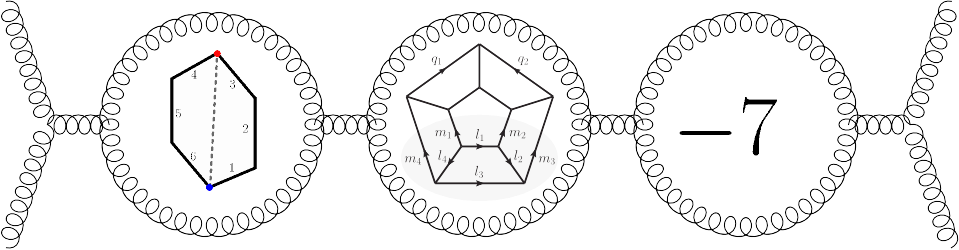
Monthly Archives: July 2013

Talks, and what they’re good for

It’s an ill-kept secret that basically everyone in academia is a specialist. Nobody is just a “physicist”, or just a “high energy theorist”, or even just a “string theorist”. Even when I describe myself as something as specific as an “amplitudeologist”, I’m still over-generalizing: there’s a lot of amplitudes work out there that I would be hard-pressed to understand, and even harder-pressed to reproduce.

In the end, each of us is only going to understand a small subset of the vastness of our subject. This is problematic when it comes to attending talks.

Rarely, we get to attend talks about something we completely understand. Generally, we’re the ones giving those talks. The rest of the time, even at conferences for people of our particular specialty, we’re going to miss some fraction of the content, either because we don’t understand it or because we don’t find it interesting.

The question then becomes, why attend the talk in the first place? Why spend an hour of your time when you’re not getting an hour’s worth of content?

There are a couple reasons, of varying levels of plausibility.

One is that it’s always nice to know what other subfields are doing. It lets one feel connected to one’s compatriots, and it helps one navigate one’s career. That said, it’s unclear whether going to talks is really the best way of doing this. If you just want to know what other people are doing, you can always just watch to see what they publish. That doesn’t take an hour, unless you’re really dedicated to wasting time.

A more important benefit is increasing levels of familiarity. These days, I can productively pay attention to the first quarter of a talk, half if it’s particularly good. When I first got to grad school, I’d probably tune out after the first five minutes. The more talks you see on a subject, the more of the talk makes sense, and the more you get out of it. That’s part of why even fairly specialized people who are further along in their careers can talk on a wide range of subjects: often, they’ve intentionally kept themselves aware of what’s going on in other subfields, going to talks, reading papers, and engaging in conversation. This is a valuable end goal, since there is some truth to the hype about the benefits of interdisciplinarity in providing unconventional solutions to problems. That said, this is a gradual process. The benefit of one individual talk is tiny, and it doesn’t seem worth an hour of time. Much like exercise, it’s the habit that provides the benefit, not any individual session.

So in the end, talks are almost always unsatisfying. But we keep going to them, because they make us better scientists.

Duality: Find out what it means to me

There’s a cute site out there called Why String Theory. Started by Oxford and the Royal Society, Why String Theory contains lots of concise and well-illustrated explanations of string theory, and it even wades into some of the more complex topics like AdS/CFT and string dualities in general. Their explanation of dualities is a nice introduction to why dualities matter in string theory, but I don’t think it does a very good job of explaining what a duality actually is or how one works. As your fearless host, I’m confident that I can do better.

Why String Theory defines dualities as when “different mathematical theories describe the same physics.” How does that work, though? In what sense are the theories different, if they describe the same thing? And if they describe the same thing, why do we need both of them?

1563px-face_or_vase_ata_01.svg_

You’ve probably seen the above image before, or one much like it. Look at it one way, and you see a goblet. Another, and you see two faces.

Now imagine that instead of a flat image, these are 3D objects, models you have in your house. You’ve got a goblet, and a pair of clay faces. You’re still pretty sure they fit together like they do in the image, though. Maybe they said they fit together on the packaging, maybe you stuck them together and it didn’t look like there were any gaps. Whatever the reason, you’re confident enough about this that you’re willing to assume it’s true.

Now suppose you want to figure out how long the noses on the faces are. In case you’ve never measured a human nose, I can let you know that it’s tricky. You could put a ruler along the nose, but it would be diagonal rather than straight, so you wouldn’t get an accurate measurement. Even putting the ruler beneath the nose doesn’t work for rounded noses like these.

That said, measuring the goblet is easy. You can run measuring tape around the neck of the goblet to find the circumference, and then calculate the diameter. And if you measure the goblet in this way, you also know how long the faces’ noses are.

You could go further, and build up a list of things you can measure on one object that tell you about the other one. The necks match up to the base of the goblet, the foreheads to the mouth, etc. It would be like a dictionary, translating between two languages: the language of measurements of the faces, and the language of measurements of the goblet.

That sort of “dictionary” is the essence of duality. When two theories have a duality (are dual to each other), you can make a “dictionary” to translate measurements in one theory to measurements in the other. That doesn’t mean, however, that the theories are clearly connected: like 3D models of the faces and the goblet, it may be that without looking at the particular “silhouette” defined by duality the two views are radically different. Rather than physical objects, the theories compare mathematical “objects”, so rather than physical obstructions like the solidity of noses we have to deal with mathematical ones, situations where one quantity or another is easier or harder to calculate depending on how the math is set up. For example, many dualities relate things that require calculations at very high loops to things that can be calculated with fewer loops (for an explanation of loops, check out this post).

As Why String Theory points out, one of the most prominent dualities is called AdS/CFT, and it relates N=4 super Yang-Mills (a Conformal Field Theory, or CFT) to string theory in something called Anti-de Sitter (AdS) space (tricky to describe, but essentially a world in which space is warped like a hyperbola). Another duality relates N=4 super Yang-Mills Feynman diagrams with n particles coming in from outside to diagrams with an n-sided shape and particles randomly coming in from the edges of the shape (these latter diagrams are called Wilson loops). In general N=4 super Yang-Mills is involved in many, many dualities, which is a big part of why it’s so dang cool.

Shout-Out for a Fellow Blogger

This is a blog about explaining science. Science is for everybody!

In particular, science is not just for geeks/those into geek culture. Nevertheless, I’m willing to bet that a substantial fraction of you are into something nerdy, whether sci-fi, fantasy, or one of the many genres and subgenres that have sprung up in the crazy genre jungles of the internet.

As such, some of you may be aware of Geek and Sundry, the Felicia Day-headed geek media mini-empire. They’re adding a set of new Vloggers (like bloggers but with video), and they’re running a contest to determine their lineup. And of these Vloggers, you should definitely vote for Kiri Callaghan.

I know Kiri as a kickass director from way back when I used to do community theatre stuff. These days, she’s running an extra-mini geek media empire of her own, centered around her blog. This blog somehow manages to update every weekday (and used to update every day), which as someone who updates once a week I can tell you is physically impossible, especially while also holding down a real job which she apparently does. She almost certainly owns a Time Turner or something.  So yeah, very impressive, and the high quality nerd stuff attached (check out some of her parody songs, in particular I Dreamed a Dream of Firefly) adds to the picture.

So for those in the audience who are into this sort of thing, vote for her! Comment on the video (apparently the scoring for this stage is based on interaction with commenters)! Join the facebook group to keep tabs on the competition!

You get paid to learn. How bad can that be?

In my “who am I” post, I describe being a grad student as like being an apprentice. I’d like to elaborate on that.

Ph.D. programs in the sciences are different at every school, but they have a few basic features. Generally you enter them with a bachelor’s degree from another university. The program lasts for somewhere between four and six years, longer for particularly unfortunate cases. Sometimes you get a Master’s degree after the first two years, sometimes you don’t, but you don’t usually have to get it from another school. Generally the first two years mostly involve taking courses while the later years are mostly research, but this can vary as well. And in general, once you’re in the program, you get paid: either as a Teaching Assistant, in which case you help grade papers, lead lab sections, and sometimes give lectures, or as a Research Assistant, in which you are paid to do research.

This last is occasionally confusing to people. If a Ph.D. student learns by doing research, then why are they also paid to do research? That sounds like not just getting your education for free, but being paid for it, which sounds at the very least like a very good deal.

There are two ways to think about the situation. One, as I mentioned in my “who am I” post, is as an apprenticeship. An apprentice is expected to learn on the job, and provided they learn enough they are eventually certified to work on their own. Despite this, an apprenticeship is still very much a job. An apprentice is subservient to their master, and can generally be counted upon to work on the master’s projects and help the master in their job. In much the same way, a Ph.D. student is not certified to work on their own until they graduate from the program and obtain their Ph.D. In the meantime they are subservient to their advisor, and they have to take their advisor’s desires into account when choosing research projects. In general, most of a grad student’s research projects will be part of their advisor’s research in one way or another, furthering their advisor’s goals. Beyond the research itself, grad students will often have other duties, depending on the nature of their advisor’s work, especially if their advisor has a lab with complicated equipment that needs to be maintained.

The other thing to realize is that grad students are, ostensibly, part-time workers. The university pays me for 20 hours a week of work. The thing is, though, I don’t just work part-time. I work full-time. I also work at home, on the weekends…whenever I can make progress on my research (and I’m not doing some side project like this blog or taking a needed sanity break), I work. So if I work 40 hours a week and am paid for 20, that means I am effectively spending half my income on education.

Not so free, is it?

It’s not as if any of us could just work less and take on another part-time job, either. Apart from the fact that many grad students are international students on visas that don’t allow them to get other jobs, it is research itself: keeping up, making progress, working towards graduating, that takes up so much of our time. To get any education out of the process at all, we have to be involved as much as possible.  So we are, inevitably, paying for our education. And hopefully, we’re getting something out of it.