Tag Archives: mathematics

How (Not) to Sum the Natural Numbers: Zeta Function Regularization

1+2+3+4+5+6+\ldots=-\frac{1}{12}

If you follow Numberphile on YouTube or Bad Astronomy on Slate you’ve already seen this counter-intuitive sum written out. Similarly, if you follow those people or Sciencetopia’s Good Math, Bad Math, you’re aware that the way that sum was presented by Numberphile in that video was seriously flawed.

There is a real sense in which adding up all of the natural numbers (numbers 1, 2, 3…) really does give you minus twelve, despite all the reasons this should be impossible. However, there is also a real sense in which it does not, and cannot, do any such thing. To explain this, I’m going to introduce two concepts: complex analysis and regularization.

This discussion is not going to be mathematically rigorous, but it should give an authentic and accurate view of where these results come from. If you’re interested in the full mathematical details, a later discussion by Numberphile should help, and the mathematically confident should read Terence Tao’s treatment from back in 2010.

With that said, let’s talk about sums! Well, one sum in particular:

\frac{1}{1^s}+\frac{1}{2^s}+\frac{1}{3^s}+\frac{1}{4^s}+\frac{1}{5^s}+\frac{1}{6^s}+\ldots = \zeta(s)

If s is greater than one, then each term in this infinite sum gets smaller and smaller fast enough that you can add them all up and get a number. That number is referred to as \zeta(s), the Riemann Zeta Function.

So what if s is smaller than one?

The infinite sum that I described doesn’t converge for s less than one. Add it up in any reasonable way, and it just approaches infinity. Put another way, the sum is not properly defined. But despite this, \zeta(s) is not infinite for s less than one!

Now as you might object, we only defined the Riemann Zeta Function for s greater than one. How do we know anything at all about it for s less than one?

That is where complex analysis comes in. Complex analysis sounds like a made-up term for something unreasonably complicated, but it’s quite a bit more approachable when you know what it means. Analysis is the type of mathematics that deals with functions, infinite series, and the basis of calculus. It’s often contrasted with Algebra, which usually considers mathematical concepts that are discrete rather than smooth (this definition is a huge simplification, but it’s not very relevant to this post). Complex means that complex analysis deals with functions, not of everyday real numbers, but of complex numbers, or numbers with an imaginary part.

So what does complex analysis say about the Riemann Zeta Function?

One of the most impressive results of complex analysis is the discovery that if a function of a complex number is sufficiently smooth (the technical term is analytic) then it is very highly constrained. In particular, if you know how the function behaves over an area (technical term: open set), then you know how it behaves everywhere else!

If you’re expecting me to explain why this is true, you’ll be disappointed. This is serious mathematics, and serious mathematics isn’t the sort of thing you can give the derivation for in a few lines. It takes as much effort and knowledge to replicate a mathematical result as it does to replicate many lab results in science.

What I can tell you is that this sort of approach crops up in many places, and is part of a general theme. There is a lot you can tell about a mathematical function just by looking at its behavior in some limited area, because mathematics is often much more constrained than it appears. It’s the same sort of principle behind the work I’ve been doing recently.

In the case of the Riemann Zeta Function, we have a definition for s greater than one. As it turns out, this definition still works if s is a complex number, as long as the real part of s is greater than one. Using this information, the value of the Riemann Zeta Function for a large area (half of the complex numbers), complex analysis tells us its value for every other number. In particular, it tells us this:

\zeta(-1)= -\frac{1}{12}

If the Riemann Zeta Function is consistently defined for every complex number, then it must have this value when s is minus one.

If we still trusted the sum definition for this value of s, we could plug in -1 and get

 1+2+3+4+5+6+\ldots=-\frac{1}{12}

Does that make this statement true? Sort of. It all boils down to a concept from physics called regularization.

In physics, we know that in general there is no such thing as infinity. With a few exceptions, nothing in nature should be infinite, and finite evidence (without mathematical trickery) should never lead us to an infinite conclusion.

Despite this, occasionally calculations in physics will give infinite results. Almost always, this is evidence that we are doing something wrong: we are not thinking hard enough about what’s really going on, or there is something we don’t know or aren’t taking into account.

Doing physics research isn’t like taking a physics class: sometimes, nobody knows how to do the problem correctly! In many cases where we find infinities, we don’t know enough about “what’s really going on” to correct them. That’s where regularization comes in handy.

Regularization is the process by which an infinite result is replaced with a finite result (made “regular”), in a way so that it keeps the same properties. These finite results can then be used to do calculations and make predictions, and so long as the final predictions are regularization independent (that is, the same if you had done a different regularization trick instead) then they are legitimate.

In string theory, one way to compute the required dimensions of space and time ends up giving you an infinite sum, a sum that goes 1+2+3+4+5+…. In context, this result is obviously wrong, so we regularize it. In particular, we say that what we’re really calculating is the Riemann Zeta Function, which we happen to be evaluating at -1. Then we replace 1+2+3+4+5+… with -1/12.

Now remember when I said that getting infinities is a sign that you’re doing something wrong? These days, we have a more rigorous way to do this same calculation in string theory, one that never forces us to take an infinite sum. As expected, it gives the same result as the old method, showing that the old calculation was indeed regularization independent.

Sometimes we don’t have a better way of doing the calculation, and that’s when regularization techniques come in most handy. A particular family of tricks called renormalization is quite important, and I’ll almost certainly discuss it in a future post.

So can you really add up all the natural numbers and get -1/12? No. But if a calculation tells you to add up all the natural numbers, and it’s obvious that the result can’t be infinite, then it may secretly be asking you to calculate the Riemann Zeta Function at -1. And that, as we know from complex analysis, is indeed -1/12.

Amplitudes on Paperscape

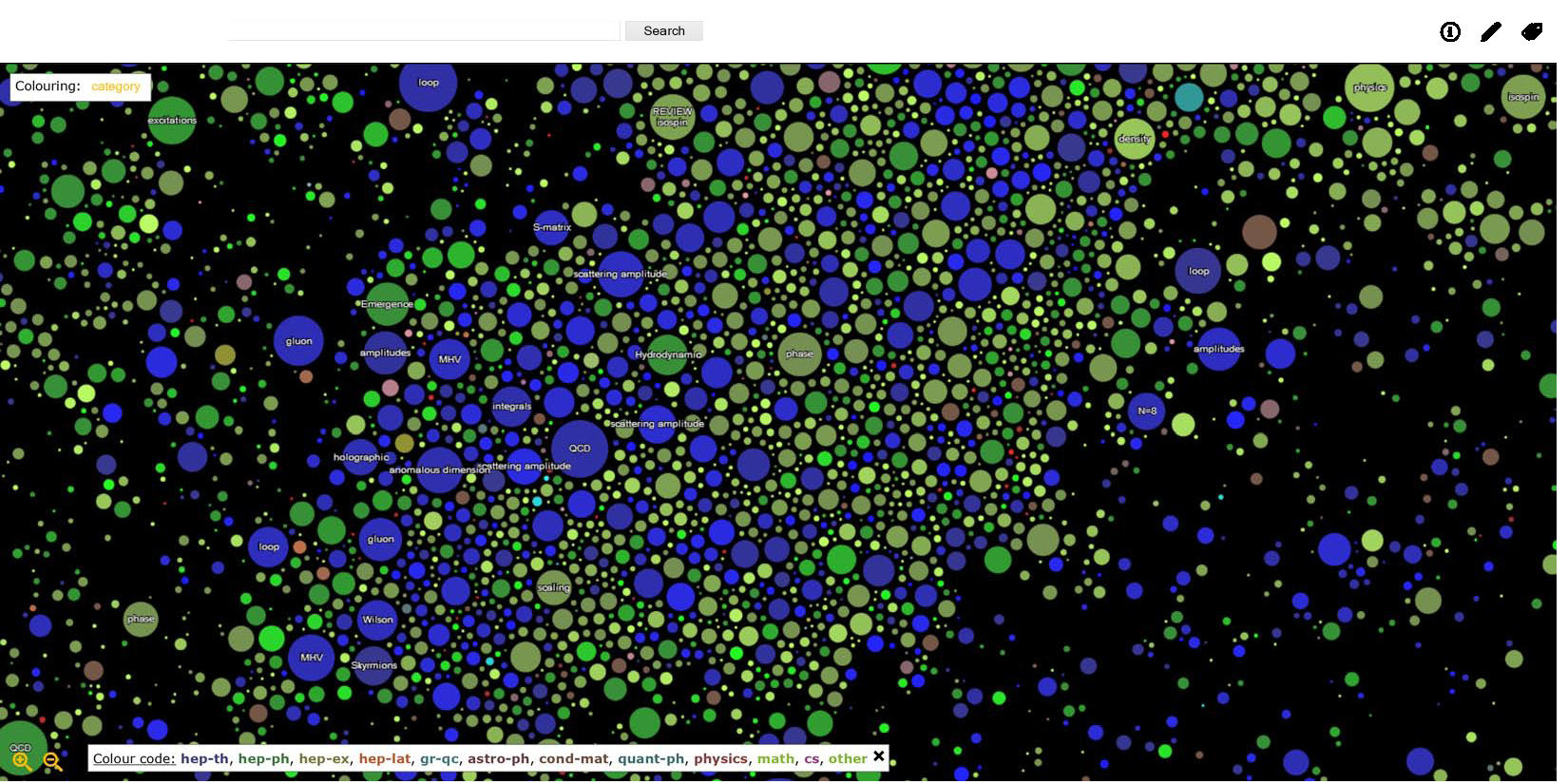
Paperscape is a very cool tool developed by Damien George and Rob Knegjens. It analyzes papers from arXiv, the paper repository where almost all physics and math papers live these days. By putting papers that cite each other closer together and pushing papers that don’t cite each other further apart, Paperscape creates a map of all the papers on arXiv, arranged into “continents” based on the links between them. Papers with more citations are shown larger, newer papers are shown brighter, and subject categories are indicated by color-coding.

Here’s a zoomed-out view:

PaperscapeFullMap

Already you can see several distinct continents, corresponding to different arXiv categories like high energy theory and astrophysics.

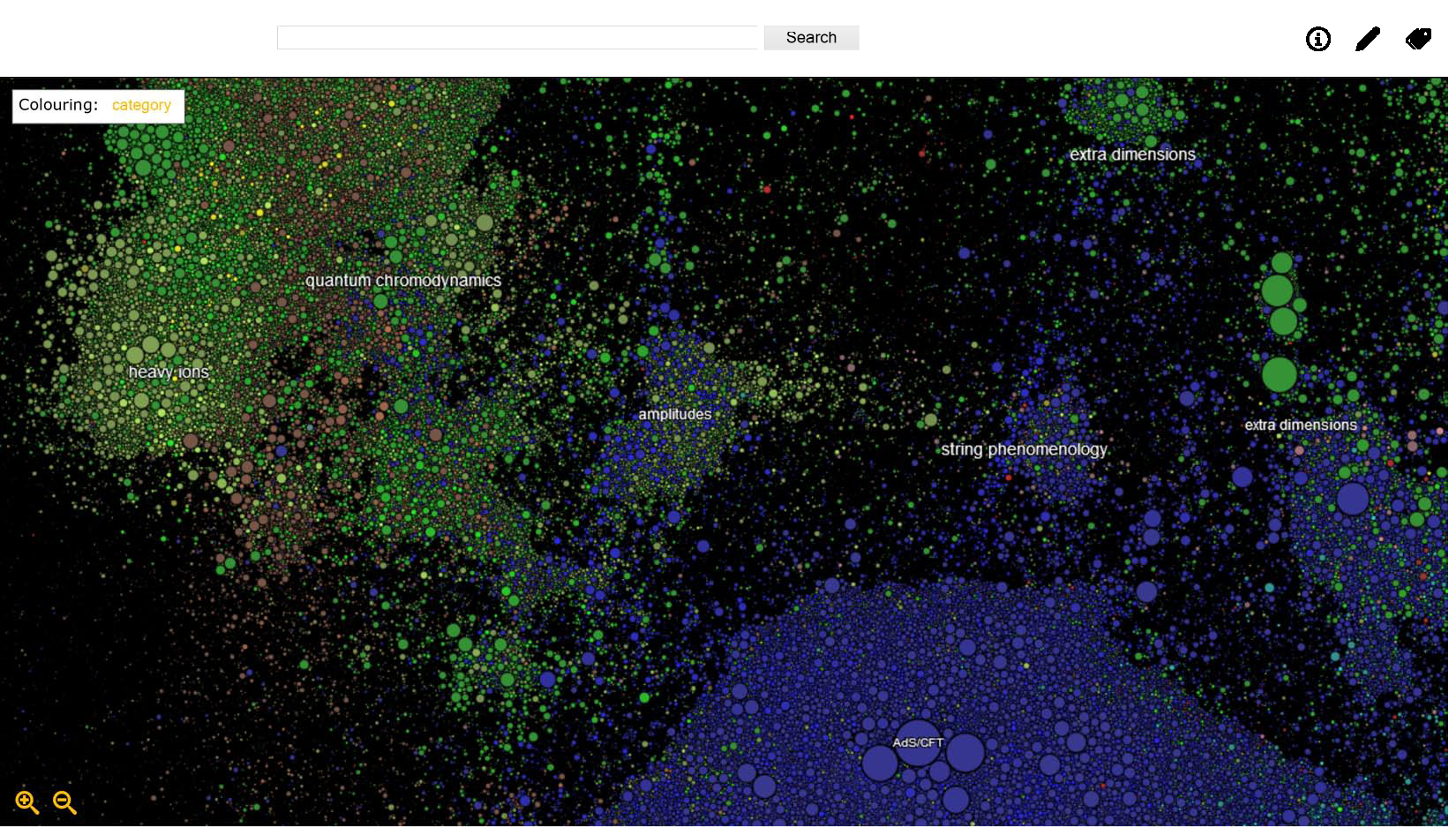
If you want to find amplitudes on this map, just zoom in between the purple continent (high energy theory, much of which is string theory) and the green one (high energy lattice, nuclear experiment, high energy experiment, and high energy phenomenology, broadly speaking these are all particle physics).

PaperscapeAmplitudesMap

When you zoom in, Paperscape shows words that commonly appear in a given region of papers. Zoomed in this far, you can see amplitudes!

Amplitudeologists like me live on an island between particle physics and string theory. We’re connected on both sides by bridges of citations and shared terms, linking us to people who study quarks and gluons on one side to people who study strings and geometry on the other. Think of us like Manhattan, an island between two shores, densely networked in to the surroundings.

PaperscapeZoomedMap

Zoom in further, and you can see common keywords for individual papers. Exploring around here shows not only what is getting talked about, but what sort of subjects as well. You can see by the color-coding that many papers in amplitudes are published as hep-th, or high energy theory, but there’s a fair number of papers from hep-ph (phenomenology) and from nuclear physics as well.

There’s a lot of interesting things you can do with Paperscape. You can search for individuals, or look at individual papers, seeing who they cite and who cite them. Try it out!

Elegance, Not So Mysterious

You’ll often hear theoretical physicists in the media referring to one theory or another as “elegant”. String theory in particular seems to get this moniker fairly frequently.

It may often seem like mathematical elegance is some sort of mysterious sixth sense theorists possess, as inexplicable to the average person as color to a blind person. What’s “elegant” about string theory, after all?

Before explaining elegance, I should take a bit of time to say what it’s not. Elegance isn’t Occam’s razor. It isn’t naturalness, either. Both of those concepts have their own technical definitions.

Elegance, by contrast, is a much hazier, and yet much simpler, notion. It’s hazy enough that any definition could provoke arguments, but I can at least give you an approximate idea by telling you that an elegant theory is simple to describe, if you know the right terms. Often, it is simpler than the phenomenon that it explains.

How does this apply to something like string theory? String theory seems to be incredibly complicated: ten dimensions, curled up in a truly vast number of different ways, giving rise to whole spectrums of particles.

That said, the basic idea is quite simple. String theory asks the question: what if, in addition to fundamental point-particles (zero dimensional objects), there were fundamental objects of other dimensions? That idea leads to complicated consequences: if your theory is going to produce all the particles of the real world then you need the ten dimensions and the supersymmetry and yadda yadda. But the basic idea is simple to describe. An elegant theory can have very complicated consequences, but still be simple to describe.

This, broadly, is the sort of explanation theoretical physicists look for. Math is the kind of field where the same basic systems can describe very complex phenomena. Since theoretical physics is about describing the world in terms of math, the right explanation is usually the most elegant.

This can occasionally trip physicists up when they migrate to other careers. In biology, for example, the elegant solution is often not the right one, because evolution doesn’t care about elegance: evolution just grabs whatever is within reach. Financial systems and economics occasionally have similar problems. All this is to say that while elegance is an important thing for a physicist to strive for, sometimes we have to be careful about it.

What’s up with arXiv?

First of all, I wanted to take a moment to say that this is the one-year anniversary of this blog. I’ve been posting every week, (almost always) on Friday, since I first was motivated to start blogging back in November 2012. It’s been a fun ride, through ups and downs, Ars Technica and Amplituhedra, and I hope it’s been fun for you, the reader, as well!

I’ve been giving links to arXiv since my very first post, but I haven’t gone into detail about what arXiv is. Since arXiv is a rather unique phenomenon, it could use a more full description.

arXivpic

The word arXiv is pronounced much like the normal word archive, just think of the capital X like a Greek letter Chi.

Much as the name would suggest, arXiv is an archive, specifically a preprint archive. A pre-print is in a sense a paper before it becomes a paper; more accurately, it is a scientific paper that has not yet been published in a journal. In the past, such preprints would be kept by individual universities, or passed between interested individuals. Now arXiv, for an increasing range of fields (first physics and mathematics, now also computer science, quantitative biology, quantitative finance, and statistics) puts all of the preprints in one easily accessible, free to access place.

Different fields have different conventions when it comes to using arXiv. As a theoretical physicist, I can only really speak to how we use the system.

When theoretical physicists write a paper, it is often not immediately clear which journal we should submit it to. Different journals have different standards, and a paper that will gather more interest can be published in a more prestigious journal. In order to gauge how much interest a paper will raise, most theoretical physicists will put their papers up on arXiv as preprints first, letting them sit there for a few months to drum up attention and get feedback before formally submitting the paper to a journal.

The arXiv isn’t just for preprints, though. Once a paper is published in a journal, a copy of the paper remains on arXiv. Often, the copy on arXiv will be updated when the paper is updated, changed to the journal’s preferred format and labeled with the correct journal reference. So arXiv, ultimately, contains almost all of the papers published in theoretical physics in the last decade or two, all free to read.

But it’s not just papers! The digital format of arXiv makes it much easier to post other files alongside a paper, so that many people upload not just their results, but the computer code they used to generate them, or their raw data in long files. You can also post papers too long or unwieldy to publish in a journal, making arXiv an excellent dropping-off point for information in whatever format you think is best.

We stand at the edge of a new age of freely accessible science. As more and more disciplines start to use arXiv and similar services, we’ll have more flexibility to get more information to more people, while still keeping the advantage of peer review for publication in actual journals. It’s going to be very interesting to see where things go from here.

Blackboards, Again

Recently I had the opportunity to give a blackboard talk. I’ve talked before about the value of blackboards, how they facilitate collaboration and can even be used to get work done. What I didn’t feel the need to explain was their advantages when giving a talk.

No, the blackboard behind me isn't my talk.

No, the blackboard behind me isn’t my talk.

When I mentioned I was giving a blackboard talk, some of my friends in other fields were incredulous.

“Why aren’t you using PowerPoint? Do you people hate technology?”

So why do theorists (and mathematicians) do blackboard talks, when many other fields don’t?

Typically, a chemist can’t bring chemicals to a talk. A biologist can’t bring a tank of fruit flies or zebrafish, and a psychologist probably shouldn’t bring in a passel of college student test subjects. As a theorist though, our test subjects are equations, and we can absolutely bring them into the room.

In the most ideal case, a talk by a theorist walks you through their calculation, reproducing it on the blackboard in enough detail that you can not only follow along, but potentially do the calculation yourself. While it’s possible to set up a calculation step by step in PowerPoint, you don’t have the same flexibility to erase and add to your equations, which becomes especially important if you need to clarify a point in response to a question.

Blackboards also often give you more space than a single slide. While your audience still only pays attention to a slide-sized area of the board at one time, you can put equations up in one area, move away, and then come back to them later. If you leave important equations up, people can remind themselves of them on their own time, without having to hold everybody up while you scroll back through the slides to the one they want to see.

Using a blackboard well is a fine art, and one I’m only beginning to learn. You have to know what to erase and what to leave up, when to pause to allow time to write or ask questions, and what to say while you’re erasing the board. You need to use all the quirks of the medium to your advantage, to show people not just what you did, but how and why you did it.

That’s why we use blackboards. And if you ask why we can’t do the same things with whiteboards, it’s because whiteboards are terrible. Everybody knows that.

Blackboards

As a college student, I already knew that theoretical physicists weren’t like how they were portrayed in movies. They didn’t wear lab coats, or have universally frizzy, unkempt white hair. I knew they didn’t have labs, or plot to take over the world. And I was pretty sure that they didn’t constantly use blackboards.

After all, blackboards are a teaching tool. They’re nice for getting equations up so that the guy way in the back can see them. But if you were actually doing a real calculation, surely you’d prefer paper, or a computer, or some other method that doesn’t involve an unkempt scrawl and a heap of loose white dust all over your clothing.

Right?

Right?

Over the last few years I’ve come to appreciate the value of blackboards. Blackboards actually can be used for calculations. You don’t want to use them all the time, but there are times when it’s useful to have a lot of room on a page, to be able to make notes and structure the board around concepts. More importantly, though, there is a third function that I didn’t even consider back in college. Between calculation and teaching, there is collaboration.

Go to a physics or math department, and you’ll find blackboards on the walls. You’ll find them not just in classrooms, but in offices, and occasionally in corridors. Go to a high-class physics location like the Perimeter Institute or the Simons Center, and they’ll brag to you about how many blackboards they have strewn around their common areas.

The purpose of these blackboards is to facilitate conversation. If you want to explain your work to someone else and you aren’t using a blog post, you need space to write in a way that you can both see what you’re doing. Blackboards are ideal for that sort of conversation, and as such are essential for collaboration and communication among scientists.

What about whiteboards? Well, whiteboards are just evil, obviously.

Achieving Transcendence: The Physicist Way

I wanted to shed some light on something I’ve been working on recently, but I realized that a little background was needed to explain some of the ideas. As such, this post is going to be a bit more math-y than usual, but I hope it’s educational!

Pi is special. Familiar to all through the area of a circle \pi r^2, pi is particularly interesting in that you cannot write an algebra equation made up of whole numbers whose solution is pi. While you can easily get fractions (3x=4 gives x=\frac{4}{3}) and even many irrational numbers (x^2=2 gives x=\sqrt{2}), pi is one of a set of numbers that it is impossible to get. These special numbers transcend other numbers, in that you cannot use more everyday numbers to get to them, and as such mathematicians call them transcendental numbers.

In addition to transcendental numbers, you can have transcendental functions. Transcendental functions are functions that can take in a normal number and produce a transcendental number. For example, you may be aware of the delightful equation below:

e^{i \pi}=-1

We can manipulate both sides of this equation by taking the natural logarithm, \ln, to find

i\pi=\ln(-1)

This tells us that the natural logarithm function can take a (negative) whole number (-1) and give us a transcendental number (pi). This means that the natural logarithm is a transcendental function.

There are many other transcendental functions. In addition to logarithms, there are a whole host of related functions called the polylogarithms, and even more generally the harmonic polylogarithms. All of these functions can take in whole numbers like -1 or 1 and give transcendental numbers.

Here physicists introduce a concept called degree of transcendentality, or transcendental weight, which we use to measure how transcendental a number or a function is. Pi (and functions that can give pi, like the natural logarithm) have transcendental weight one. Pi squared has transcendental weight two. Pi cubed (and another number called \zeta(3)) have transcendental weight three. And so on.

Note here that, according to mathematicians, there is no rigorous way that a number can be “more transcendental” than another number. In the case of some of these numbers, like \zeta(5), it hasn’t even been proven that the number is actually transcendental at all! However, physicists still use the concept of transcendental weight because it allows us to classify and manipulate a common and useful set of functions. This is an example of the differences in methods and standards between physicists and mathematicians, even when they are working on similar things.

In what way are these functions common and useful? Well it turns out that in N=4 super Yang-Mills many calculated results are not only made up of these polylogarithms, they have a particular (fixed) transcendental weight. In situations when we expect this to be true, we can use our knowledge to guess most, or even all, of the result without doing direct calculations. That’s immensely useful, and it’s a big part of what I’ve been doing recently.

Physics and its (Ridiculously One-Sided) Search for a Nemesis

Maybe it’s arrogance, or insecurity. Maybe it’s due to viewing themselves as the arbiters of good and bad science. Perhaps it’s just because, secretly, every physicist dreams of being a supervillain.

Physicists have a rivalry, you see. Whether you want to call it an archenemy, a nemesis, or even a kismesis, there is another field of study that physicists find so antithetical to everything they believe in that it crops up in their darkest and most shameful dreams.

What field of study? Well, pretty much all of them, actually.

Won’t you be my Kismesis?

Chemistry

A professor of mine once expressed the following sentiment:

“I have such respect for chemists. They accomplish so many things, while having no idea what they are doing!”

Disturbingly enough, he actually meant this as a compliment. Physicists’ relationship with chemists is a bit like a sibling rivalry. “Oh, isn’t that cute! He’s just playing with chemicals. Little guy doesn’t know anything about atoms, and yet he’s just sluggin’ away…wait, why is it working? What? How did you…I mean, I could have done that. Sure.”

Biology

They study all that weird, squishy stuff. They get to do better mad science. And somehow they get way more funding than us, probably because the government puts “improving lives” over “more particles”. Luckily, we have a solution to the problem.

Mathematics

Saturday Morning Breakfast Cereal has a pretty good take on this. Mathematicians are rigorous…too rigorous. They never let us have any fun, even when it’s totally fine, and everyone thinks they’re better than us. Well they’re not! Neener neener.

Computer Science

I already covered math, didn’t I?

Engineering

Think about how mathematicians think about physicists, and you’ll know how physicists think about engineers. They mangle our formulas, ignoring our pristine general cases for silly criteria like “ease of use” and “describing the everyday world”. Just lazy!

Philosophy

What do these guys even study? I mean, what’s the point of metaphysics? We’ve covered that, it’s called physics! And why do they keep asking what quantum mechanics means?

These guys have an annoying habit of pointing out moral issues with things like nuclear power plants and worry entirely too much about world-destroying black holes. They’re also our top competition for GRE scores.

Economics

So, what do you guys use real analysis for again? Pretending to be math-based science doesn’t make you rigorous, guys.

Psychology

We point out that surveys probably don’t measure anything, and that you can’t take the average of “agree” and “strongly agree”. Plus, if you’re a science, where is your F=ma?

They point out that we don’t actually know anything about how psychology research actually works, and that we seem to think that all psychologists are Freud. Then they ask us to look at just how fuzzy the plots we get from colliders actually are.

The argument escalates from there, often ending with frenzied makeout sessions.

Geology?  Astronomy?

Hey, we want a nemesis, but we’re not that desperate.eyH

Ansatz: Progress by Guesswork

I’ve talked before about how hard traditional Quantum Field Theory is. Building things up step by step is slow and inefficient. And like any slow and inefficient process, there is a quicker way. An easier way. A…riskier way.

You guess.

Guess is such an ugly word, though…so let’s call it an ansatz.

Ansatz is a word of German origin. In German, it is part of various idiomatic expressions, where it can refer to an approach, an attempt, or a starting point. When physicists and mathematicians use the term ansatz, they mean a combination of all of these.

An ansatz is an approach in that it is a way of finding a solution to a problem without using more general, inefficient methods. Rather than approaching problems starting from the question, an ansatz approaches problems by starting with an answer, or rather, an attempt at an answer.

An ansatz is an attempt in that it serves as researcher’s best first guess at what the answer is, based on what they know about it. This knowledge can come from several sources. Sometimes, the question constrains the answer, ruling out some possibilities or restricting the output to a particular form. Usually, though, the attempt of an ansatz goes beyond this, incorporating the scientist’s experience as to what sorts of answers similar questions have had in the past, even if it isn’t understood yet why those sorts of answers are common. With information from both of these sources, a scientist comes up with a preliminary guess, or ansatz, as to answer to the problem at hand.

What if the answer is wrong, though? The key here is that an ansatz is only a starting point. Rather than being a full answer with all the details filled in, an ansatz generally leaves some parameters free. These free parameters represent unknowns, and it is up to further tests to fix their values and complete the answer. These tests can be experimental, but they can also be mathematical: often there are restrictions on possible answers that are difficult to apply when creating a first guess, but easier to apply when one has only a few parameters to fix. In order to avoid the risk of finding an ansatz that only works by coincidence, many more tests are done than there are parameters. That way, if the guess behind the ansatz is wrong, then some of the tests will give contradictory rules for the values of the parameters, and you’ll know that it’s time to go back and find a better guess.

In the end, this approach, using your first attempt as a starting point, should end up with only a few parameters free, ideally none at all. One way or another, you have figured out a lot about your question just by guessing the answer!

The use of ansatzes is quite common in theoretical physics. Some of the most interesting problem either can’t be solved or are tedious to solve through traditional means. The only way to make progress, to go beyond what everyone else can already do, is to notice a pattern, make a guess, and hope you get lucky. Well, not just a guess: an ansatz.

Why I Am Not A Mathematician

(No relation to Russel’s Why I Am Not A Christian. Well, not much.)

I am a theorist. I study theories. Not the well-supported theories of the AAAS definition, but simply potential lists of particles, and lists that, further, are almost certainly not “true”.

Most people find that disconcerting. Used to thinking of scientists as people who investigate the real world, people whose ideas are always tested in the fire of experiment, the idea of a scientist whose work has no direct connection to the real world is a major source of cognitive dissonance…for at least a few minutes. After that, a light dawns in most people’s heads, as they turn to me with a sigh of relief and say,

“Oh. So you’re a Mathematician.”

No.

No, I am not a Mathematician. There is a difference, subtle but vast, between what I do and a mathematician does.

An illustrative example: Quantum Electro-Dynamics, or QED, is the most successful theory in the entirety of science. Yes, I do mean the entirety of science. Quantum Electro-Dynamics, the theory of how electrons and light behave, agrees with experiments to ten decimal places. Ten digits of detail, predicted then observed. That’s more confirmed accuracy than anything else in physics, in science at all, has ever achieved.

And if you ask a mathematician who specializes in this sort of thing, they’ll tell you that QED probably doesn’t exist.

Now, by this they don’t mean that electrons don’t exist, or that light doesn’t exist. What they mean is that, if you follow the theory’s implications all the way, you get a contradiction. You can calculate each step of the way, getting reasonable results each time, results that keep agreeing perfectly with experiments…but if you were to go all the way, off to infinity, you get results that make your whole theory stop making any sort of reasonable sense.

But as physicists, we keep using it. Because before reaching infinity, for any real calculation, it works. Perfectly.

That’s the difference between a theoretical physicist and a mathematician: for a mathematician, everything must be completely rigorous, and every implication, out to infinity, has to be vetted. For a physicist, if a theory gives reasonable results, we don’t really care whether it is completely clear how it works mathematically. We use physical reasoning, using concepts that work in the physical world, even if we’re studying a theory that doesn’t actually exist in the physical world. And while that sounds like a poor way to study abstract ideas, it allows us to take risks mathematicians can’t, which sometimes means we can make discoveries that even the mathematicians find interesting.