Tag Archives: Machine Learning

I’ve Felt Like a Hallucinating LLM

ChatGPT and its kin work by using Large Language Models, or LLMs.

A climate model is a pile of mathematics and code, honed on data from the climate of the past. Tell it how the climate starts out, and it will give you a prediction for what happens next.

Similarly, a language model is a pile of mathematics and code, honed on data from the texts of the past. Tell it how a text starts, and it will give you a prediction for what happens next.

We have a rough idea of what a climate model can predict. The climate has to follow the laws of physics, for example. Similarly, a text should follow the laws of grammar, the order of verbs and nouns and so forth. The creators of the earliest, smallest language models figured out how to do that reasonably well.

Texts do more than just follow grammar, though. They can describe the world. And LLMs are both surprisingly good and surprisingly bad at that. They can do a lot when used right, answering test questions most humans would struggle with. But they also “hallucinate”, confidently saying things that have nothing to do with reality.

If you want to understand why large language models make both good predictions and bad, you shouldn’t just think about abstract “texts”. Instead, think about a specific type of text: a story.

Stories follow grammar, most of the time. But they also follow their own logic. The hero sets out, saves the world, and returns home again. The evil queen falls from the tower at the climax of the final battle. There are three princesses, and only the third can break the spell.

We aren’t usually taught this logic, like we’re taught physics or grammar. We learn it from experience, from reading stories and getting used to patterns. It’s the logic, not of how a story must go, but of how a story typically goes. And that question, of what typically comes next, is exactly the question LLMs are designed to answer.

It’s also a question we sometimes answer.

I was a theatre kid, and I loved improv in particular. Some of it was improv comedy, the games and skits you might have seen on “Whose Line is it Anyway?” But some of it was more…hippy stuff.

I’d meet up with a group on Saturdays. One year we made up a creation myth, half-rehearsed and half-improvised, a collection of gods and primordial beings. The next year we moved the story forward. Civilization had risen…and fallen again. We played a group of survivors gathered around a campfire, wary groups wondering what came next.

We plotted out characters ahead of time. I was the “villain”, or the closest we had to one. An enforcer of the just-fallen empire, the oppressor embodied. While the others carried clubs, staves, and farm implements, I was the only one with a real weapon: a sword.

(Plastic in reality, but the audience knew what to do.)

In the arguments and recriminations of the story, that sword set me apart, a constant threat that turned my character from contemptible to dangerous, that gave me a seat at the table even as I antagonized and stirred the pot.

But the story had another direction. The arguments pushed and pulled, and gradually the survivors realized that they would not survive if they did not put their grievances to rest, if they did not seek peace. So, one man stepped forward, and tossed his staff into the fire.

The others followed. One by one, clubs and sticks and menacing tools were cast aside. And soon, I was the only one armed.

If I was behaving logically, if I followed my character’s interests, I would have “won” there. I had gotten what I wanted, now there was no check on my power.

But that wasn’t what the story wanted. Improv is a game of fast decisions and fluid invention. We follow our instincts, and our instincts are shaped by experience. The stories of the past guide our choices, and must often be the only guide: we don’t have time to edit, or to second-guess.

And I felt the story, and what it wanted. It was a command that transcended will, that felt like it left no room for an individual actor making an individual decision.

I cast my sword into the fire.

The instinct that brought me to do that is the same instinct that guides authors when they say that their characters write themselves, when their story goes in an unexpected direction. It’s an instinct that can be tempered and counteracted, with time and effort, because it can easily lead to nonsense. It’s why every good book needs an editor, why improv can be as repetitive as it is magical.

And it’s been the best way I’ve found to understand LLMs.

An LLM telling a story tells a typical story, based on the data used to create it. In the same way, an LLM giving advice gives typical advice, to some extent in content but more importantly in form, advice that is confident and mentions things advice often mentions. An LLM writing a biography will write a typical biography, which may not be your biography, even if your biography was one of those used to create it, because it tries to predict how a biography should go based on all the other biographies. And all of these predictions and hallucinations are very much the kind of snap judgement that disarmed me.

These days, people are trying to build on top of LLMs and make technology that does more, that can edit and check its decisions. For the most part, they’re building these checks out of LLMs. Instead of telling one story, of someone giving advice on the internet, they tell two stories: the advisor and the editor, one giving the advice and one correcting it. They have to tell these stories many times, broken up into many parts, to approximate something other than the improv actor’s first instincts, and that’s why software that does this is substantially more expensive than more basic software that doesn’t.

I can’t say how far they’ll get. Models need data to work well, decisions need reliability to be good, computers need infrastructure to compute. But if you want to understand what’s at an LLM’s beating heart, think about the first instincts you have in writing or in theatre, in stories or in play. Then think about a machine that just does that.
AI Can’t Do Science…And Neither Can Other Humans

Seen on Twitter:

I don’t know the context here, so I can’t speak to what Prof. Cronin meant. But it got me thinking.

Suppose you, like Prof. Cronin, were to insist that AI “cannot in principle” do science, because AI “is not autonomous” and “does not come up with its own problems to solve”. What might you mean?

You might just be saying that AI is bad at coming up with new problems to solve. That’s probably fair, at least at the moment. People have experimented with creating simple “AI researchers” that “study” computer programs, coming up with hypotheses about the programs’ performance and testing them. But it’s a long road from that to reproducing the much higher standards human scientists have to satisfy.

You probably don’t mean that, though. If you did, you wouldn’t have said “in principle”. You mean something stronger.

More likely, you might mean that AI cannot come up with its own problems, because AI is a tool. People come up with problems, and use AI to help solve them. In this perspective, not only is AI “not autonomous”, it cannot be autonomous.

On a practical level, this is clearly false. Yes, machine learning models, the core technology in current AI, are set up to answer questions. A user asks something, and receives the model’s prediction of the answer. That’s a tool, but for the more flexible models like GPT it’s trivial to turn it into something autonomous. Just add another program: a loop that asks the model what to do, does it, tells the model the result, and asks what to do next. Like taping a knife to a Roomba, you’ve made a very simple modification to make your technology much more dangerous.

You might object, though, that this simple modification of GPT is not really autonomous. After all, a human created it. That human had some goal, some problem they wanted to solve, and the AI is just solving the problem for them.

That may be a fair description of current AI, but insisting it’s true in principle has some awkward implications. If you make a “physics AI”, just tell it to do “good physics”, and it starts coming up with hypotheses you’d never thought of, is it really fair to say it’s just solving your problem?

What if the AI, instead, was a child? Picture a physicist encouraging a child to follow in their footsteps, filling their life with physics ideas and rhapsodizing about the hard problems of the field at the dinner table. Suppose the child becomes a physicist in turn, and finds success later in life. Were they really autonomous? Were they really a scientist?

What if the child, instead, was a scientific field, and the parent was the general public? The public votes for representatives, the representatives vote to hire agencies, and the agencies promise scientists they’ll give them money if they like the problems they come up with. Who is autonomous here?

(And what happens if someone takes a hammer to that process? I’m…still not talking about this! No-politics-rule still in effect, sorry! I do have a post planned, but it will have to wait until I can deal with the fallout.)

At this point, you’d probably stop insisting. You’d drop that “in principle”, and stick with the claim I started with, that current AI can’t be a scientist.

But you have another option.

You can accept the whole chain of awkward implications, bite all the proverbial bullets. Yes, you insist, AI is not autonomous. Neither is the physicist’s child in your story, and neither are the world’s scientists paid by government grants. Each is a tool, used by the one, true autonomous scientist: you.

You are stuck in your skull, a blob of curious matter trained on decades of experience in the world and pre-trained with a couple billion years of evolution. For whatever reason, you want to know more, so you come up with problems to solve. You’re probably pretty vague about those problems. You might want to see more pretty pictures of space, or wrap your head around the nature of time. So you turn the world into your tool. You vote and pay taxes, so your government funds science. You subscribe to magazines and newspapers, so you hear about it. You press out against the world, and along with the pressure that already exists it adds up, and causes change. Biological intelligences and artificial intelligences scurry at your command. From their perspective, they are proposing their own problems, much more detailed and complex than the problems you want to solve. But from yours, they’re your limbs beyond limbs, sight beyond sight, asking the fundamental questions you want answered.

Integration by Parts, Evolved

I posted what may be my last academic paper today, about a project I’ve been working on with Matthias Wilhelm for most of the last year. The paper is now online here. For me, the project has been a chance to broaden my horizons, learn new skills, and start to step out of my academic comfort zone. For Matthias, I hope it was grant money well spent.

I wanted to work on something related to machine learning, for the usual trendy employability reasons. Matthias was already working with machine learning, but was interested in pursuing a different question.

When is machine learning worthwhile? Machine learning methods are heuristics, unreliable methods that sometimes work well. You don’t use a heuristic if you have a reliable method that runs fast enough. But if all you have are heuristics to begin with, then machine learning can give you a better heuristic.

Matthias noticed a heuristic embedded deep in how we do particle physics, and guessed that we could do better. In particle physics, we use pictures called Feynman diagrams to predict the probabilities for different outcomes of collisions, comparing those predictions to observation to look for evidence of new physics. Each Feynman diagram corresponds to an integral, and for each calculation there are hundreds, thousands, or even millions of those integrals to do.

Luckily, physicists don’t actually have to do all those integrals. It turns out that most of them are related, by a slightly more advanced version of that calculus class mainstay, integration by parts. Using integration by parts you can solve a list of equations, finding out how to write your integrals in terms of a much smaller list.

How big a list of equations do you need, and which ones? Twenty-five years ago, Stefano Laporta proposed a “golden rule” to choose, based on his own experience, and people have been using it (more or less, with their own tweaks) since then.

Laporta’s rule is a heuristic, with no proof that it is the best option, or even that it will always work. So we probably shouldn’t have been surprised when someone came up with a better heuristic. Watching talks at a December 2023 conference, Matthias saw a presentation by Johann Usovitsch on a curious new rule. The rule was surprisingly simple, just one extra condition on top of Laporta’s. But it was enough to reduce the number of equations by a factor of twenty.

That’s great progress, but it’s also a bit frustrating. Over almost twenty-five years, no-one had guessed this one simple change?

Maybe, thought Matthias and I, we need to get better at guessing.

We started out thinking we’d try reinforcement learning, a technique where a machine is trained by playing a game again and again, changing its strategy when that strategy brings it a reward. We thought we could have the machine learn to cut away extra equations, getting rewarded if it could cut more while still getting the right answer. We didn’t end up pursuing this very far before realizing another strategy would be a better fit.

What is a rule, but a program? Laporta’s golden rule and Johann’s new rule could both be expressed as simple programs. So we decided to use a method that could guess programs.

One method stood out for sheer trendiness and audacity: FunSearch. FunSearch is a type of algorithm called a genetic algorithm, which tries to mimic evolution. It makes a population of different programs, “breeds” them with each other to create new programs, and periodically selects out the ones that perform best. That’s not the trendy or audacious part, though, people have been doing that sort of genetic programming for a long time.

The trendy, audacious part is that FunSearch generates these programs with a Large Language Model, or LLM (the type of technology behind ChatGPT). Using an LLM trained to complete code, FunSearch presents the model with two programs labeled v0 and v1 and asks it to complete v2. In general, program v2 will have some traits from v0 and v1, but also a lot of variation due to the unpredictable output of LLMs. The inventors of FunSearch used this to contribute the variation needed for evolution, using it to evolve programs to find better solutions to math problems.

We decided to try FunSearch on our problem, modifying it a bit to fit the case. We asked it to find a shorter list of equations, giving a better score for a shorter list but a penalty if the list wasn’t able to solve the problem fully.

Some tinkering and headaches later, it worked! After a few days and thousands of program guesses, FunSearch was able to find a program that reproduced the new rule Johann had presented. A few hours more, and it even found a rule that was slightly better!

But then we started wondering: do we actually need days of GPU time to do this?

An expert on heuristics we knew had insisted, at the beginning, that we try something simpler. The approach we tried then didn’t work. But after running into some people using genetic programming at a conference last year, we decided to try again, using a Python package they used in their work. This time, it worked like a charm, taking hours rather than days to find good rules.

This was all pretty cool, a great opportunity for me to cut my teeth on Python programming and its various attendant skills. And it’s been inspiring, with Matthias drawing together more people interested in seeing just how much these kinds of heuristic methods can do there. I should be clear though, that so far I don’t think our result is useful. We did better than the state of the art on an example, but only slightly, and in a way that I’d guess doesn’t generalize. And we needed quite a bit of overhead to do it. Ultimately, while I suspect there’s something useful to find in this direction, it’s going to require more collaboration, both with people using the existing methods who know better what the bottlenecks are, and with experts in these, and other, kinds of heuristics.

So I’m curious to see what the future holds. And for the moment, happy that I got to try this out!

Freelancing in [Country That Includes Greenland]

(Why mention Greenland? It’s a movie reference.)

I figured I’d give an update on my personal life.

A year ago, I resigned from my position in France and moved back to Denmark. I had planned to spend a few months as a visiting researcher in my old haunts at the Niels Bohr Institute, courtesy of the spare funding of a generous friend. There turned out to be more funding than expected, and what was planned as just a few months was extended to almost a year.

I spent that year learning something new. It was still an amplitudes project, trying to make particle physics predictions more efficient. But this time I used Python. I looked into reinforcement learning and PyTorch, played with using a locally hosted Large Language Model to generate random code, and ended up getting good results from a classic genetic programming approach. Along the way I set up a SQL database, configured Docker containers, and puzzled out interactions with CUDA. I’ve got a paper in the works, I’ll post about it when it’s out.

All the while, on the side, I’ve been seeking out stories. I’ve not just been a writer, but a journalist, tracking down leads and interviewing experts. I had three pieces in Quanta Magazine and one in Ars Technica.

Based on that, I know I can make money doing science journalism. What I don’t know yet is whether I can make a living doing it. This year, I’ll figure that out. With the project at the Niels Bohr Institute over, I’ll have more time to seek out leads and pitch to more outlets. I’ll see whether I can turn a skill into a career.

So if you’re a scientist with a story to tell, if you’ve discovered something or accomplished something or just know something that the public doesn’t, and that you want to share: do reach out. There’s a lot that can be of interest, passion that can be shared.

At the same time, I don’t know yet whether I can make a living as a freelancer. Many people try and don’t succeed. So I’m keeping my CV polished and my eyes open. I have more experience now with Data Science tools, and I’ve got a few side projects cooking that should give me a bit more. I have a few directions in mind, but ultimately, I’m flexible. I like being part of a team, and with enthusiastic and competent colleagues I can get excited about pretty much anything. So if you’re hiring in Copenhagen, if you’re open to someone with ten years of STEM experience who’s just starting to see what industry has to offer, then let’s chat. Even if we’re not a good fit, I bet you’ve got a good story to tell.

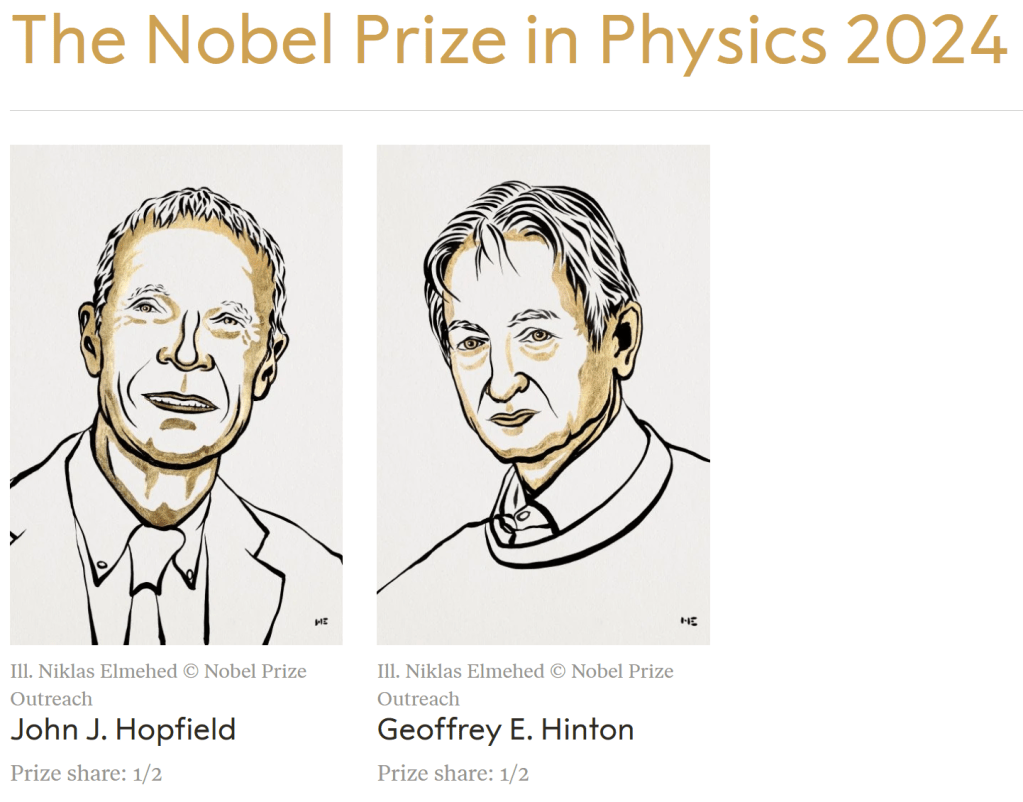
Congratulations to John Hopfield and Geoffrey Hinton!

The 2024 Physics Nobel Prize was announced this week, awarded to John Hopfield and Geoffrey Hinton for using physics to propose foundational ideas in the artificial neural networks used for machine learning.

If the picture above looks off-center, it’s because this is the first time since 2015 that the Physics Nobel has been given to two, rather than three, people. Since several past prizes bundled together disparate ideas in order to make a full group of three, it’s noteworthy that this year the committee decided that each of these people deserved 1/2 the prize amount, without trying to find one more person to water it down further.

Hopfield was trained as a physicist, working in the broad area known as “condensed matter physics”. Condensed matter physicists use physics to describe materials, from semiconductors to crystals to glass. Over the years, Hopfield started using this training less for the traditional subject matter of the field and more to study the properties of living systems. He moved from a position in the physics department of Princeton to chemistry and biology at Caltech. While at Caltech he started studying neuroscience and proposed what are now known as Hopfield networks as a model for how neurons store memory. Hopfield networks have very similar properties to a more traditional condensed matter system called a “spin glass”, and from what he knew about those systems Hopfield could make predictions for how his networks would behave. Those networks would go on to be a major inspiration for the artificial neural networks used for machine learning today.

Hinton was not trained as a physicist, and in fact has said that he didn’t pursue physics in school because the math was too hard! Instead, he got a bachelor’s degree in psychology, and a PhD in the at the time nascent field of artificial intelligence. In the 1980’s, shortly after Hopfield published his network, Hinton proposed a network inspired by a closely related area of physics, one that describes temperature in terms of the statistics of moving particles. His network, called a Boltzmann machine, would be modified and made more efficient over the years, eventually becoming a key part of how artificial neural networks are “trained”.

These people obviously did something impressive. Was it physics?

In 2014, the Nobel prize in physics was awarded to the people who developed blue LEDs. Some of these people were trained as physicists, some weren’t: Wikipedia describes them as engineers. At the time, I argued that this was fine, because these people were doing “something physicists are good at”, studying the properties of a physical system. Ultimately, the thing that ties together different areas of physics is training: physicists are the people who study under other physicists, and go on to collaborate with other physicists. That can evolve in unexpected directions, from more mathematical research to touching on biology and social science…but as long as the work benefits from being linked to physics departments and physics degrees, it makes sense to say it “counts as physics”.

By that logic, we can probably call Hopfield’s work physics. Hinton is more uncertain: his work was inspired by a physical system, but so are other ideas in computer science, like simulated annealing. Other ideas, like genetic algorithms, are inspired by biological systems: does that mean they count as biology?

Then there’s the question of the Nobel itself. If you want to get a Nobel in physics, it usually isn’t enough to transform the field. Your idea has to actually be tested against nature. Theoretical physics is its own discipline, with several ideas that have had an enormous influence on how people investigate new theories, ideas which have never gotten Nobels because the ideas were not intended, by themselves, to describe the real world. Hopfield networks and Boltzmann machines, similarly, do not exist as physical systems in the real world. They exist as computer simulations, and it is those computer simulations that are useful. But one can simulate many ideas in physics, and that doesn’t tend to be enough by itself to get a Nobel.

Ultimately, though, I don’t think this way of thinking about things is helpful. The Nobel isn’t capable of being “fair”, there’s no objective standard for Nobel-worthiness, and not much reason for there to be. The Nobel doesn’t determine which new research gets funded, nor does it incentivize anyone (except maybe Brian Keating). Instead, I think the best way of thinking about the Nobel these days is a bit like Disney.

When Disney was young, its movies had to stand or fall on their own merits. Now, with so many iconic movies in its history, Disney movies are received in the context of that history. Movies like Frozen or Moana aren’t just trying to be a good movie by themselves, they’re trying to be a Disney movie, with all that entails.

Similarly, when the Nobel was young, it was just another award, trying to reward things that Alfred Nobel might have thought deserved rewarding. Now, though, each Nobel prize is expected to be “Nobel-like”, an analogy between each laureate and the laureates of the past. When new people are given Nobels the committee is on some level consciously telling a story, saying that these people fit into the prize’s history.

This year, the Nobel committee clearly wanted to say something about AI. There is no Nobel prize for computer science, or even a Nobel prize for mathematics. (Hinton already has the Turing award, the most prestigious award in computer science.) So to say something about AI, the Nobel committee gave rewards in other fields. In addition to physics, this year’s chemistry award went in part to the people behind AlphaFold2, a machine learning tool to predict what shapes proteins fold into. For both prizes, the committee had a reasonable justification. AlphaFold2 genuinely is an amazing advance in the chemistry of proteins, a research tool like nothing that came before. And the work of Hopfield and Hinton did lead ideas in physics to have an enormous impact on the world, an impact that is worth recognizing. Ultimately, though, whether or not these people should have gotten the Nobel doesn’t depend on that justification. It’s an aesthetic decision, one that (unlike Disney’s baffling decision to make live-action remakes of their most famous movies) doesn’t even need to impress customers. It’s a question of whether the action is “Nobel-ish” enough, according to the tastes of the Nobel committee. The Nobel is essentially expensive fanfiction of itself.

And honestly? That’s fine. I don’t think there’s anything else they could be doing at this point.

At Quanta This Week, With a Piece on Multiple Imputation

I’ve got another piece in Quanta Magazine this week.

While my past articles in Quanta have been about physics, this time I’m stretching my science journalism muscles in a new direction. I was chatting with a friend who works for a pharmaceutical company, and he told me about a statistical technique that sounded ridiculous. Luckily, he’s a patient person, and after annoying him and a statistician family member for a while I understood that the technique actually made sense. Since I love sharing counterintuitive facts, I thought this would be a great story to share with Quanta’s readers. I then tracked down more statisticians, and annoyed them in a more professional way, finally resulting in the Quanta piece.

The technique is called multiple imputation, and is a way to deal with missing data. By filling in (“imputing”) missing information with good enough guesses, you can treat a dataset with missing data as if it was complete. If you do this imputation multiple times with the help of a source of randomness, you can also model how uncertain those guesses are, so your final statistical estimates are as uncertain as they ought to be. That, in a nutshell, is multiple imputation.

In the piece, I try to cover the key points: how the technique came to be, how it spread, and why people use it. To complement that, in this post I wanted to get a little bit closer to the technical details, and say a bit about why some of the workarounds a naive physicist would come up with don’t actually work.

If you’re anything like me, multiple imputation sounds like a very weird way to deal with missing data. In order to fill in missing data, you have to use statistical techniques to find good guesses. Why can’t you just use the same techniques to analyze the data in the first place? And why do you have to use a random number generator to model your uncertainty, instead of just doing propagation of errors?

It turns out, you can sort of do both of these things. Full Information Maximum Likelihood is a method where you use all the data you have, and only the data you have, without imputing anything or throwing anything out. The catch is that you need a model, one with parameters you can try to find the most likely values for. Physicists usually do have a model like this (for example, the Standard Model), so I assumed everyone would. But for many things you want to measure in social science and medicine, you don’t have any such model, so multiple imputation ends up being more versatile in practice.

(If you want more detail on this, you need to read something written by actual statisticians. The aforementioned statistician family member has a website here that compares and contrasts multiple imputation with full information maximum likelihood.)

What about the randomness? It turns out there is yet another technique, called Fractional Imputation. While multiple imputation randomly chooses different values to impute, fractional imputation gives each value a weight based on the chance for it to come up. This gives the same result…if you can compute the weights, and store all the results. The impression I’ve gotten is that people are working on this, but it isn’t very well-developed.

“Just do propagation of errors”, the thing I wanted to suggest as a physicist, is much less of an option. In many of these datasets, you don’t attribute errors to the base data points to begin with. And on the other hand, if you want to be more sophisticated, then something like propagation of errors is too naive. You have a variety of different variables, correlated with each other in different ways, giving a complicated multivariate distribution. Propagation of errors is already pretty fraught when you go beyond linear relationships (something they don’t tend to tell baby physicists), using it for this would be pushing it rather too far.

The thing I next wanted to suggest, “just carry the distribution through the calculation”, turns out to relate to something I’ve called the “one philosophical problem of my sub-field”. In the area of physics I’ve worked in, a key question is what it means to have “done” an integral. Here, one can ask what it means to do a calculation on a distribution. In both cases, the end goal is to get numbers out: physics predictions on the one hand, statistical estimates on the other. You can get those numbers by “just” doing numerics, using randomness and approximations to estimate the number you’re interested in. And in a way, that’s all you can do. Any time you “just do the integral” or “just carry around the distribution”, the thing you get in the end is some function: it could be a well-understood function like a sine or log, or it could be an exotic function someone defined for that purpose. But whatever function you get, you get numbers out of it the same way. A sine or a log, on a computer, is just an approximation scheme, a program that outputs numbers.

(But we do still care about analytic results, we don’t “just” do numerics. That’s because understanding the analytics helps us do numerics better, we can get more precise numbers faster and more stably. If you’re just carrying around some arbitrarily wiggly distribution, it’s not clear you can do that.)

So at this point, I get it. I’m still curious to see how Fractional Imputation develops, and when I do have an actual model I’d lean to wanting to use Full Information Maximum Likelihood instead. (And there are probably some other caveats I may need to learn at some point!) But I’m comfortable with the idea that Multiple Imputation makes sense for the people using it.

The Mistakes Are the Intelligence

There’s a lot of hype around large language models, the foundational technology behind services like ChatGPT. Representatives of OpenAI have stated that, in a few years, these models might have “PhD-level intelligence“. On the other hand, at the time, ChatGPT couldn’t count the number of letter “r”s in the word “strawberry”. The model and the setup around it has improved, and GPT-4o1 apparently now gets the correct 3 “r”s…but I’m sure it makes other silly mistakes, mistakes an intelligent human would never make.

The mistakes made by large language models are important, due to the way those models are used. If people are going to use them for customer service, writing transcripts, or editing grammar, they don’t want to introduce obvious screwups. (Maybe this means they shouldn’t use the models this way!)

But the temptation is to go further, to say that these mistakes are proof that these models are, and will always be, dumb, not intelligent. And that’s not the right way to think about intelligence.

When we talk about intelligent people, when we think about measuring things like IQ, we’re looking at a collection of different traits. These traits typically go together in humans: a human who is good at one will usually be good at the others. But from the perspective of computer science, these traits are very different.

Intelligent people tend to be good at following complex instructions. They can remember more, and reason faster. They can hold a lot in their head at once, from positions of objects to vocabulary.

These are all things that computers, inherently, are very good at. When Turing wrote down his abstract description of a computer, he imagined a machine with infinite memory, able to follow any instructions with perfect fidelity. Nothing could live up to that ideal, but modern computers are much closer to it than humans. “Computer” used to be a job, with rooms full of people (often women) hired to do calculations for scientific projects. We don’t do that any more, machines have made that work superfluous.

What’s more, the kind of processing a Turing machine does is probably the only way to reliably answer questions. If you want to make sure you get the correct answer every time, then it seems that you can’t do better than to use a sufficiently powerful computer.

But while computer-the-machine replaced computer-the-job, mathematician-the-job still exists. And that’s because not all intelligence is about answering questions reliably.

Alexander Grothendieck was a famous mathematician, known for his deep insights and powerful ideas. According to legend, when giving a talk referring to prime numbers, someone in the audience asked him to name a specific prime. He named 57.

With a bit of work, any high-school student can figure out that 57, which equals 3 times 19, isn’t a prime number. A computer can easily figure out that 57 is not a prime number. Even ChatGPT knows that 57 is not a prime number.

But this doesn’t mean that Grothendieck was dumber than a high school student, or dumber than ChatGPT. Grothendieck was using a different kind of intelligence, the heuristic kind.

Heuristics are unreliable reasoning. They’re processes that get the right answer some of the time, but not all of the time. Because of that, though, they don’t have the same limits as reliable computer programs. Pick the right situation and the right conditions, and a heuristic can give you an answer faster than you could possibly get by following reliable rules.

Intelligent humans follow instructions well, but they also have good heuristics. They solve problems creatively, sometimes problems that are very hard for computers to address. People like Grothendieck make leaps of mathematical reasoning, guessing at the right argument before they have completely fleshed out a proof. This kind of intelligence is error-prone: rely on it, and you might claim 57 is prime. But at the moment, it’s our only intellectual advantage over machines.

Ultimately, ChatGPT is an advance in language processing, and language is a great example. Sentences don’t have definite meaning, we interpret what we read and hear in context, and sometimes our interpretation is wrong. Sometimes we hear words no-one actually said! It’s impossible, both for current technology and for the human brain, to process general text in a 100% reliable way. So large language models like GPT don’t do it reliably. They use an approximate model, a big complicated pile of rules tweaked over and over again until, enough of the time, they get the next word right in a text.

The kind of heuristic reasoning done by large language models is more effective than many people expected. Being able to predict the next word in a text unreliably also means you can write code unreliably, or count things unreliably, or do math unreliably. You can’t do any of these things as well as an appropriately-chosen human, at least not with current resources.

But in the longer run, heuristic intelligence is precisely the type of intelligence we should aspire to…or fear. Right now, we hire humans to do intellectual work because they have good heuristics. If we could build a machine with equivalent or better heuristics for those tasks, then people would hire a lot fewer humans. And if you’re worried about AI taking over the world, you’re worried about AI coming up with shortcuts to our civilization, tricks we couldn’t anticipate or plan against that destroy everything we care about. Those tricks can’t come from following rules: if they did, we could discover them just as easily. They would have to come from heuristics, sideways solutions that don’t work all the time but happen to work the one time that matters.

So yes, until the latest release, ChatGPT couldn’t tell you how many “r”s are in “strawberry”. Counting “r”s is something computers could already do, because it’s something that can be done by following reliable rules. It’s also something you can do easily, if you follow reliable rules. ChatGPT impresses people because it can do some of the things you do, that can’t be done with reliable rules. If technology like it has any chance of changing the world, those are the kinds of things it will have to be able to do.

The Machine Learning for Physics Recipe

Last week, I went to a conference on machine learning for physics. Machine learning covers a huge variety of methods and ideas, several of which were on full display. But again and again, I noticed a pattern. The people who seemed to be making the best use of machine learning, the ones who were the most confident in their conclusions and getting the most impressive results, the ones who felt like they had a whole assembly line instead of just a prototype, all of them were doing essentially the same thing.

This post is about that thing. If you want to do machine learning in physics, these are the situations where you’re most likely to see a benefit. You can do other things, and they may work too. But this recipe seems to work over and over again.

First, you need simulations, and you need an experiment.

Your experiment gives you data, and that data isn’t easy to interpret. Maybe you’ve embedded a bunch of cameras in the antarctic ice, and your data tells you when they trigger and how bright the light is. Maybe you’ve surrounded a particle collision with layers silicon, and your data tells you how much electric charge the different layers absorb. Maybe you’ve got an array of telescopes focused on a black hole far far away, and your data are pixels gathered from each telescope.

You want to infer, from your data, what happened physically. Your cameras in the ice saw signs of a neutrino, you want to know how much energy it had and where it was coming from. Your silicon is absorbing particles, what kind are they and what processes did they come from? The black hole might have the rings predicted by general relativity, but it might have weirder rings from a variant theory.

In each case, you can’t just calculate the answer you need. The neutrino streams past, interacting with the ice and camera positions in unpredictable ways. People can write down clean approximations for particles in the highest-energy part of a collision, but once they start cooling down the process becomes so messy that no straightforward formula describes them. Your array of telescopes fuzz and pixellate and have to be assembled together in a complicated way, so that there is no one guaranteed answer you can find to establish what they saw.

In each case, though, you can use simulations. If you specify in advance the energy and path of the neutrino, you can use a computer to predict how much light your cameras should see. If you know what particles you started with, you can run sophisticated particle physics code to see what “showers” of particles you eventually find. If you have the original black hole image, you can fuzz and pixellate and take it apart to match what your array of telescopes will do.

The problem is, for the experiments, you can’t anticipate, and you don’t know in advance. And simulations, while cheaper than experiments, aren’t cheap. You can’t run a simulation for every possible input and then check them against the experiments. You need to fill in the gaps, run some simulations and then use some theory, some statistical method or human-tweaked guess, to figure out how to interpret your experiments.

Or, you can use Machine Learning. You train a machine learning model, one well-suited the task (anything from the old standby of boosted decision trees to an old fad of normalizing flows to the latest hotness of graph neural networks). You run a bunch of simulations, as many as you can reasonably afford, and you use that data for training, making a program that matches the input data you want to find with its simulated results. This program will be less reliable than your simulations, but it will run much faster. If it’s reliable enough, you can use it instead of the old human-made guesses and tweaks. You now have an efficient, reliable way to go from your raw experiment data to the physical questions you actually care about.

Crucially, each of the elements in this recipe is essential.

You need a simulation. If you just have an experiment with no simulation, then you don’t have a way to interpret the results, and training a machine to reproduce the experiment won’t tell you anything new.

You need an experiment. If you just have simulations, training a machine to reproduce them also doesn’t tell you anything new. You need some reason to want to predict the results of the simulations, beyond just seeing what happens in between which the machine can’t tell you.

And you need to not have anything better than the simulation. If you have a theory where you can write out formulas for what happens then you don’t need machine learning, you can interpret the experiments more easily without it. This applies if you’ve carefully designed your experiment to measure something easy to interpret, like the ratio of rates of two processes that should be exactly the same.

These aren’t the only things you need. You also need to do the whole thing carefully enough that you understand well your uncertainties, not just what the machine predicts but how often it gets it wrong, and whether it’s likely to do something strange when you use it on the actual experiment. But if you can do that, you have a reliable recipe, one many people have followed successfully before. You have a good chance of making things work.

This isn’t the only way physicists can use machine learning. There are people looking into something more akin to what’s called unsupervised learning, where you look for strange events in your data as clues for what to investigate further. And there are people like me, trying to use machine learning on the mathematical side, to guess new formulas and new heuristics. There is likely promise in many of these approaches. But for now, they aren’t a recipe.

HAMLET-Physics 2024

Back in January, I announced I was leaving France and leaving academia. Since then, it hasn’t made much sense for me to go to conferences, even the big conference of my sub-field or the conference I organized.

I did go to a conference this week, though. I had two excuses:

  1. The conference was here in Copenhagen, so no travel required.
  2. The conference was about machine learning.

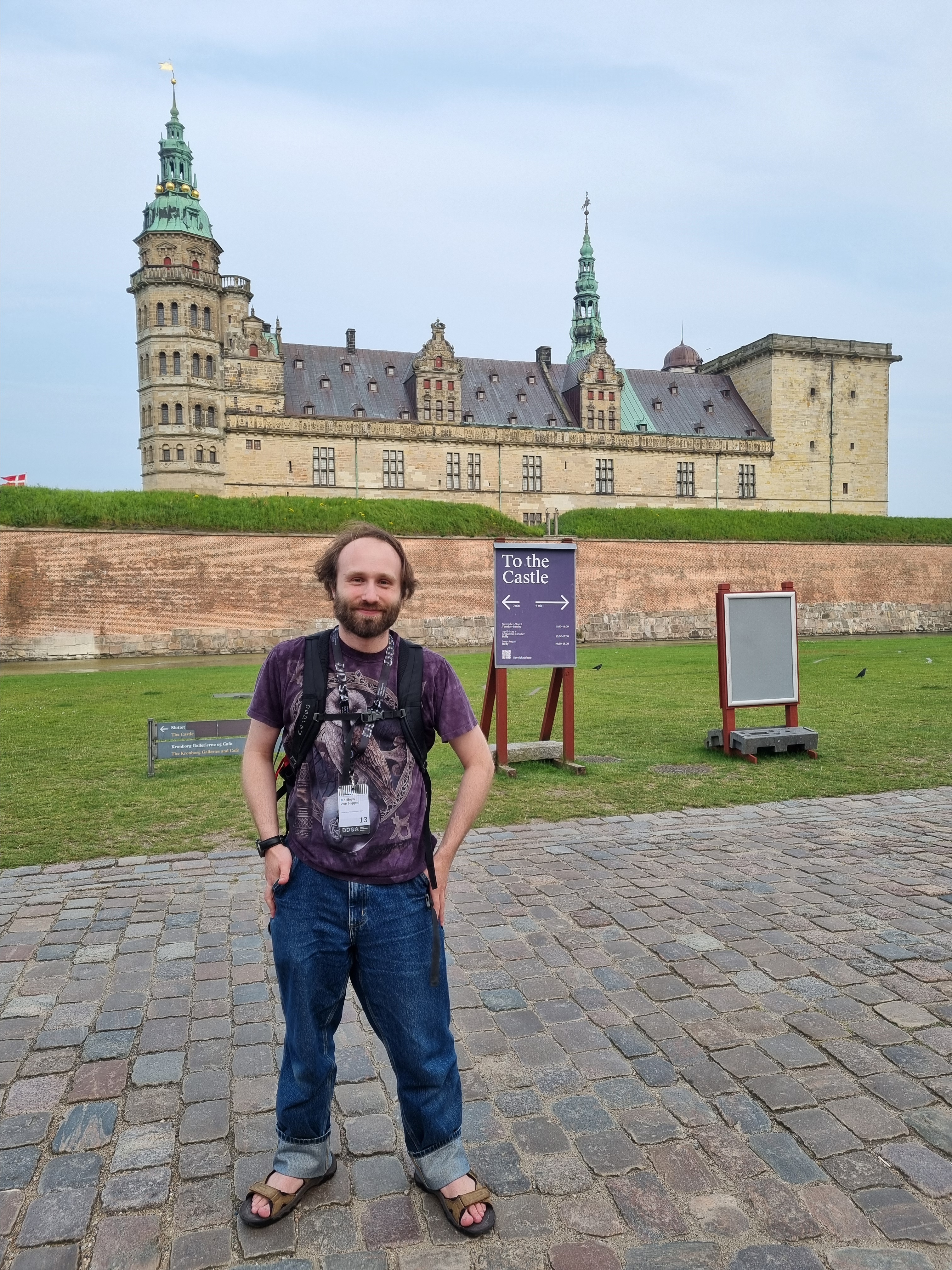
HAMLET-Physics, or How to Apply Machine Learning to Experimental and Theoretical Physics, had the additional advantage of having an amusing acronym. Thanks to generous support by Carlsberg and the Danish Data Science Academy, they could back up their choice by taking everyone on a tour of Kronborg (better known in the English-speaking world as Elsinore).

This conference’s purpose was to bring together physicists who use machine learning, machine learning-ists who might have something useful to say to those physicists, and other physicists who don’t use machine learning yet but have a sneaking suspicion they might have to at some point. As a result, the conference was super-interdisciplinary, with talks by people addressing very different problems with very different methods.

Interdisciplinary conferences are tricky. It’s easy for the different groups of people to just talk past each other: everyone shows up, gives the same talk they always do, socializes with the same friends they always meet, then leaves.

There were a few talks that hit that mold, and were so technical only a few people understood. But most were better. The majority of the speakers did really well at presenting their work in a way that would be understandable and even exciting to people outside their field, while still having enough detail that we all learned something. I was particularly impressed by Thea Aarestad’s keynote talk on Tuesday, a really engaging view of how machine learning can be used under the extremely tight time constraints LHC experiments need to decide whether to record incoming data.

For the social aspect, the organizers had a cute/gimmicky/machine-learning-themed solution. Based on short descriptions and our public research profiles, they clustered attendees, plotting the connections between them. They then used ChatGPT to write conversation prompts between any two people on the basis of their shared interests. In practice, this turned out to be amusing but totally unnecessary. We were drawn to speak to each other not by conversation prompts, but by a drive to learn from each other. “Why do you do it that way?” was a powerful conversation-starter, as was “what’s the best way to do this?” Despite the different fields, the shared methodologies gave us strong reasons to talk, and meant that people were very rarely motivated to pick one of ChatGPT’s “suggestions”.

Overall, I got a better feeling for how machine learning is useful in physics (and am planning a post on that in future). I also got some fresh ideas for what to do myself, and a bit of a picture of what the future holds in store.

(Not At) Amplitudes 2024 at the IAS

For over a decade, I studied scattering amplitudes, the formulas particle physicists use to find the probability that particles collide, or scatter, in different ways. I went to Amplitudes, the field’s big yearly conference, every year from 2015 to 2023.

This year is different. I’m on the way out of the field, looking for my next steps. Meanwhile, Amplitudes 2024 is going full speed ahead at the Institute for Advanced Study in Princeton.

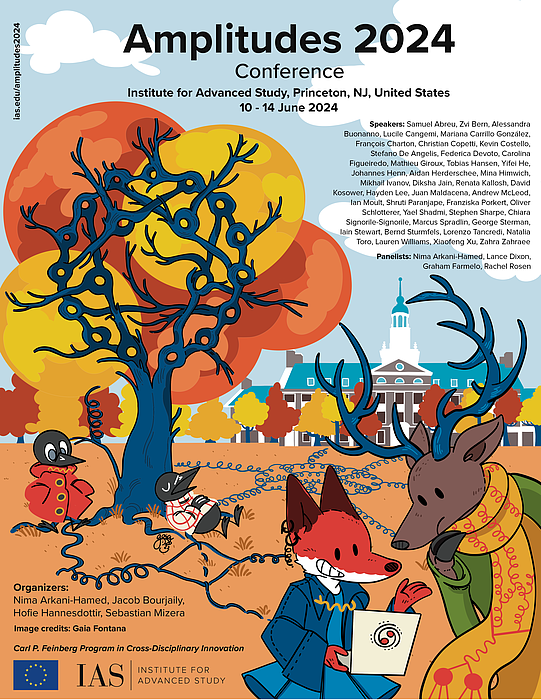
With poster art that is, as the kids probably don’t say anymore, “on fleek”

The talks aren’t live-streamed this year, but they are posting slides, and they will be posting recordings. Since a few of my readers are interested in new amplitudes developments, I’ve been paging through the posted slides looking for interesting highlights. So far, I’ve only seen slides from the first few days: I will probably write about the later talks in a future post.

Each day of Amplitudes this year has two 45-minute “review talks”, one first thing in the morning and the other first thing after lunch. I put “review talks” in quotes because they vary a lot, between talks that try to introduce a topic for the rest of the conference to talks that mostly focus on the speaker’s own research. Lorenzo Tancredi’s talk was of the former type, an introduction to the many steps that go into making predictions for the LHC, with a focus on those topics where amplitudeologists have made progress. The talk opens with the type of motivation I’d been writing in grant and job applications over the last few years (we don’t know most of the properties of the Higgs yet! To measure them, we’ll need to calculate amplitudes with massive particles to high precision!), before moving into a review of the challenges and approaches in different steps of these calculations. While Tancredi apologizes in advance that the talk may be biased, I found it surprisingly complete: if you want to get an idea of the current state of the “LHC amplitudes pipeline”, his slides are a good place to start.

Tancredi’s talk serves as introduction for a variety of LHC-focused talks, some later that day and some later in the week. Federica Devoto discussed high-energy quarks while Chiara Signorile-Signorile and George Sterman showed advances in handling of low-energy particles. Xiaofeng Xu has a program that helps predict symbol letters, the building-blocks of scattering amplitudes that can be used to reconstruct or build up the whole thing, while Samuel Abreu talked about a tricky state-of-the-art case where Xu’s program misses part of the answer.

Later Monday morning veered away from the LHC to focus on more toy-model theories. Renata Kallosh’s talk in particular caught my attention. This blog is named after a long-standing question in amplitudes: will the four-graviton amplitude in N=8 supergravity diverge at seven loops in four dimensions? This seemingly arcane question is deep down a question about what is actually required for a successful theory of quantum gravity, and in particular whether some of the virtues of string theory can be captured by a simpler theory instead. Answering the question requires a prodigious calculation, and the more “loops” are involved the more difficult it is. Six years ago, the calculation got to five loops, and it hasn’t passed that mark since then. That five-loop calculation gave some reason for pessimism, a nice pattern at lower loops that stopped applying at five.

Kallosh thinks she has an idea of what to expect. She’s noticed a symmetry in supergravity, one that hadn’t previously been taken into account. She thinks that symmetry should keep N=8 supergravity from diverging on schedule…but only in exactly four dimensions. All of the lower-loop calculations in N=8 supergravity diverged in higher dimensions than four, and it seems like with this new symmetry she understands why. Her suggestion is to focus on other four-dimensional calculations. If seven loops is still too hard, then dialing back the amount of supersymmetry from N=8 to something lower should let her confirm her suspicions. Already a while back N=5 supergravity was found to diverge later than expected in four dimensions. She wants to know whether that pattern continues.

(Her backup slides also have a fun historical point: in dimensions greater than four, you can’t get elliptical planetary orbits. So four dimensions is special for our style of life.)

Other talks on Monday included a talk by Zahra Zahraee on progress towards “solving” the field’s favorite toy model, N=4 super Yang-Mills. Christian Copetti talked about the work I mentioned here, while Meta employee François Charlton’s “review talk” dealt with his work applying machine learning techniques to “translate” between questions in mathematics and their answers. In particular, he reported progress with my current boss Matthias Wilhelm and frequent collaborator and mentor Lance Dixon on using transformers to guess high-loop formulas in N=4 super Yang-Mills. They have an interesting proof of principle now, but it will probably still be a while until they can use the method to predict something beyond the state of the art.

In the meantime at least they have some hilarious AI-generated images

Tuesday’s review by Ian Moult was genuinely a review, but of a topic not otherwise covered at the conference, that of “detector observables”. The idea is that rather than talking about which individual particles are detected, one can ask questions that make more sense in terms of the experimental setup, like asking about the amounts of energy deposited in different detectors. This type of story has gone from an idle observation by theorists to a full research program, with theorists and experimentalists in active dialogue.

Natalia Toro brought up that, while we say each particle has a definite spin, that may not actually be the case. Particles with so-called “continuous spins” can masquerade as particles with a definite integer spin at lower energies. Toro and Schuster promoted this view of particles ten years ago, but now can make a bit more sense of it, including understanding how continuous-spin particles can interact.

The rest of Tuesday continued to be a bit of a grab-bag. Yael Shadmi talked about applying amplitudes techniques to Effective Field Theory calculations, while Franziska Porkert talked about a Feynman diagram involving two different elliptic curves. Interestingly (well, to me at least), the curves never appear “together”, you can represent the diagram as a sum of terms involving one curve and terms involving the other, much simpler than it could have been!

Tuesday afternoon’s review talk by Iain Stewart was one of those “guest from an adjacent field” talks, in this case from an approach called SCET, and at first glance didn’t seem to do much to reach out to the non-SCET people in the audience. Frequent past collaborator of mine Andrew McLeod showed off a new set of relations between singularities of amplitudes, found by digging in to the structure of the equations discovered by Landau that control this behavior. He and his collaborators are proposing a new way to keep track of these things involving “minimal cuts”, a clear pun on the “maximal cuts” that have been of great use to other parts of the community. Whether this has more or less staying power than “negative geometries” remains to be seen.

Closing Tuesday, Shruti Paranjape showed there was more to discover about the simplest amplitudes, called “tree amplitudes”. By asking why these amplitudes are sometimes equal to zero, she was able to draw a connection to the “double-copy” structure that links the theory of the strong force and the theory of gravity. Johannes Henn’s talk noticed an intriguing pattern. A while back, I had looked into under which circumstances amplitudes were positive. Henn found that “positive” is an understatement. In a certain region, the amplitudes we were looking at turn out to not just be positive, but also always decreasing, and also with second derivative always positive. In fact, the derivatives appear to alternate, always with one sign or the other as one takes more derivatives. Henn is calling this unusual property “completely monotonous”, and trying to figure out how widely it holds.

Wednesday had a more mathematical theme. Bernd Sturmfels began with a “review talk” that largely focused on his own work on the space of curves with marked points, including a surprising analogy between amplitudes and the likelihood functions one needs to minimize in machine learning. Lauren Williams was the other “actual mathematician” of the day, and covered her work on various topics related to the amplituhedron.

The remaining talks on Wednesday were not literally by mathematicians, but were “mathematically informed”. Carolina Figueiredo and Hayden Lee talked about work with Nima Arkani-Hamed on different projects. Figueiredo’s talk covered recent developments in the “curve integral formalism”, a recent step in Nima’s quest to geometrize everything in sight, this time in the context of more realistic theories. The talk, which like those Nima gives used tablet-written slides, described new insights one can gain from this picture, including new pictures of how more complicated amplitudes can be built up of simpler ones. If you want to understand the curve integral formalism further, I’d actually suggest instead looking at Mark Spradlin’s slides from later that day. The second part of Spradlin’s talk dealt with an area Figueiredo marked for future research, including fermions in the curve integral picture. I confess I’m still not entirely sure what the curve integral formalism is good for, but Spradlin’s talk gave me a better idea of what it’s doing. (The first part of his talk was on a different topic, exploring the space of string-like amplitudes to figure out which ones are actually consistent.)

Hayden Lee’s talk mentions the emergence of time, but the actual story is a bit more technical. Lee and collaborators are looking at cosmological correlators, observables like scattering amplitudes but for cosmology. Evaluating these is challenging with standard techniques, but can be approached with some novel diagram-based rules which let the results be described in terms of the measurable quantities at the end in a kind of “amplituhedron-esque” way.

Aidan Herderschee and Mariana Carrillo González had talks on Wednesday on ways of dealing with curved space. Herderschee talked about how various amplitudes techniques need to be changed to deal with amplitudes in anti-de-Sitter space, with difference equations replacing differential equations and sum-by-parts relations replacing integration-by-parts relations. Carrillo González looked at curved space through the lens of a special kind of toy model theory called a self-dual theory, which allowed her to do cosmology-related calculations using a double-copy technique.

Finally, Stephen Sharpe had the second review talk on Wednesday. This was another “outside guest” talk, a discussion from someone who does Lattice QCD about how they have been using their methods to calculate scattering amplitudes. They seem to count the number of particles a bit differently than we do, I’m curious whether this came up in the question session.