Tag Archives: gravity

What’s A Graviton? Or: How I Learned to Stop Worrying and Love Quantum Gravity

I’m four gravitons and a grad student. And despite this, I haven’t bothered to explain what a graviton is. It’s time to change that.

Let’s start like we often do, with a quick answer that will take some unpacking:

Gravitons are the force-carrying bosons of gravity.

I mentioned force-carrying bosons briefly here. Basically, a force can either be thought of as a field, or as particles called bosons that carry the effect of that field. Thinking about the force in terms of particles helps, because it allows you to visualize Feynman diagrams. While most forces come from Yang-Mills fields with spin 1, gravity has spin 2.

Now you may well ask, how exactly does this relate to the idea that gravity, unlike other forces, is a result of bending space and time?

First, let’s talk about what it means for space itself to be bent. If space is bent, distances are different than they otherwise would be.

Suppose we’ve got some coordinates: x and y. How do we find a distance? We use the Pythagorean Theorem:

d^2=x^2+y^2

Where d is the full distance. If space is bent, the formula changes:

d^2=g_{x}x^2+g_{y}y^2

Here g_{x} and g_{y} come from gravity. Normally, they would depend on x and y, modifying the formula and thus “bending” space.

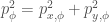
Let’s suppose instead of measuring a distance, we want to measure the momentum of some other particle, which we call \phi because physicists are overly enamored of Greek letters. If p_{x,\phi} is its momentum (physicists also really love subscripts), then its total momentum can be calculated using the Pythagorean Theorem as well:

p_\phi^2= p_{x,\phi}^2+ p_{y,\phi}^2

Or with gravity:

p_\phi^2= g_{x}p_{x,\phi}^2+ g_{y} p_{y,\phi}^2

At the moment, this looks just like the distance formula with a bunch of extra stuff in it. Interpreted another way, though, it becomes instructions for the interactions of the graviton. If g_{x} and g_{y} represent the graviton, then this formula says that one graviton can interact with two \phi particles, like so:
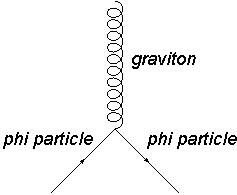
graviton

Saying that gravitons can interact with \phi particles ends up meaning the same thing as saying that gravity changes the way we measure the \phi particle’s total momentum. This is one of the more important things to understand about quantum gravity: the idea that when people talk about exotic things like “gravitons”, they’re really talking about the same theory that Einstein proposed in 1916. There’s nothing scary about describing gravity in terms of particles just like the other forces. The scary bit comes later, as a result of the particular way that quantum calculations with gravity end up. But that’s a tale for another day.

Black Holes and a Superluminal River of Glass

If I told you that scientists have been able to make black holes in their labs for years, you probably either wouldn’t believe me, or would suddenly get exceptionally paranoid. Turns out it’s true, provided you understand a little bit about black holes.

A black hole is, at its most basic, an object that light cannot escape. That’s why it’s “black”: it absorbs all colors of light. That’s really, deep down, all you need in order to have a black hole.

Black holes out in space, as you are likely aware, are the result of collapsed stars. Gather enough mass into a small enough space and, according to general relativity, space and time begin to bend. Bend space and time enough and the paths that light would follow curve in on themselves, until inside the event horizon (the “point of no return”) the only way light can go is down, into the center of the black hole.

That’s not the only way to get a “point of no return” though. Imagine flying a glider above a fast-moving river. If the plane is slower than the river, then any object placed in the river is like a “point of no return”:  once the object passes you, you can never fly back and find it again.

Of course, trying to apply this to light runs into a difficulty: you can have a river faster than a plane, but it’s pretty hard to have a river faster than light. You might even say it’s impossible: nothing can travel faster than light, after all, right?

The idea that nothing can travel faster than light is actually a common misconception, held because it makes a better buzzword than the truth: nothing can travel faster than light in a vacuum. Light in a vacuum goes straight to its target, the fastest thing in the universe. But light in a substance, moving through air or water or glass, gets deflected: it runs into atoms, gets absorbed, gets released, and overall moves slower. So in order to make a black hole, all we need is some substance moving faster than light moves in that substance: a superluminal river of glass.

(By the way, is that not an amazingly evocative phrase? Sounds like the title of a Gibson novel.)

Now it turns out that literally making glass move faster than light moves inside it is still well beyond modern science. But scientists can get around that. Instead of making the glass move, they  make the properties of the glass change, using lasers to alter the glass so that the altered area moves faster than the light around it. With this sort of setup, they can test all sorts of theoretical black hole properties up close, in the comfort of a university basement.

That’s just one example of how to create an artificial black hole. There are several others, and all of them rely on various ingenious manipulations of the properties of matter. You live in a world in which artificial black holes are routine and diverse. Inspiring, no?

Wormholes and Donut Holes

I’ve heard people claim that in order to understand wormholes, you need to understand five-dimensional space.

Well that’s just silly.

A wormhole is often described as a hole in space-time. It can be imagined as a black hole where instead of getting crushed when you fall in to the center, you emerge somewhere else (or even some-when else: wormholes are possibly the only way to get time travel). They’re a staple of science fiction, even if they aren’t always portrayed accurately.

Probably not what a wormhole looks like

How does this work? Well like many things in physics, it’s helpful to imagine it with fewer dimensions first:

Suppose that you live on the surface of a donut. You can’t get up off the surface; you’re stuck to its gooey sugary coating. All you can do is slide around it.

It’s a simple life

Let’s say that one day you’re sitting on the pink side of the donut, near the center. Your friend lives on the non-frosted side, and you want to go see her. You could go all the way back to the outside edge of the donut, around the side, and down to the bottom, but you’re tired and the frosting is sticky. Luckily, you can use your futuristic pastry technology, the donut hole! Instead of going around the outside, you dive in through the inside hole, getting to your friend’s house much faster.

That’s really all a wormhole is. Instead of living on a two-dimensional donut surface, you live in a world with three space dimensions and one time dimension. A wormhole is still just like a donut hole: a shortcut, made possible by space being a non-obvious shape.

Now earlier I said that you don’t need to understand five-dimensional space to understand wormholes, and that’s true. Yes, real donuts exist in three dimensions…but if you live on the surface only, you only see two: inward versus outward, and around the center. It’s like a 2D video game with a limited map: the world looks flat, but if you go up past the top edge you find yourself on the bottom. Going from the top edge directly to the bottom is easier than going all the way down the screen: it’s just the same as a wormhole. You don’t need extra dimensions to have wormholes, just rules: when you go up far enough, you come back down. Go to the center of the wormhole, and come out the other side. And as one finds in physics, it’s the rules, not naïve intuitions, that determine how the world works. Just like a video game.