Putting aside some highly controversial exceptions, string theory has made no testable predictions. Conceivably, a world governed by string theory and a world governed by conventional particle physics would be indistinguishable to every test we could perform today. Furthermore, it’s not even possible to say that string theory predicts the same things with fewer fudge-factors, as string theory descriptions of our world seem to have dramatically many more free parameters than conventional ones.
Critics of string theory point to this as a reason why string theory should be excluded from science, sent off to the chilly arctic wasteland of the math department. (No offense to mathematicians, I’m sure your department is actually quite warm and toasty.) What these critics are missing is an important feature of the scientific process: before scientists are able to make predictions, they propose explanations.
To explain what I mean by that, let’s go back to the beginning of the 16th century.
At the time, the authority on astronomy was still Ptolemy’s Syntaxis Mathematica, a book so renowned that it is better known by the Arabic-derived superlative Almagest, “the greatest”. Ptolemy modeled the motions of the planets and stars as a series of interlocking crystal spheres with the Earth at the center, and did so well enough that until that time only minor improvements on the model had been made.
This is much trickier than it sounds, because even in Ptolemy’s day astronomers could tell that the planets did not move in simple circles around the Earth. There were major distortions from circular motion, the most dramatic being the phenomenon of retrograde motion.
If the planets really were moving in simple circles around the Earth, you would expect them to keep moving in the same direction. However, ancient astronomers saw that sometimes, some of the planets moved backwards. The planet would slow down, turn around, go backwards a bit, then come to a stop and turn again.

Thus sparking the invention of the spirograph.
In order to take this into account, Ptolemy introduced epicycles, extra circles of motion for the planets. The epicycle would move on the planet’s primary circle, or deferent, and the planet would rotate around the epicycle, like so:

French Wikipedia had a better picture.
These epicycles weren’t just for retrograde motion, though. They allowed Ptolemy to model all sorts of irregularities in the planets’ motions. Any deviation from a circle could conceivably be plotted out by adding another epicycle (though Ptolemy had other methods to model this sort of thing, among them something called an equant). Enter Copernicus.

Enter Copernicus’s hair.
Copernicus didn’t like Ptolemy’s model. He didn’t like equants, and what’s more, he didn’t like the idea that the Earth was the center of the universe. Like Plato, he preferred the idea that the center of the universe was a divine fire, a source of heat and light like the Sun. He decided to put together a model of the planets with the Sun in the center. And what he found, when he did, was an explanation for retrograde motion.
In Copernicus’s model, the planets always go in one direction around the Sun, never turning back. However, some of the planets are faster than the Earth, and some are slower. If a planet is slower than the Earth and it passes by it will look like it is going backwards, due to the Earth’s speed. This is tricky to visualize, but hopefully the picture below will help: 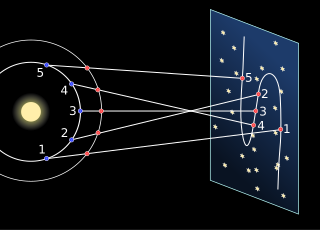 As you can see in the picture, Mars starts out ahead of Earth in its orbit, then falls behind, making it appear to move backwards.
Despite this simplification, Copernicus still needed epicycles. The planets’ motions simply aren’t perfect circles, even around the Sun. After getting rid of the equants from Ptolemy’s theory, Copernicus’s model ended up having just as many epicycles as Ptolemy’s!
Copernicus’s model wasn’t any better at making predictions (in fact, due to some technical lapses in its presentation, it was even a little bit worse). It didn’t have fewer “fudge factors”, as it had about the same number of epicycles. If you lived in the 16th century, you would have been completely justified in believing that the Earth was the center of the universe, and not the Sun. Copernicus had failed to establish his model as scientific truth.
However, Copernicus had still done something Ptolemy didn’t: he had explained retrograde motion. Retrograde motion was a unique, qualitative phenomenon, and while Ptolemy could include it in his math, only Copernicus gave you a reason why it happened.
That’s not enough to become the reigning scientific truth, but it’s a damn good reason to pay attention. It was justification for astronomers to dedicate years of their lives to improving the model, to working with it and trying to get unique predictions out of it. It was enough that, over half a century later, Kepler could take it and turn it into a theory that did make predictions better than Ptolemy, that did have fewer fudge-factors.
String theory as a model of the universe doesn’t make novel predictions, it doesn’t have fewer fudge factors. What it does is explain, explaining spectra of particles in terms of shapes of space and time, the existence of gravity and light in terms of closed and open strings, the temperature of black holes in terms of what’s going on inside them (this last really ought to be the subject of its own post, it’s one of the big triumphs of string theory). You don’t need to accept it as scientific truth. Like Copernicus’s model in his day, we don’t have the evidence for that yet. But you should understand that, as a powerful explanation, the idea of string theory as a model of the universe is worth spending time on.
Of course, string theory is useful for many things that aren’t modeling the universe. But that’s the subject of another post.
 4 gravitons