Category Archives: Life as a Physicist

Science is Debugging

What do I do, when I get to work in the morning?

I debug programs.

I debug programs literally, in that most of the calculations I do are far to complicated to do by hand. I write programs to do my calculations, and invariably these programs have bugs. So, I debug.

I debug programs in a broader sense, too.

In science, a research program is a broad approach, taken by a number of people, used to make progress on some set of important scientific questions. Someone suggests a way forward (“Let’s try using an ansatz of transcendental functions!” “Let’s try to represent our calculations with a geometrical object!”) and they and others apply the new method to as many problems as they can. Eventually the program loses steam, and a new program is proposed.

The thing about these programs is, they’re pretty much never fully fleshed out at the beginning. There’s a general idea, and a good one, but it usually requires refinement. If you just follow the same steps as the first person in the program you’re bound to fail. Instead, you have to tweak the program, broadening it and adapting it to the problem you’re trying to solve.

It’s a heck of a lot like debugging a computer program, really. You start out with a hastily written script, and you try applying it as-is, hoping that it works. Often it doesn’t, and you have to go back, step by step, and figure out what’s going wrong.

So when I debug computer programs at work, I’m doing it with a broader goal. I’m running a scientific program, looking for bugs in that. If and when I find them, I can write new computer programs to figure out what’s going wrong. Then I have to debug those computer programs…

I’ll just leave this here.

The Near and the Far: Motivations for Physics

When I introduce myself, I often describe my job like this:

“I develop mathematical tools to make calculations in particle physics easier and more efficient.”

However, I could equally well describe my job like this:

“I’m looking for a radical new way to reformulate particle physics in order to solve fundamental problems in space and time.”

These may sound very different, but they’re both correct. That’s because in theoretical physics, like in many branches of science, we have two types of goals: near-term and far-term.

In the near-term, I develop mathematical tools and tricks, which let me calculate things I (and others) couldn’t calculate before. Pushing the tricks to their limits gives me more proficiency, making the tools I develop more robust. In the future, I can imagine applying the tools to more types of calculations, and specifically to more “important” calculations.

All of that still involves relatively near-term goals, though. Develop a new trick, and you can already envision what it might be used for. The far-term goals are generally deeper.

End of the road, not just the next tree.

In the far term, the new techniques that I and others develop might lead to fundamentally new ways to understand particle physics. That’s because a central feature of most of the tricks we develop is that they rephrase the calculation in a way that leaves out something that used to be thought of as fundamental. They’re “revolutions”, overthrowing some basic principle of how we do things. The hope is that the right “revolution” will help us solve problems that our current understanding of physics seems incapable of solving.

Most scientists have both sorts of goals. Someone who studies quantum mechanics might talk about developing a quantum computer, but in the near-term be interested in perfecting some algorithm. A biologist might study how information is stored in a cell, but introduce themself as someone trying to cure cancer.

For some people, the far-term goals are a big component of how they view themselves. Nima Arkani-Hamed, for example, has joked that believing that “spacetime is doomed” is what allows him to get out of bed in the morning. (For a transcript of the relevant parts, see here.) There are plenty of others with similar perspectives, people who need a “big” goal to feel motivated.

Myself, I find it harder to identify with these kinds of goals, because the payoff is so uncertain. Rephrasing particle physics in a new way might be the solution to a fundamental problem…but it could also just be another way to say the same thing. There’s no guarantee that any one project will be that one magical solution. In contrast, for me, near term goals are something I can feel confident I’m making real progress on. I can envision each step along the way, and see the part my work plays in a larger picture, led along by the satisfaction of solving each puzzle as it comes.

Neither way is better than the other, and both are important parts of science. Some people do better with one, some do better with the other, and in the end, everyone can view themselves as accomplishing something they care about.

Perimeter!

I’m moving in at Perimeter this week, so I don’t have time to write a long post. For those who aren’t familiar with it, the Perimeter Institute for Theoretical Physics is an independent research institute, not affiliated with any university. Instead, it’s funded by a combination of government and private sources (for why private sources might fund theoretical physics, read my discussion here). Because it’s not a university they have budgets to do things like hire people to make the transition process easier, so everything has been really nice and well-organized.

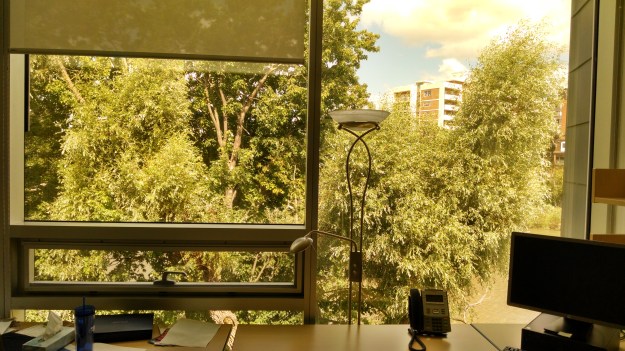
The postdoc offices are really nice, with a view of the nearby park, shown below.

On the Perimeter...of Waterloo Park

On the Perimeter…of Waterloo Park

Stop! Impostor!

Ever felt like you don’t belong? Like you don’t deserve to be where you are, that you’re just faking competence you don’t really have?

If not, it may surprise you to learn that this is a very common feeling among successful young academics. It’s called impostor syndrome, and it happens to some very talented people.

It’s surprisingly easy to rationalize success as luck, to assume praise comes from people who don’t know the full story. In science, we’re surrounded by people who seem to come up with brilliant insights on a regular basis. We see others’ successes far more often than we see their failures, and often we forget that science is at its heart a process of throwing ideas against a wall until something sticks. Hyper-aware of our own failures, when we present ourselves as successful we can feel like we’re putting on a paper-thin disguise, constantly at risk that someone will see through it.

As paper-thin disguises go, I prefer the classics.

In my experience, theoretical physics is especially heavy on impostor syndrome, for a number of reasons.

First, there’s the fact that beginning grad students really don’t know all they need to. Theoretical physics requires a lot of specialized knowledge, and most grad students just have the bare bones basics of a physics undergrad degree. On the strength of those basics, you’re somehow supposed to convince a potential advisor, an established, successful scientist, that you’re worth paying attention to.

Throw in the fact that many people have a little more than the basics, whether from undergrad research projects or grad-level courses taken early, and you have a group where everyone is trying to seem more advanced than they are. There’s a very real element of fake it till you make it, of going to talks and picking up just enough of the lingo to bluff your way through a conversation.

And the thing is, even after you make it, you’ll probably still feel like you’re faking it.

As I’ve mentioned before, there’s an enormous amount of jury-rigging that goes into physics research. There are a huge number of side-disciplines that show up at one point or another, from numerical methods to programming to graphic design. We can’t hire a professional to handle these things, we have to learn them ourselves. As such, we become minor dabblers in a whole mess of different fields. Work on something enough and others will start looking to you for help. It won’t feel like you’re an expert, though, because you know in the back of your mind that the real experts know so much more.

In the end, the best approach I’ve found is simply to keep saying yes. Keep using what you know, going to talks and trying new things. The more you “pretend” to know what you’re doing, the more experience you’ll get, until you really do know what you’re doing. There’s always going to be more to learn, but chances are if you’re feeling impostor syndrome you’ve already learned a lot. Take others’ opinions of you at face value, and see just how far you can go.

The Many (Body) Problems of the Academic Lifestyle

I’m visiting Perimeter this week, searching for apartments in the area. This got me thinking about how often one has to move in academia. You move for college, you move for grad school, you move for each postdoc job, and again when you start as a professor. Even then, you may not get to stay where you are if you don’t manage to get tenure, and it may be healthier to resign yourself to moving every seven years rather than assuming you’re going to settle down.

Most of life isn’t built around the idea that people move across the country (or the world!) every 2-7 years, so naturally this causes a few problems for those on the academic path. Below are some well-known, and not-so-well-known, problems facing academics due to their frequent relocations:

The two-body problem:

Suppose you’re married, or in a committed relationship. Better hope your spouse has a flexible job, because in a few years you’re going to be moving to another city. This is even harder if your spouse is also an academic, as that requires two rare academic jobs to pop up in the same place. And woe betide you if you’re out of synch, and have to move at different times. Many couples end up having to resort to some sort of long-distance arrangement, which further complicates matters.

The N-body problem:

Like the two-body problem, but for polyamorous academics. Leads to poly-chains up and down the East Coast.

The 2+N-body problem:

Alternatively, add a time dimension to your two-body problem via the addition of children. Now your kids are busily being shuffled between incommensurate school systems. But you’re an academic, you can teach them anything they’re missing, right?

The warm body problem:

Of course, all this assumes you’re in a relationship. If you’re single, you instead have the problem of never really having a social circle beyond your department, having to tenuously rebuild your social life every few years. What sorts of clubs will the more socially awkward of you enter, just to have some form of human companionship?

The large body of water problem:

We live in an age where everything is connected, but that doesn’t make distance cheap. An ocean between you and your collaborators means you’ll rarely be awake at the same time. And good luck crossing that ocean again, not every job will be eager to pay relocation expenses.

The obnoxious governing body problem:

Of course, the various nations involved won’t make all this travel easy. Many countries have prestigious fellowships only granted on the condition that the winner returns to their home country for a set length of time. Since there’s no guarantee that anyone in your home country does anything similar to what you do, this sort of requirement can have people doing whatever research they can find, however tangentially related, or trying to avoid the incipient bureaucratic nightmare any way they can.


Experimentalist Says What?

I’m a theoretical physicist. That means I work with pencil and paper, or with my laptop, or at most with a computer cluster. I don’t have a lab, and even if I did I wouldn’t have any equipment to store there.

By contrast, most physicists (and most scientists in general) are experimentalists, the people who actually do experiments, actually work in labs, and actually use piles and piles of expensive equipment. Naturally, these two groups have very different ways of doing things, spawned by different requirements for their jobs. This leads to very different ways of talking. We theorists sometimes get confused by the quaint turns of phrase used by experimentalists, so I’ve put together this handy translation guide:


Lab: Kind of like an office, but has a bunch of big machines in it for some reason. Also, in some of them they don’t even drink coffee, some nonsense about toxic contaminants. I don’t know how they get any work done with all those test tubes all over the place.

PI: Not Private Investigator, but close! The Primary Investigator is the big cheese among the experimentalists, the one who owns all the big machines. All of the others must bow before him or her, even fellow professors must grovel if they want to use the PI’s expensive equipment. Naturally, this makes experimentalists very hierarchical, a sharp contrast to theorists who are obviously totally egalitarian.

Poster: Let me tell you a secret about experimentalists: there are a lot of them. Way more than there are theorists. So many, that if they all go to a conference it’s impossible for them all to give talks! That’s where posters come in: some of the experimentalists all stand in a room in front of rectangles of cardboard covered in charts, while the others walk around and ask questions. Traditionally, these posters are printed an hour before the conference, obviously for maximum freshness and not at all because of procrastination.

Group: Like our Institutes, but (because there are a lot of experimentalists) there isn’t just one per university and (because of the shared lab) they actually have something to talk about. This leads to regular group meetings, because when you’re using expensive equipment you actually need to show you’re doing something worthwhile with it.

IRB: For the medical and psychological folks, the Internal Review Board is there to tell you that, no, you can’t infect monkeys with flesh-eating bacteria just to see what happens. They’re also the people who ask you whether a grammatical change in your online survey will pose risks to pregnant women, which is clearly exactly as important. Theorists don’t have these, because numbers are an oppressed underclass with no rights to speak of. EHS (Environmental Health and Safety) fills a similar role for those who only oppress yeast and their own grad students.

Annual Meeting: Experimentalists tend to be part of big organizations like the American Physical Society. And that’s all well and good, occupies a space on the CV and so forth. What’s somewhat more baffling is their tendency to trust those organizations to run conferences. Generally these are massive affairs, with people from all sorts of sub-fields participating. This only works because experimentalists have the mysterious ability to walk into each other’s talks and actually understand what’s going on, even if the subject matter is very different from what they’re used to. Experts suggest this has something to do with actually studying real things in the real world, but this is a hypothesis at best.

How do I get where you are?

I’ve mentioned before that this blog will be undergoing a redesign this summer, transitioning from 4gravitons.wordpress.com to just 4gravitons.wordpress.com. One part of that redesign will be the introduction of new categories to help people search for content, as well as new guides like the ones for N=4 super Yang-Mills and the (2,0) theory for some of those categories. Of those, one planned category/guide will discuss careers in physics, with an eye towards explaining some of the often-unstated assumptions behind the process.

I’ve already posted on being a graduate research assistant and on what a postdoc is. I haven’t said much yet about the process leading up to becoming a graduate student. In this post, I’m going to give an overview of a career in theoretical physics, with a focus on what happens before you find an advisor. This is going to be inherently biased, based as it will be on my experiences. In particular, each country’s education system is different, so much of this will only be relevant for students in the US.

Let’s start at the beginning.

A very good place to start.

If you want to become a theoretical physicist, you’d better start by taking physics and math courses in high school. Unfortunately, this is where socioeconomic status has a big effect. Some schools have Advanced Placement or International Baccalaureate courses that let you get a head-start on college, many don’t. Some schools don’t even have physics courses at all anymore. My only advice here is to get what you can, when you can. If you can take a physics course, do it. If you can take calculus, do it. If you can take classes that will give you university credit, take them.

After high school, you go to college for a Bachelor’s degree in physics. Getting into college these days is some sort of ridiculous popularity contest, and I don’t pretend to be able to give advice on that. What I can say is that once you’re in college, coursework is important, but research is more important. Graduate schools will look at how well you did in your courses and how advanced those courses were, but they will pay special attention to who you get recommendations from, and whether you did research with them. Whether or not your college has anyone who you can research with, you should consider doing summer research somewhere interesting. With programs like the NSF’s Research Experience for Undergraduates (or REU) you can apply to get hooked up with interesting projects and mentors. In addition to looking good on an application to grad school, doing research helps boost your self-confidence: knowing that you can do something real really helps you start feeling like a scientist. Research also teaches you specialized skills much faster than coursework can: I’ve learned much more about programming from having to use it on projects than from any actual programming course.

That said, coursework is also useful. You want courses that will familiarize you with basic tools of your field, physics courses on classical mechanics and quantum mechanics and electromagnetism and math courses on linear algebra and differential equations. You want to take a math course on group theory, but only if it’s taught by a physicist, as mathematicians focus on different aspects. More than any of that, though, you want to try to take at least a few graduate-level courses in while you’re still in college.

That’s important, because grad school in theoretical physics is kind of a mess. You’ll be there for around five years in total (I was in at the low end with four, some people take six or seven). However, you take most if not all of your courses in the first two years. In general, during that time you are paid as a Teaching Assistant. The school pays your tuition and a livable (if barely) wage, and in return you lead lab sections or grade papers. Teaching experience can be a positive thing, but you don’t want to keep doing it for too long, because the point of grad school isn’t teaching or courses, it’s research. Your goal is to find an advisor who is willing to pay you out of one of their (usually government) grants, so that you can transition from Teaching Assistant to Research Assistant. This is hard to do while you’re still taking courses: you won’t have time, and worse, you won’t know everything you need. Theoretical physics requires a lot of background, and much of it gets taught in grad school. Here at Stony Brook, you’d be taking graduate-level quantum mechanics, quantum field theory, and string theory. Until recently, each one of those was a one-year course, and the most logical way to take them was one after the other. Add that up, and that’s three years…kind of a problem when you want to start research after two. That’s why getting ahead in courses, however and whenever you can, is so important: not so much for the courses themselves, but so you can get past them and do research.

Research is what you do for the rest of your time in grad school. It’s what you do after you graduate, when you become a postdoc. It (and teaching) are what you do as a professor, what you are judged on when they decide whether or not you get tenure. Working through research is going to teach you more than any other experience you will have, so get as much of it as you can. And good luck!

The PhD Defense

Last Wednesday I completed the final stage of my PhD, the Defense. I booted up a projector and, in a room filled with esteemed physicists, eager grad students, and a three foot sub, I summarized the last two years of my work. A few questions later, people were shaking my hand and calling me “Doctor von Hippel”.

Now that I’m transitioning out of the grad student world, my blog will be transitioning too. I’ll be starting work as a Postdoctoral Fellow in the Fall at the Perimeter Institute for Theoretical Physics. Some time in between, probably in July, this blog will undergo a redesign, hopefully becoming easier to navigate. I’ll also be dropping the “and a grad student” from the title, switching to a new URL, 4gravitons.wordpress.com. Don’t worry, traffic from the old address will be forwarded, so infrequent readers won’t lose track. That said, if anyone with more experience has some advice about making the transition more seamless I’d love to hear it.

There are a lot of stereotypes about the PhD Defense, and mine broke almost all of them. My advisor hadn’t been directly involved in my work, my committee chair was one of the nicest, mellowest professors I’ve ever known, my experimentalist asked me a theoretical physics question, and my external member was NimafrigginArkani-Hamed.

That said, I’ve also seen several other PhD Defenses, and I have to say that the stereotypes are usually right on the money. And since I’m on a bit of a list-based comedy kick recently, let me introduce you to the four members of your PhD committee:

First, of course, is your advisor. If you two collaborate closely, you may find yourself presenting material that your advisor had a hand in. Naturally, the other committee members will ask questions about this material, and naturally you will answer them. Naturally, those answers will not be how your advisor would have explained it, so naturally your advisor will start explaining it themselves. (After all, it’s their work that’s being questioned!) Manage things well and the whole defense will be an argument between your advisor and the other committee members, and you won’t have to say anything at all!

Second is your committee chair. This is someone from your field, chosen for their general eminence and chair-ish-ness. They’ve done a lot of these before, and in their mind they’ve developed a special bond with the students, a bond forged by questions. See, if you have a typical committee chair, they will ask you the toughest, most nitpicky, most downright irrelevant lines of questions possible. The chair’s goal isn’t to keep things moving, it’s to make sure that you took their class and remember everything from it, no matter how much time that takes away from discussing your actual dissertation.

Third you must face your experimentalist. According to the ancient ideals of academia (ideals somehow unbreakably important for grad students and largely irrelevant for top-level university administrators), a dissertation must be judged not only by the yes-men of your own sub-field, but also by someone from the rest of your department. For a theoretical physicist, that means bringing in an experimental physicist. You may try to make things accessible to this person, but eventually you have to actually start talking about your work. This is healthy, as it will allow them much-needed sleep. Once they awake, they will bless you with a question that represents the most tenuous link they can draw between their own work and yours, generally asking after the mass of some subatomic particle. Once you have demonstrated your ignorance in some embarrassing fashion the experimentalist may return to sleep.

Finally, the defense brings in a special individual, the external member. Not only must you prove your worth to an experimentalist, but to someone from outside of your department altogether! For the lucky, this means someone who does similar work at a nearby university. For the terminally rural, this instead means finding the closest department and bringing in someone who will at least recognize some of the words in your talk. For us, this generally means a mathematician. Like the experimentalist, they will favor you with bewildered looks or snores, depending on temperament. Unlike the experimentalist, they are under no illusion that anything they do is relevant to anything you do, so their questions will be mercifully brief.

Grilled by these four, you then leave the room, allowing them to talk about the weather or their kids or something before they ask you back in to tell you that, of course, you’ve got your PhD. Because after all that, anything else would just be rude.

The Four Ways Physicists Name Things

If you’re a biologist and you discover a new animal, you’ve always got Latin to fall back on. If you’re an astronomer, you can describe what you see. But if you’re a physicist, your only option appears to involve falling back on one of a few terrible habits.

The most reasonable option is just to name it after a person. Yang-Mills and the Higgs Boson may sound silly at first, but once you know the stories of C. N. Yang, Robert Mills, Peter Higgs and Satyendra Nath Bose you start appreciating what the names mean. While this is usually the most elegant option, the increasingly collaborative nature of physics means that many things have to be named with a series of initials, like ABJM, BCJ and KKLT.

A bit worse is the tendency to just give it the laziest name possible. What do you call the particles that “glue” protons and neutrons together? Why gluons, of course, yuk yuk yuk!

This is particularly common when it comes to supersymmetry, where putting the word “super” in front of something almost always works. If that fails, it’s time to go for more specific conventions: to find the partner of an existing particle, if the new particle is a boson, just add “s-” for “super”“scalar” apparently to the name. This creates perfectly respectable names like stau, sneutrino, and selectron. If the new particle is a fermion, instead you add “-ino” to the end, getting something like a gluino if you start with a gluon. If you’ve heard of neutrinos, you may know that neutrino means “little neutral one”. You might perfectly rationally expect that gluino means “little gluon”, if you had any belief that physicists name things logically. We don’t. A gluino is called a gluino because it’s a fermion, and neutrinos are fermions, and the physicists who named it were too lazy to check what “neutrino” actually means.

Pictured: the superpartner of Nidoran?

Worse still are names that are obscure references and bad jokes. These are mercifully rare, and at least memorable when they occur. In quantum mechanics, you write down probabilities using brackets of two quantum states, \langle a | b\rangle. What if you need to separate the two states, \langle a| and |b\rangle? Then you’ve got a “bra” and a “ket”!

Or have you heard the story of how quarks were named? Quarks, for those of you unfamiliar with them, are found in protons and neutrons in groups of three. Murray Gell-Mann, one of the two people who first proposed the existence of quarks, got their name from Finnegan’s Wake, a novel by James Joyce, which at one point calls for “Three quarks for Muster Mark!” While this may at first sound like a heartwarming tale of respect for the literary classics, it should be kept in mind that a) Finnegan’s Wake is a novel composed almost entirely of gibberish, read almost exclusively by people who pretend to understand it to seem intelligent and b) this isn’t exactly the most important or memorable line in the book. So Gell-Mann wasn’t so much paying homage to a timeless work of literature as he was referencing the most mind-numbingly obscure piece of nerd trivia before the invention of Mara Jade. Luckily these days we have better ways to remember the name.

Albeit wrinklier ways.

The final, worst category, though, don’t even have good stories going for them. They are the names that tell you absolutely nothing about the thing they are naming.

Probably the worst examples of this from my experience are the a-theorem and the c-theorem. In both cases, a theory happened to have a parameter in it labeled by a letter. When a theorem was proven about that parameter, rather than giving it a name that told you anything at all about what it was, people just called it by the name of the parameter. Mathematics is full of names like this too. Without checking Wikipedia, what’s the difference between a set, a group, and a category? What the heck is a scheme?

If you ever have to name something, be safe and name it after a person. If you don’t, just try to avoid falling into these bad habits of physics naming.

“Super” Computers: Using a Cluster

When I join a new department or institute, the first thing I ask is “do we have a cluster?”

Most of what I do, I do on a computer. Gone are the days when theorists would always do all their work on notepads and chalkboards (though many still do!). Instead, we use specialized computer programs like Mathematica and Maple. Using a program helps keep us from forgetting pesky minus signs, and it allows working with equations far too long to fit on a sheet of paper.

Now if computers help, more computer should help more. Since physicists like to add “super” to things, what about a supercomputer?

The Jaguars of the computing world.

Supercomputers are great, but they’re also expensive. The people who use supercomputers are the ones who model large, complicated systems, like the weather, or supernovae. For most theorists, you still want power, but you don’t need quite that much. That’s where computer clusters come in.

A computer cluster is pretty much what it sounds like: several computers wired together. Different clusters contain different numbers of computers. For example, my department has a ten-node cluster. Sure, that doesn’t stack up to a supercomputer, but it’s still ten times as fast as an ordinary computer, right?

The power of ten computers!

The power of ten computers!

Well, not exactly. As several of my friends have been surprised to learn, the computers on our cluster are actually slower than most of our laptops.

The power of ten old computers!

The power of ten old computers!

Still, ten older computers is still faster than one new one, yes?

Even then, it depends how you use it.

Run a normal task on a cluster, and it’s just going to run on one of the computers, which, as I’ve said, are slower than a modern laptop. You need to get smarter.

There are two big advantages of clusters: time, and parallelization.

Sometimes, you want to do a calculation that will take a long time. Your computer is going to be busy for a day or two, and that’s inconvenient when you want to do…well, pretty much anything else. A cluster is a space to run those long calculations. You put the calculation on one of the nodes, you go back to doing your work, and you check back in a day or two to see if it’s finished.

Clusters are at their most powerful when you can parallelize. If you need to do ten versions of the same calculation, each slightly different, then rather than doing them one at a time a cluster lets you do them all at once. At that point, it really is making you ten times faster.

If you ever program, I’d encourage you to look into the resources you have available. A cluster is a very handy thing to have access to, no matter what you’re doing!