Category Archives: Life as a Physicist

Historic Montreal

I’m at a conference in Montreal this week, so it’s going to be a short post. The University of Montreal’s Centre de Recherches Mathématiques has been holding a program on the various hidden symmetries of N=4 super Yang-Mills since the beginning of the summer. This week is the amplitudes-focused part of the program, so they’ve brought in a bunch of amplitudes-folks from around the world, myself included.

It’s been great hanging out with fellow members of my sub-field, as always, both at the conference and at dinner afterwards. Over possibly too much wine I heard stories of the heady days of 2007, when James Drummond and Johannes Henn first discovered one of the most powerful symmetries of N=4 super Yang-Mills (a duality called dual conformal invariance) and Andrew Hodges showed off the power of a set of funky variables called twistors. It’s amazing to me how fast the field moves, sometimes: by the time I started doing amplitudes work in 2011 these ideas were the bedrock of the field. History operates on different scales, and in amplitudes a few decades have played host to an enormous amount of progress.

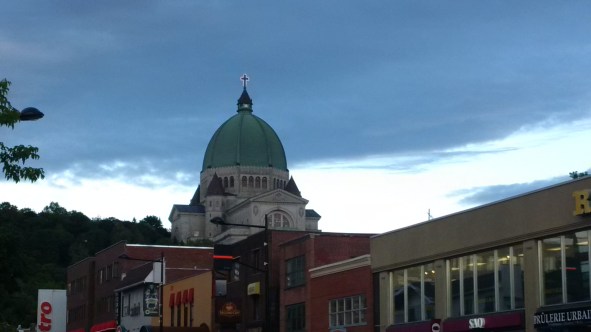
History in the real world can move surprisingly fast too. After seeing cathedrals in Zurich that date back to the medieval era, I was surprised when the majestic basilica overlooking Montreal turned out to be less than a century old.

In retrospect the light-up cross should have made it obvious.

In retrospect the light-up cross should have made it obvious.

What Do You Get When You Put 136 Amplitudeologists into One Room? Amplitudes 2015!

I’m at Amplitudes this week, my subfield’s big yearly conference, located this year in sweltering but otherwise lovely Zurich.

A typical inhabitant of Zurich.

A typical inhabitant of Zurich.

I gave a talk on Tuesday. They’ve posted the slides online, and I think they’re going to post the talk itself at some point.

This is the first year I’ve been to Amplitudes, and it’s remarkable seeing the breadth of the field. We’ve got everything from people focused heavily on the needs of experimentalists, trying to perfect calculations that will reduce the error on measurements coming out of the LHC, to people primarily interested in some of the more esoteric aspects of string theory. Putting everyone into the same room definitely helps emphasize just how many different approaches there are under the amplitudes umbrella. It’s the first time I’ve really appreciated just how “big” the field is, how much it’s grown to encompass.

Where Do the Experts Go When They Need an Expert?

If your game crashes, or Windows keeps spitting out bizarre error messages, you google the problem. Chances are, you find someone on a help forum who had the same problem, and hopefully someone else posted the answer.

(If your preferred strategy is to ask a younger relative, then I’m sorry, but nine times out of ten they’re just doing that.)

What do scientists do, though? We’re at the cutting-edge of knowledge. When we have a problem, who do we turn to?

Typically, Stack Exchange.

The thing is, when we’re really confused about something, most of the time it’s not really a physics problem. We get mystified by the intricacies of Mathematica, or we need some quality trick from numerical methods. And while I haven’t done much with them yet, there are communities dedicated to answering actual physics questions, like Physics Overflow.

The idea I was working on last week? That came from a poster on the Mathematica Stack Exchange, who mentioned a handy little function called Association that I hadn’t heard of before. (It worked, by the way.)

Science is a collaborative process. Sometimes that means actual collaborators, but sometimes we need a little help from folks online, just like everyone else.

Why I Spent Convergence Working

Convergence is basically Perimeter Institute Christmas.

This week, the building was dressed up in festive posters and elaborate chalk art, and filled with Perimeter’s many distant relations. Convergence is like a hybrid of an alumni reunion and a conference, where Perimeter’s former students and close collaborators come to hear talks about the glory of Perimeter and the marvels of its research.

Sponsored by the Bank of Montreal

And I attended none of those talks.

I led a discussion session on the first day of Convergence (which was actually pretty fun!), and I helped out in the online chat for the public lecture on Emmy Noether. But I didn’t register for the conference, and I didn’t take the time to just sit down and listen to a talk.

Before you ask, this isn’t because the talks are going to be viewable online. (Though they are, and I’d recommend watching a few if you’re in the mood for a fun physics talk.)

It’s partly to do with how general these talks are. Convergence is very broad: rather than being focused on a single topic, its goal is to bring people from very different sub-fields together, hopefully to spark new ideas. The result, though, are talks that are about as broad as you can get while still being directed at theoretical physicists. Most physics departments have talks like these once a week, they’re called colloquia. Perimeter has colloquia too: they’re typically in the room that the Convergence talks happened in. Some of the Convergence talks have already been given as colloquia! So part of my reluctance is the feeling that, if I haven’t seen these talks before, I probably will before too long.

The main reason, though, is work. I’ve been working on a fairly big project, since shortly after I got to Perimeter. It’s an extension of my previous work, dealing with the next, more complicated step in the same calculation. And it’s kind of driving me nuts.

The thing is, we had almost all of what we needed around January. We’ve accomplished our main goal, we’ve got the result that we were looking for. We just need to plot it, to get actual numbers out. And for some reason, that’s taken six months.

This week, I thought I had an idea that would make the calculation work. Rationally, I know I could have just taken the week to attend Convergence, and worked on the problem afterwards. We’ve waited six months, we can wait another week.

But that’s not why I do science. I do science to solve problems. And right here, in front of me, I had a problem that maybe I could solve. And I knew I wasn’t going to be able to focus on a bunch of colloquium talks with that sitting in the back of my mind.

So I skipped Convergence, and sat watching the calculation run again and again, each time trying to streamline it until it’s fast enough to work properly. It hasn’t worked yet, but I’m so close. So I’m hoping.

Physics Is a Small World

Earlier this week, Vilhelm Bohr gave a talk at Perimeter about the life of his grandfather, the famous physicist Niels Bohr. The video of the talk doesn’t appear to be up on the Perimeter site yet, but it should be soon.

Until then, here is a picture of some eyebrows.

This was especially special for me, because my family has a longstanding connection to the Bohrs. My great grandfather worked at the Niels Bohr Institute in the mid-1930’s, and his children became good friends with Bohr’s grandchildren, often visiting each other even after my family relocated to the US.

These kinds of connections are more common in physics than you might think. Time and again I’m surprised by how closely linked people are in this field. There’s a guy here at Perimeter who went to school with Jaroslav Trnka, and a bunch of Israelis at nearby institutions all know each other from college. In my case, I went to high school with an unusually large number of mathematicians.

While it’s fun to see familiar faces, there’s a dark side to the connected nature of physics. So much of what it takes to succeed in academia involves knowing unwritten rules, as well as a wealth of other information that just isn’t widely known. Many people don’t even know it’s possible to have a career in physics, and I’ve met many who didn’t know that science grad schools pay your tuition. Academic families, and academic communities, have an enormous leg up on this kind of knowledge, so it’s not surprising that so many physicists come from so few sources.

Artificially limiting the pool of people who become physicists is bound to hurt us in the long run. Great insights often come from outsiders, like Hooke in the 17th century and Noether in the early 20th. If we can expand the reach of physics, make the unwritten rules written and the secret tricks revealed, if we work to make physics available to anyone who might be suited for it, then we can make sure that physics doesn’t end up a hereditary institution, with all the problems that entails.

Calculus Is About Pokemon

Occasionally, people tell me that calculus was when they really gave up on math. It’s a pity, because for me calculus was the first time math really started to become fun. After all, it’s when math introduces the Pokemon.

What Pokemon? Why, the special functions of course.

By special functions I mean things like \sin x, \cos x, e^x, and \ln x. Like Pokemon, these guys come in a bewildering variety. And in calculus, you learn that they, like Pokemon, can evolve.

x integrates into \frac{1}{2}x^2!

\frac{1}{x} integrates into \ln x!

\sin x integrates into -\cos x, and \cos x integrates into…\sin x.

Ok, the analogy isn’t perfect. Pokemon don’t evolve back into themselves. But the same things that make Pokemon so appealing are precisely why calculus was such a breath of fresh air. Suddenly, there was a grand diversity of new things, and those new things were related.

College gave me new Pokemon, in the form of the Bessel functions. Nowadays, I work with a group of functions called Polylogarithms, and they’re even more like Pokemon. Logarithms are like the baby Pokemon of the Polylogarithms, integrating into Dilogarithms. Dilogarithms integrate into Trilogarithms, and so on.

062poliwrath

Polylogarithms, in turn, evolve into Poliwrath

To this day, the talks I enjoy the most are those that show me new special functions, or new relations between old ones. If a talk shows me a new use of multiple zeta values, or new types of Polylogarithm, it’s not just teaching me new physics or mathematics: it’s expanding my Pokemon collection.

The Cycle of Exploration

Science is often described as a journey of exploration. You might imagine scientists carefully planning an expedition, gathering their equipment, then venturing out into the wilds of Nature, traveling as far as they can before returning with tales of the wonders they discovered.

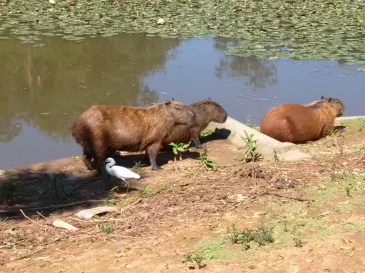
Is it capybaras? Please let it be capybaras.

Is it capybaras? Please let it be capybaras.

This misses an important part of the story, though. In science, exploration isn’t just about discovering the true nature of Nature, as important as that is. It’s also about laying the groundwork for future exploration.

Picture our explorers, traveling out into the wilderness with no idea what’s in store. With only a rough idea of the challenges they might face, they must pack for every possibility: warm clothing for mountains, sunscreen for the desert, canoes to ford rivers, cameras in case they encounter capybaras. Since they can only carry so much, they can only travel so far before they run out of supplies.

Once they return, though, the explorers can assess what they did and didn’t need. Maybe they found a jungle, full of capybaras. The next time they travel they’ll make sure to bring canoes and cameras, but they can skip the warm coats. This lets them free up more room, letting them bring more supplies that’s actually useful. In the end, this lets them travel farther.

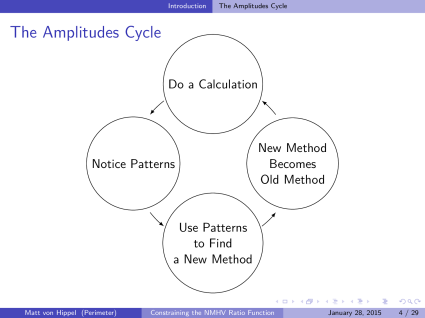
Science is a lot like this. The more we know, the better questions we can ask, and the further we can explore. It’s true not just for experiments, but for theoretical work as well. Here’s a slide from a talk I’m preparing, about how this works in my sub-field of Amplitudeology.

Unfortunately not a capybara.

Unfortunately not a capybara.

In theoretical physics, you often start out doing a calculation using the most general methods you have available. Once you’ve done it, you understand a bit more about your results: in particular, you can start figuring out which parts of the general method are actually unnecessary. By paring things down, you can figure out a new method, one that’s more efficient and allows for more complicated calculations. Doing those calculations then reveals new patterns, letting you propose even newer methods and do even more complicated calculations.

It’s the circle of exploration, and it really does move us all, motivating everything we do. With each discovery, we can go further, learn more, than the last attempt, keeping science churning long into the future.

My Travels, and Someone Else’s

I arrived in São Paulo, Brazil a few days ago. I’m going to be here for two months as part of a partnership between Perimeter and the International Centre for Theoretical Physics – South American Institute for Fundamental Research. More specifically, I’m here as part of a program on Integrability, a set of tricks that can, in limited cases, let physicists bypass the messy approximations we often have to use.

I’m still getting my metaphorical feet under me here, so I haven’t had time to think of a proper blog post. However, if you’re interested in hearing about the travels of physicists in general, a friend of mine from Stony Brook is going to the South Pole to work on the IceCube neutrino detection experiment, and has been writing a blog about it.

Where do you get all those mathematical toys?

I’m at a conference at Caltech this week, so it’s going to be a shorter post than usual.

The conference is on something call the Positive Grassmannian, a precursor to Nima Arkani-Hamed’s much-hyped Amplituhedron. Both are variants of a central idea: take complicated calculations in physics and express them in terms of clean, well-defined mathematical objects.

Because of this, this conference is attended not just by physicists, but by mathematicians as well, and it’s been interesting watching how the two groups interact.

From a physics perspective, mathematicians are great because they give us so many useful tools! Many significant advances in my field happened because a physicist talked to a mathematician and learned that a problem that had stymied the physics world had already been solved in the math community.

This tends to lead to certain expectations among physicists. If a mathematician gives a talk at a physics conference, we expect them to present something we can use. Our ideal math talk is like when Q presents the gadgets at the beginning of a Bond movie: a ton of new toys with just enough explanation for us to use them to save the day in the second act.

Pictured: Mathematicians, through Physicist eyes

You may see the beginning of a problem here, once you realize that physicists are the James Bond in this analogy.

Physicists like to see themselves as the protagonists of their own stories. That’s true of every field, though, to some degree or another. And it’s certainly true of mathematicians.

Mathematicians don’t go to physics conferences just to be someone’s supporting cast. They do it because physics problems are interesting to them: by hearing what physicists are working on they hope to get inspiration for new mathematical structures, concepts jury-rigged together by physicists that represent corners that mathematics hasn’t yet explored. Their goal is to take home an idea that they can turn into something productive, gaining glory among their fellow mathematicians. And if that sounds familiar…

Pictured: Physicists, through Mathematician eyes

While it’s amusing to watch the different expectations go head-to-head, the best collaborations between physicists and mathematicians are those where both sides respect that the other is the protagonist of their own story. Allow for give-and-take, paying attention not just to what you find interesting but to what the other person does, without assuming a tired old movie script, and it’s possible to make great progress.

Of course, that’s true of life in general as well.

Research or Conference? Can’t it be both?

“If you’re there for two months, for sure you’ll be doing research.”

I wanted to be snarky. I wanted to point out that, as a theoretical physicist, I do research wherever I go. I wanted to say that I even did research on the drive over. (This may not have been true, I think I mostly thought about Magic the Gathering cards.)

More than any of those, though, I wanted to get my travel visa. So instead I said,

“That’s fair.”

“Mmhmm, that’s fair.” Looking down at the invitation letter, she triumphantly pointed to the name of the inviting institution: “South American Institute for Fundamental Research.”

A bit of background: I’m going to Brazil this winter. Partly, this is because winter in Canada is not especially desirable, but it’s also because Sao Paulo’s International Center for Theoretical Physics is running a Program on Integrability, the arcane set of techniques that seeks to bypass the approximate perturbations we often use in particle physics and find full, exact results.

What do I mean by a Program? It’s not the sort of scientific program I’ve talked about before, though the ideas are related. When an institute holds a Program, they’re declaring a theme. For a certain length of time (generally from a few months to a whole semester), there will be a large number of talks at the institute focused on some particular scientific theme. The institute invites people from all over the world who work on that theme. Those people are there to give and attend talks, but they’re also there to share ideas with each other, to network and collaborate and do research.

This is where things get tricky. See, Brazil has multiple types of visas. A Tourist Visa can be used, among other things, for attending a scientific conference. On the other hand, someone coming to Brazil to do research uses Visa 1.

A Program is essentially a long conference…but it’s also an opportunity to do research. So are most short conferences, though! In theoretical physics we have workshops, short conferences explicitly focused on collaboration and research, but even if a conference isn’t a workshop you can bet that we’ll be doing some research there, for sure. We don’t need labs, and some of us don’t even need computers, research can happen whenever the inspiration strikes. The distinction between conferences and research, from our perspective, is an arbitrary one.

In physics, we like to cut through this sort of ambiguity by looking at what’s really important. I wanted to figure out what about research makes the Brazilian government use a different visa for it, whether it was about motivating people to enter the country for specific reasons or tracking certain sorts of activities. I wanted to understand that, because it would let me figure out whether my own research fell under those reasons, and thus figure out objectively which type of visa I ought to have.

I wanted to ask about all of this…but more than any of that, I wanted to get my travel visa. So I applied for the visa they told me to, and left.