Category Archives: Life as a Physicist

Wait, How Do Academics Make Money?

I’ve been working on submitting one of my papers to a journal, which reminded me of the existence of publication fees. That in turn reminded me of a conversation I saw on tumblr a while back:

beatontumblr

“beatonna” here is Kate Beaton, of the history-themed webcomic Hark! a Vagrant. She’s about as academia-adjacent as a non-academic gets, but even she thought that the academic database JSTOR paid academics for their contributions, presumably on some kind of royalty system.

In fact, academics don’t get paid by databases, journals, or anyone else that publishes or hosts our work. In the case of journals, we’re often the ones who pay publication fees. Those who write textbooks get royalties, but that’s about it on that front.

Kate Beaton’s confusion here is part of a more general confusion: in my experience, most people don’t know how academics are paid.

The first assumption is usually that we’re paid to teach. I can’t count the number of times I’ve heard someone respond to someone studying physics or math with the question “Oh, so you’re going to teach?”

This one is at least sort of true. Most academics work at universities, and usually have teaching duties. Often, part of an academic’s salary is explicitly related to teaching.

Still, it’s a bit misleading to think of academics as paid to teach: at a big research university, teaching often doesn’t get much emphasis. The extent to which the quality of teaching determines a professor’s funding or career prospects is often quite minimal. Academics teach, but their job isn’t “teacher”.

From there, the next assumption is the one Kate Beaton made. If academics aren’t paid to teach, are they paid to write?

Academia is often described as publish-or-perish, and research doesn’t really “count” until it’s made it to a journal. It would be reasonable to assume that academics are like writers, paid when someone buys our content. As mentioned, though, that’s just not how it works: if anything, sometimes we are the ones who pay the publishers!

It’s probably more accurate (though still not the full story) to say that academics are paid to research.

Research universities expect professors not only to teach, but to do novel and interesting research. Publications are important not because we get paid to write them, but because they give universities an idea of how productive we are. Promotions and the like, at least at research universities, are mostly based on those sorts of metrics.

Professors get some of their money from their universities, for teaching and research. The rest comes from grants. Usually, these come from governments, though private donors are a longstanding and increasingly important group. In both cases, someone decides that a certain general sort of research ought to be done and solicits applications from people interested in doing it. Different people apply with specific proposals, which are assessed with a wide range of esoteric criteria (but yes publications are important), and some people get funding. That funding includes not just equipment, but contributions to salaries as well. Academics really are, in many cases, paid by grants.

This is really pretty dramatically different from any other job. There’s no “customer” in the normal sense, and even the people in charge of paying us are more concerned that a certain sort of work be done than that they have control over it. It’s completely understandable that the public rounds that off to “teaching” or “writing”. It’s certainly more familiar.


 

What If the Field Is Doomed?

Around Halloween, I have a tradition of exploring the spooky and/or scary side of physics (sometimes rather tenuously). This time, I want to talk about something particle physicists find scary: the future of the field.

For a long time, now, our field has centered around particle colliders. Early colliders confirmed the existence of quarks and gluons, and populated the Standard Model with a wealth of particles, some expected and some not. Now, an enormous amount of effort has poured into the Large Hadron Collider, which found the Higgs…and so far, nothing else.

Plans are being discussed for an even larger collider, in Europe or China, but it’s not clear that either will be funded. Even if the case for new physics isn’t as strong in such a collider, there are properties of the Higgs that the LHC won’t be able to measure, things it’s important to check with a more powerful machine.

That’s the case we’ll have to make to the public, if we want such a collider to be built. But in addition to the scientific reasons, there are selfish reasons to hope for a new collider. Without one, it’s not clear the field can survive in its current form.

By “the field”, here, I don’t just mean those focused on making predictions for collider physics. My work isn’t plugged particularly tightly into the real world, the same is true of most string theorists. Naively, you’d think it wouldn’t matter to us if a new collider gets built.

The trouble is, physics is interconnected. We may not all make predictions about the world, but the purpose of the tools we build and concepts we explore is to eventually make contact. On grant applications, we talk about that future, one that leads not just to understanding the mathematics and models we use but to understanding reality. And for a long while, a major theme in those grant applications has been collider physics.

Different sub-fields are vulnerable to this in different ways. Surprisingly, the people who directly make predictions for the LHC might have it easiest. Many of them can pivot, and make predictions for cosmological observations and cheaper dark matter detection experiments. Quite a few are already doing so.

It’s harder for my field, for amplitudeology. We try to push the calculation techniques of theoretical physics to greater and greater precision…but without colliders, there are fewer experiments that can match that precision. Cosmological observations and dark matter detection won’t need four-loop calculations.

If there isn’t a next big collider, our field won’t dry up overnight. Our work is disconnected enough, at a far enough remove from reality, that it takes time for that sort of change to be reflected in our funding. Optimistically, this gives people enough time to change gears and alter their focus to the less collider-dependent parts of the field. Pessimistically, it means people would be working on a zombie field, shambling around in a field that is already dead but can’t admit it.

z-nation-field-of-zombies

Well I had to use some Halloween imagery

My hope is that this won’t happen. Even if the new colliders don’t get approved and collider physics goes dormant, I’d like to think my colleagues are adaptable enough to stay useful as the world’s demands change. But I’m young in this field, I haven’t seen it face these kinds of challenges before. And so, I worry.

Jury-Rigging: The Many Uses of Dropbox

I’ll be behind the Great Firewall of China next week, so I’ve been thinking about various sites I won’t be able to access. Prominent among them is Dropbox, a service that hosts files online.

250px-dropbox_icon-svg

A helpful box to drop things in

What do physicists do with Dropbox? Quite a lot.

For us, Dropbox is a great way to keep collaborations on the same page. By sharing a Dropbox folder, we can share research programs, mathematical expressions, and paper drafts. It makes it a lot easier to keep one consistent version of a document between different people, and it’s a lot simpler than emailing files back and forth.

All that said, Dropbox has its drawbacks. You still need to be careful not to have two people editing the same thing at the same time, lest one overwrite the other’s work. You’ve got the choice between editing in place, making everyone else receive notifications whenever the files change, or editing in a separate folder, and having to be careful to keep it coordinated with the shared one.

Programmers will know there are cleaner solutions to these problems. GitHub is designed to share code, and you can work together on a paper with ShareLaTeX. So why do we use Dropbox?

Sometimes, it’s more important for a tool to be easy and universal, even if it doesn’t do everything you want. GitHub and ShareLaTeX might solve some of the problems we have with Dropbox, but they introduce extra work too. Because no one disadvantage of Dropbox takes up too much time, it’s simpler to stick with it than to introduce a variety of new services to fill the same role.

This is the source of a lot of jury-rigging in science. Our projects aren’t often big enough to justify more professional approaches: usually, something hacked together out of what’s available really is the best choice.

For one, it’s why I use wordpress. WordPress.com is not a great platform for professional blogging: it doesn’t give you a lot of control without charging, and surprise updates can make using it confusing. However, it takes a lot less effort than switching to something more professional, and for the moment at least I’m not really in a position that justifies the extra work.

Ingredients of a Good Talk

It’s one of the hazards of physics that occasionally we have to attend talks about other people’s sub-fields.

Physics is a pretty heavily specialized field. It’s specialized enough that an otherwise perfectly reasonable talk can be totally incomprehensible to someone just a few sub-fields over.

I went to a talk this week on someone else’s sub-field, and was pleasantly surprised by how much I could follow. I thought I’d say a bit about what made it work.

In my experience, a good talk tells me why I should care, what was done, and what we know now.

Most talks start with a Motivation section, covering the why I should care part. If a talk doesn’t provide any motivation, it’s assuming that everyone finds the point of the research self-evident, and that’s a risky assumption.

Even for talks with a Motivation section, though, there’s a lot of variety. I’ve been to plenty of talks where the motivation presented is very sketchy: “this sort of thing is important in general, so we’re going to calculate one”. While that’s technically a motivation, all it does for an outsider is to tell them which sub-field you’re part of. Ideally, a motivation section does more: for a good talk, the motivation should not only say why you’re doing the work, but what question you’re asking and how your work can answer it.

The bulk of any talk covers what was done, but here there’s also varying quality. Bad talks often make it unclear how much was done by the presenter versus how much was done before. This is important not just to make sure the right people get credit, but because it can be hard to tell how much progress has been made. A good talk makes it clear not only what was done, but why it wasn’t done before. The whole point of a talk is to show off something new, so it should be clear what the new thing is.

If those two parts are done well, it becomes a lot easier to explain what we know now. If you’re clear on what question you were asking and what you did to answer it, then you’ve already framed things in those terms, and the rest is just summarizing. If not, you have to build it up from scratch, ending up with the important information packed in to the last few minutes.

This isn’t everything you need for a good talk, but it’s important, and far too many people neglect it. I’ll be giving a few talks next week, and I plan to keep this structure in mind.

arXiv, Our Printing Press

IMG_20160714_091400

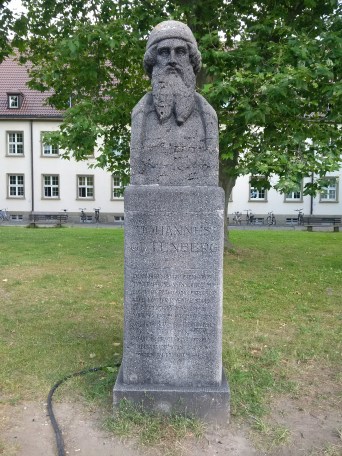
Johannes Gutenberg, inventor of the printing press, and possibly the only photogenic thing on the Mainz campus

I’ve had a few occasions to dig into older papers recently, and I’ve noticed a trend: old papers are hard to read!

Ok, that might not be surprising. The older a paper is, the greater the chance it will use obsolete notation, or assume a context that has long passed by. Older papers have different assumptions about what matters, or what rigor requires, and their readers cared about different things. All this is to be expected: a slow, gradual approach to a modern style and understanding.

I’ve been noticing, though, that this slow, gradual approach doesn’t always hold. Specifically, it seems to speed up quite dramatically at one point: the introduction of arXiv, the website where we store all our papers.

Part of this could just be a coincidence. As it happens, the founding papers in my subfield, those that started Amplitudes with a capital “A”, were right around the time that arXiv first got going. It could be that all I’m noticing is the difference between Amplitudes and “pre-Amplitudes”, with the Amplitudes subfield sharing notation more than they did before they had a shared identity.

But I suspect that something else is going on. With arXiv, we don’t just share papers (that was done, piecemeal, before arXiv). We also share LaTeX.

LaTeX is a document formatting language, like a programming language for papers. It’s used pretty much universally in physics and math, and increasingly in other fields. As it turns out, when we post a paper to arXiv, we don’t just send a pdf: we include the raw LaTeX code as well.

Before arXiv, if you wanted to include an equation from another paper, you’d format it yourself. You’d probably do it a little differently from the other paper, in accord with your own conventions, and just to make it easier on yourself. Over time, more and more differences would crop up, making older papers harder and harder to read.

With arXiv, you can still do all that. But you can also just copy.

Since arXiv makes the LaTeX code behind a paper public, it’s easy to lift the occasional equation. Even if you’re not lifting it directly, you can see how they coded it. Even if you don’t plan on copying, the default gets flipped around: instead of having to try to make your equation like the one in the previous paper and accidentally getting it wrong, every difference is intentional.

This reminds me, in a small-scale way, of the effect of the printing press on anatomy books.

Before the printing press, books on anatomy tended to be full of descriptions, but not illustrations. Illustrations weren’t reliable: there was no guarantee the monk who copied them would do so correctly, so nobody bothered. This made it hard to tell when an anatomist (fine it was always Galen) was wrong: he could just be using an odd description. It was only after the printing press that books could actually have illustrations that were reliable across copies of a book. Suddenly, it was possible to point out that a fellow anatomist had left something out: it would be missing from the illustration!

In a similar way, arXiv seems to have led to increasingly standard notation. We still aren’t totally consistent…but we do seem a lot more consistent than older papers, and I think arXiv is the reason why.

Still Traveling

I’m still traveling this week, so this will  be a short post.

Last year, when I went to Amplitudes I left Europe right after. This felt like a bit of a waste: an expensive, transcontinental flight, and I was only there for a week?

So this year, I resolved to visit a few more places. I was at the Niels Bohr Institute in Copenhagen earlier this week.

IMG_20160712_205034_hdr

Where the live LHC collisions represented as lights shining on the face of the building are rather spoiled by the lack of any actual darkness to see them by.

Now, I’m at Mainz, visiting Johannes Henn.

Oddly enough, I’ve got family connections to both places. My great-grandfather spent some time at the Niels Bohr Institute on his way out of Europe, and I have a relative who works at Mainz. So while the primary purpose of this trip was research, I’ve gotten to learn a little family history in the process.

Map Your Dead Ends

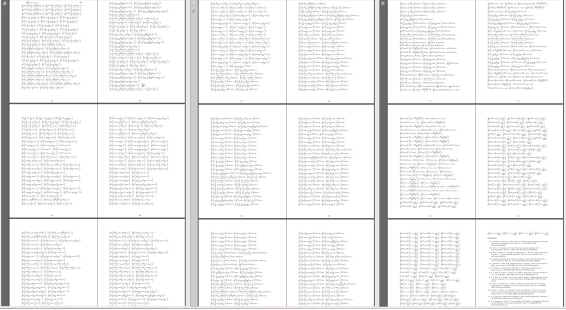
I’m at Brown this week, where I’ve been chatting with Mark Spradlin and Anastasia Volovich, two of the founding figures of my particular branch of amplitudeology. Back in 2010 they figured out how to turn this seventeen-page two-loop amplitude:

Why yes, this is one equation that covers seventeen pages. You're lucky I didn't post the eight-hundred page one.

into a formula that just takes up two lines:gsvvformThis got everyone very excited, it inspired some of my collaborators to do work that would eventually give rise to the Hexagon Functions, my main research project for the past few years.

Unfortunately, when we tried to push this to higher loops, we didn’t get the sort of nice, clean-looking formulas that the Brown team did. Each “loop” is an additional layer of complexity, a series of approximations that get closer to the exact result. And so far, our answers look more like that first image than the second: hundreds of pages with no clear simplifications in sight.

At the time, people wondered whether some simple formula might be enough. As it turns out, you can write down a formula similar to the one found by Spradlin and Volovich, generalized to a higher number of loops. It’s clean, it’s symmetric, it makes sense…and it’s not the right answer.

That happens in science a lot more often than science fans might expect. When you hear about this sort of thing in the news, it always works: someone suggests a nice, simple answer, and it turns out to be correct, and everyone goes home happy. But for every nice simple guess that works, there are dozens that don’t: promising ideas that just lead to dead ends.

One of the postdocs here at Brown worked on this “wrong” formula, and while chatting with him here he asked a very interesting question: why is it wrong? Sure, we know that it’s wrong, we can check that it’s wrong…but what, specifically, is missing? Is it “part” of the right answer in some sense, with some predictable corrections?

As it turns out, this is a very interesting question! We’ve been looking into it, and the “wrong” answer has some interesting relationships with some of our Hexagon Functions. It may have been a “dead end”, but it still could turn out to be a useful one.

A good physics advisor will tell their students to document their work. This doesn’t just mean taking notes: most theoretical physicists will maintain files, in standard journal article format, with partial results. One reason to do this is that, if things work out, you’ll have some of your paper already written. But if something doesn’t work out, you’ll end up with a pdf on your hard drive carefully explaining an idea that didn’t quite work. Physicists often end up with dozens of these files squirreled away on their computers. Put together, they’re a map: a map of dead ends.

There’s a handy thing about having a map: it lets you retrace your steps. Any one of these paths may lead nowhere, but each one will contain some substantive work. And years later, often enough, you end up needing some of it: some piece of the calculation, some old idea. You follow the map, dig it up…and build it into something new.

Bras and Kets, Trading off Instincts

Some physics notation is a joke, but that doesn’t mean it shouldn’t be taken seriously.

Take bras and kets. On the surface, as silly a physics name as any. If you want to find the probability that a state in quantum mechanics turns into another state, you write down a “bracket” between the two states:

\langle a | b\rangle

This leads, with typical physics logic, to the notation for the individual states: separate out the two parts, into a “bra” and a “ket”:

\langle a||b\rangle

It’s kind of a dumb joke, and it annoys the heck out of mathematicians. Not for the joke, of course, mathematicians probably have worse.

Mathematicians are annoyed when we use complicated, weird notation for something that looks like a simple, universal concept. Here, we’re essentially just taking inner products of vectors, something mathematicians have been doing in one form or another for centuries. Yet rather than use their time-tested notation we use our own silly setup.

There’s a method to the madness, though. Bras and kets are handy for our purposes because they allow us to leverage one of the most powerful instincts of programmers: the need to close parentheses.

In programming, various forms of parentheses and brackets allow you to isolate parts of code for different purposes. One set of lines might only activate under certain circumstances, another set of brackets might make text bold. But in essentially every language, you never want to leave an open parenthesis. Doing so is almost always a mistake, one that leaves the rest of your code open to whatever isolated region you were trying to create.

Open parentheses make programmers nervous, and that’s exactly what “bras” and “kets” are for. As it turns out, the states represented by “bras” and “kets” are in a certain sense un-measurable: the only things we can measure are the brackets between them. When people say that in quantum mechanics we can only predict probabilities, that’s a big part of what they mean: the states themselves mean nothing without being assembled into probability-calculating brackets.

This ends up making “bras” and “kets” very useful. If you’re calculating something in the real world and your formula ends up with a free “bra” or a “ket”, you know you’ve done something wrong. Only when all of your bras and kets are assembled into brackets will you have something physically meaningful. Since most physicists have done some programming, the programmer’s instinct to always close parentheses comes to the rescue, nagging until you turn your formula into something that can be measured.

So while our notation may be weird, it does serve a purpose: it makes our instincts fit the counter-intuitive world of quantum mechanics.

Scooped Is a Spectrum

I kind of got scooped recently.

I say kind of, because as I’ve been realizing being scooped isn’t quite the all-or-nothing thing you’d think it would be. Rather, being scooped is a spectrum.

Go ahead and scoop up a spectrum as you’re reading this.

By the way, I’m going to be a bit cagey about what exactly I got scooped on. As you’ll see, there are still a few things my collaborator and I need to figure out, and in the meantime I don’t want to put my foot in my mouth. Those of you who follow what’s going on in amplitudes might have some guesses. In case you’re worried, it has nothing to do with my work on Hexagon Functions.

When I heard about the paper that scooped us, my first reaction was to assume the project I’d been working on for a few weeks was now a dead end. When another group publishes the same thing you’ve been working on, and does it first, there doesn’t seem to be much you can do besides shake hands and move on.

As it turns out, though, things are a bit more complicated. The risk of publishing fast, after all, is making mistakes. In this case, it’s starting to look like a few of the obstructions that were holding us back weren’t solved by the other group, and in fact that they may have ignored those obstructions altogether in their rush to get something publishable.

This creates an interesting situation. It’s pretty clear the other group is beyond us in certain respects, they published first for a (good) reason. On the other hand, precisely because we’ve been slower, we’ve caught problems that it looks like the other group didn’t notice. Rather than rendering our work useless, this makes it that much more useful: complementing the other group’s work rather than competing with it.

Being scooped is a spectrum. If two groups are working on very similar things, then whoever publishes first usually wins. But if the work is different enough, then a whole range of roles opens up, from corrections and objections to extensions and completions. Being scooped doesn’t have to be the end of the world, in fact, it can be the beginning.

The Theorist Exclusion Principle

There are a lot of people who think theoretical physics has gone off-track, though very few of them agree on exactly how. Some think that string theory as a whole is a waste of time, others that the field just needs to pay more attention to their preferred idea. Some think we aren’t paying enough attention to the big questions, or that we’re too focused on “safe” ideas like supersymmetry, even when they aren’t working out. Some think the field needs less focus on mathematics, while others think it needs even more.

Usually, people act on these opinions by writing strongly worded articles and blog posts. Sometimes, they have more power, and act with money, creating grants and prizes that only go to their preferred areas of research.

Let’s put the question of whether the field actually needs to change aside for the moment. Even if it does, I’m skeptical that this sort of thing will have any real effect. While grants and blogs may be very good at swaying experimentalists, theorists are likely to be harder to shift, due to what I’m going to call the Theorist Exclusion Principle.

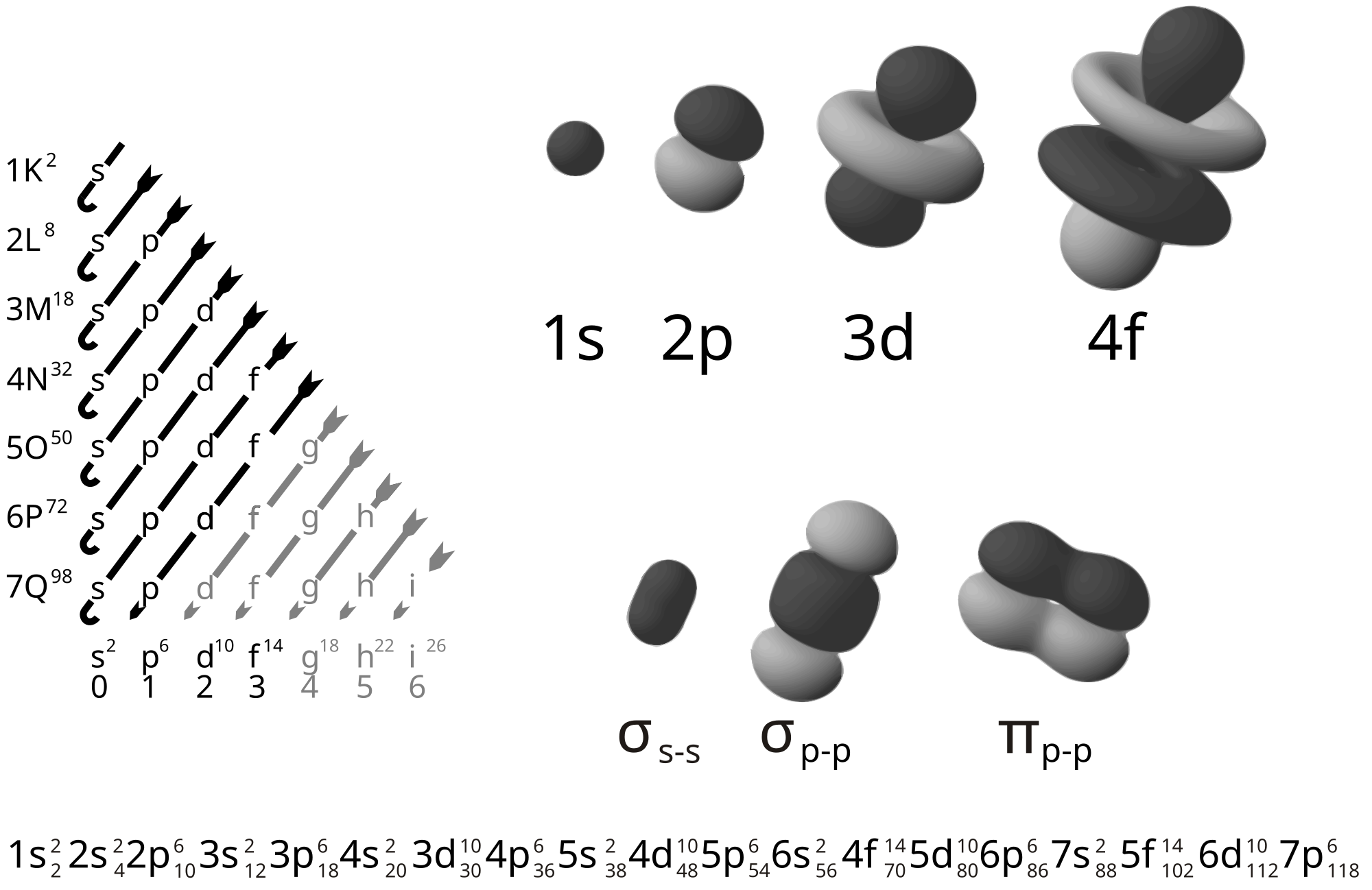
The Pauli Exclusion Principle is a rule from quantum mechanics that states that two fermions (particles with half-integer spin) can’t occupy the same state. Fermions include electrons, quarks, protons…essentially, all the particles that make up matter. Many people learn about the Pauli Exclusion Principle first in a chemistry class, where it explains why electrons fall into different energy levels in atoms: once one energy level “fills up”, no more electrons can occupy the same state, and any additional electrons are “excluded” and must occupy a different energy level.

Those 1s electrons are such a clique!

In contrast, bosons (like photons, or the Higgs) can all occupy the same state. It’s what allows for things like lasers, and it’s why all the matter we’re used to is made out of fermions: because fermions can’t occupy the same state as each other, as you add more fermions the structures they form have to become more and more complicated.

Experimentalists are a little like bosons. While you can’t stuff two experimentalists into the same quantum state, you can get them working on very similar projects. They can form large collaborations, with each additional researcher making the experiment that much easier. They can replicate eachother’s work, making sure it was accurate. They can take some physical phenomenon and subject it to a battery of tests, so that someone is bound to learn something.

Theorists, on the other hand, are much more like fermions. In theory, there’s very little reason to work on something that someone else is already doing. Replication doesn’t mean very much: the purest theory involves mathematical proofs, where replication is essentially pointless. Theorists do form collaborations, but they don’t have the same need for armies of technicians and grad students that experimentalists do. With no physical objects to work on, there’s a limit to how much can be done pursuing one particular problem, and if there really are a lot of options they can be pursued by one person with a cluster.

Like fermions, then, theorists expand to fill the projects available. If an idea is viable, someone will probably work on it, and once they do, there isn’t much reason for someone else to do the same thing.

This makes theory a lot harder to influence than experiment. You can write the most beautiful thinkpiece possible to persuade theorists to study the deep questions of the universe, but if there aren’t any real calculations available nothing will change. Contrary to public perception, theoretical physicists aren’t paid to just sit around thinking all day: we calculate, compute, and publish, and if a topic doesn’t lend itself to that then we won’t get much mileage out of it. And no matter what you try to preferentially fund with grants, mostly you’ll just get people re-branding what they’re already doing, shifting a few superficial details to qualify.

Theorists won’t occupy the same states, so if you want to influence theorists you need to make sure there are open states where you’re trying to get them to go. Historically, theorists have shifted when new states have opened up: new data from experiment that needed a novel explanation, new mathematical concepts that opened up new types of calculations. You want there to be fewer string theorists, or more focus on the deep questions? Give us something concrete to do, and I guarantee you’ll get theorists flooding in.