Category Archives: Life as a Physicist

Topic Conferences, Place Conferences

I spent this week at Current Themes in High Energy Physics and Cosmology, a conference at the Niels Bohr Institute.

Most conferences focus on a particular topic. Usually the broader the topic, the bigger the conference. A workshop on flux tubes is smaller than Amplitudes, which is smaller than Strings, which is smaller than the March Meeting of the American Physical Society.

“Current Themes in High Energy Physics and Cosmology” sounds like a very broad topic, but it was a small conference. The reason why is that it wasn’t a “topic conference”, it was a “place conference”.

Most conferences focus on a topic, but some are built around a place. These conferences are hosted by a particular institute year after year. Sometimes each year has a loose theme (for example, the Simons Summer Workshop this year focused on theories without supersymmetry) but sometimes no attempt is made to tie the talks together (“current themes”).

Instead of a theme, the people who go to these conferences are united by their connections to the institute. Some of them have collaborators there, or worked there in the past. Others have been coming for many years. Some just happened to be in the area.

While they may seem eclectic, “place” conferences have a valuable role: they help to keep our interests broad. In physics, there’s a natural tendency to specialize. Left alone, we end up reading papers and going to talks only when they’re directly relevant for what we’re working on. By doing this we lose track of the wider field, losing access to the insights that come from different perspectives and methods.

“Place” conferences, like seminars, help pull things in the other direction. When you’re hearing talks from “everyone connected to the Simons Center” or “everyone connected to the Niels Bohr Institute”, you’re exposed to a much broader range of topics than a conference for just your sub-field. You get a broad overview of what’s going on in the field, but unlike a big conference like Strings there are few enough people that you can actually talk to everyone.

Physicists’ attachment to places is counter-intuitive. We’re studying mathematical truths and laws of nature, surely it shouldn’t matter where we work. In practice, though, we’re still human. Out of the vast span of physics we still pick our interests based on the people around us. That’s why places, why institutes with a wide range of excellent people, are so important: they put our social instincts to work studying the universe.

Copenhagen!

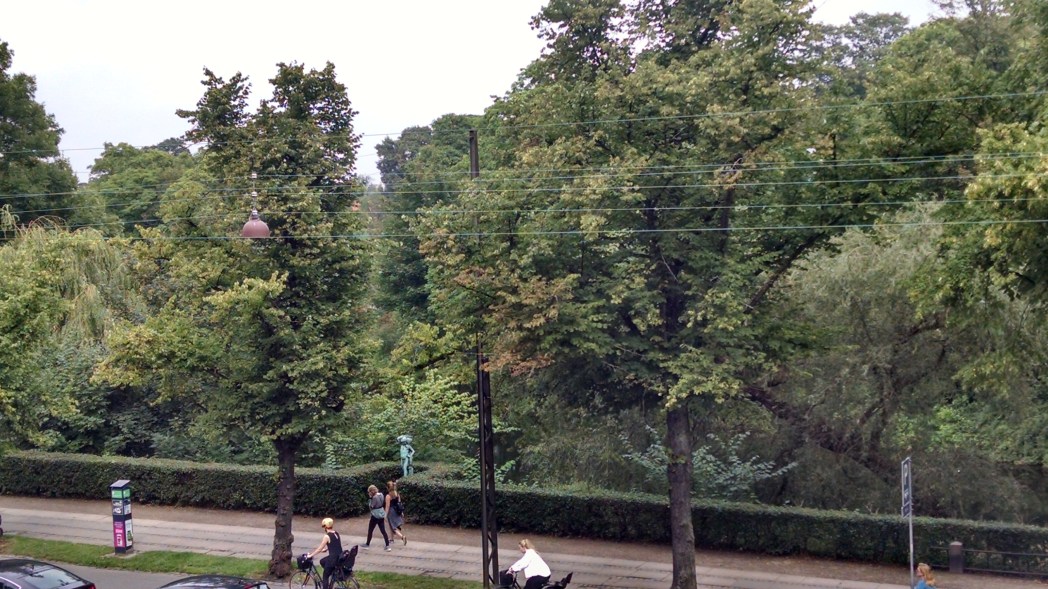
After a week of packing, shipping, selling or donating my worldly possessions, I have now arrived in Denmark! I’m too exhausted for much of a post this week, so enjoy this picture of the wilderness of the frozen north.

IMG_20170818_141518306_HDR.jpg

Ok fine it’s a park.

We’re Weird

Preparing to move to Denmark, it strikes me just how strange what I’m doing would seem to most people. I’m moving across the ocean to a place where I don’t know the language. (Or at least, don’t know more than half a duolingo lesson.) I’m doing this just three years after another international move. And while I’m definitely nervous, this isn’t the big life changing shift it would be for many people. It’s just how academic careers are expected to work.

At borders, I’m often asked why I am where I am. Why be an American working in Canada? Why move to Denmark? And in general, the answer is just that it’s where I need to be to do what I want to do, because it’s where the other people who do what I want to do are. A few people seed this process by managing to find faculty jobs in their home countries, and others sort themselves out by their interests. In the end, we end up with places like Perimeter, an institute in the middle of Canada with barely any Canadians.

This is more pronounced for smaller fields than for larger ones. A chemist or biologist might just manage to have their whole career in the same state of the US, or the same country in Europe. For a theoretical physicist, this is much less likely. I also suspect it’s more true of more “universal” fields: that most professors of Portuguese literature are in Portugal or Brazil, for example.

For theoretical physics, the result is an essentially random mix of people around the world. This works, in part, because essentially everyone does science in English. Occasionally, a group of collaborators happens to speak the same non-English language, so you sometimes hear people talking science in Russian or Spanish or French. But even then there are times people will default to English anyway, because they’re used to it. We publish in English, we chat in English. And as a result, wherever we end up we can at least talk to our colleagues, even if the surrounding world is trickier.

Communities this international, with four different accents in every conversation, are rare, and I occasionally forget that. Before grad school, the closest I came to this was on the internet. On Dungeons and Dragons forums, much like in academia, everyone was drawn together by shared interests and expertise. We had Australians logging on in the middle of everyone else’s night to argue with the Germans, and Brazilians pointing out how the game’s errata was implemented differently in Portuguese.

It’s fun to be in that sort of community in the real world. There’s always something to learn from each other, even on completely mundane topics. Lunch often turns into a discussion of different countries’ cuisines. As someone who became an academic because I enjoy learning, it’s great to have the wheels constantly spinning like that. I should remember, though, that most of the world doesn’t live like this: we’re currently a pretty weird bunch.

Join the Dark Side: Become a Seminar Organizer

Attending talks is the bane of many a physicist’s existence. Taking an hour out of your busy schedule to listen to someone you know you’ll only understand for fifteen minutes, hoping that they’ll at least give you a vague idea of why you should care but expecting that they won’t…who would willingly subject people to that?

Well, I would.

I’ve signed up to be the High Energy Theory Seminar organizer for the Niels Bohr Institute this year. Most physics institutes hold regular seminars, usually once or twice a week, where they invite speakers from the surrounding region and all over the world. Organizing these seminars is a job often handed to one of the local postdocs: in this case, me.

In the past I’ve put some thought into the purpose of seminars, but mostly from the perspective of someone attending and occasionally giving them. Now that I’m involved in organizing them, entirely new questions present themselves.

Are seminars for work, or for fun? On the one hand, seminars can be a way to keep up with your own field and pick up useful techniques from others. Looked at in that way, I should invite speakers whose interests line up with the researchers at NBI. On the other hand, seminars can be a good way to find out what’s going on outside of your own field, to satisfy your curiosity about the “next big thing”. Sometimes you see a paper and wish you could ask the author what they were thinking, seminars let you ask face to face.

Is it better to invite big names, or grad students? The big-name people might give better talks on more interesting topics, and they enhance the prestige of the seminar series. They also tend to be busy, and don’t need the talks as much as the grad students do.

People from nearby, or far away? It’s cheaper to invite people from nearby, but you want at least a few big names from farther away.

For most of these, the right approach is a balanced one. You want to invite people whose interests line up with your colleagues, but also a few more distant people for breadth. You want a mix of established big-name people and younger researchers, nearby people and far away ones.

The Niels Bohr Institute does a lot of seminars, typically two per week. Even with a co-organizer filling half of them, that’s a lot of ground to cover, a lot of room to balance all of these goals.

Seminar organizers get exposed to a wide range of researchers working on a wide range of topics. It’s supposed to be good for the career, the ultimate networking experience. For myself, I’m still quite specialized, so I’m hoping this will be a good opportunity to broaden my interests and learn about what others are doing. Along the way, perhaps I’ll get a better idea of what seminars are really for.

Where Grants Go on the Ground

I’ve seen several recent debates about grant funding, arguments about whether this or that scientist’s work is “useless” and shouldn’t get funded. Wading into the specifics is a bit more political than I want to get on this blog right now, and if you’re looking for a general defense of basic science there are plenty to choose from. I’d like to focus on a different part, one where I think the sort of people who want to de-fund “useless” research are wildly overoptimistic.

People who call out “useless” research act as if government science funding works in a simple, straightforward way: scientists say what they want to work on, the government chooses which projects it thinks are worth funding, and the scientists the government chooses get paid.

This may be a (rough) picture of how grants are assigned. For big experiments and grants with very specific purposes, it’s reasonably accurate. But for the bulk of grants distributed among individual scientists, it ignores what happens to the money on the ground, after the scientists get it.

The simple fact of the matter is that what a grant is “for” doesn’t have all that much influence on what it gets spent on. In most cases, scientists work on what they want to, and find ways to pay for it.

Sometimes, this means getting grants for applied work, doing some of that, but also fitting in more abstract theoretical projects during downtime. Sometimes this means sharing grant money, if someone has a promising grad student they can’t fund at the moment and needs the extra help. (When I first got research funding as a grad student, I had to talk to the particle physics group’s secretary, and I’m still not 100% sure why.) Sometimes this means being funded to look into something specific and finding a promising spinoff that takes you in an entirely different direction. Sometimes you can get quite far by telling a good story, like a mathematician I know who gets defense funding to study big abstract mathematical systems because some related systems happen to have practical uses.

Is this unethical? Some of it, maybe. But from what I’ve seen of grant applications, it’s understandable.

The problem is that if scientists are too loose with what they spend grant money on, grant agency asks tend to be far too specific. I’ve heard of grants that ask you to give a timeline, over the next five years, of each discovery you’re planning to make. That sort of thing just isn’t possible in science: we can lay out a rough direction to go, but we don’t know what we’ll find.

The end result is a bit like complaints about job interviews, where everyone is expected to say they love the company even though no-one actually does. It creates an environment where everyone has to twist the truth just to keep up with everyone else.

The other thing to keep in mind is that there really isn’t any practical way to enforce any of this. Sure, you can require receipts for equipment and the like, but once you’re paying for scientists’ time you don’t have a good way to monitor how they spend it. The best you can do is have experts around to evaluate the scientists’ output…but if those experts understand enough to do that, they’re going to be part of the scientific community, like grant committees usually already are. They’ll have the same expectations as the scientists, and give similar leeway.

So if you want to kill off some “useless” area of research, you can’t do it by picking and choosing who gets grants for what. There are advocates of more drastic actions of course, trying to kill whole agencies or fields, and that’s beyond the scope of this post. But if you want science funding to keep working the way it does, and just have strong opinions about what scientists should do with it, then calling out “useless” research doesn’t do very much: if the scientists in question think it’s useful, they’ll find a way to keep working on it. You’ve slowed them down, but you’ll still end up paying for research you don’t like.

Final note: The rule against political discussion in the comments is still in effect. For this post, that means no specific accusations of one field or another as being useless, or one politician/political party/ideology or another of being the problem here. Abstract discussions and discussions of how the grant system works should be fine.

Visiting LBNL

I’ve been traveling this week, giving a talk at Lawrence Berkeley National Laboratory, so this will be a short post.

In my experience, most non-scientists don’t know about the national labs. In the US, the majority of scientists work for universities, but a substantial number work at one of the seventeen national labs overseen by the Department of Energy. It’s a good gig, if you can get it: no teaching duties, and a fair amount of freedom in what you research.

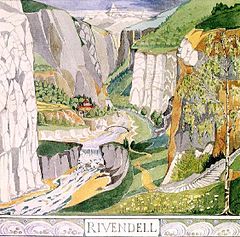
Each lab has its own focus, and its own culture. In the past I’ve spent a lot of time at SLAC, which runs a particle accelerator near Stanford (among other things). Visiting LBNL, I was amused by some of the differences. At SLAC, the guest rooms have ads for Stanford-branded bed covers. LBNL, meanwhile, brags about its beeswax-based toiletries in recyclable cardboard bottles. SLAC is flat, spread out, and fairly easy to navigate. LBNL is a maze of buildings arranged in tight terraces on a steep hill.

240px-rivendell_illustration

I forgot to take a picture, but someone appears to have drawn one.

While the differences were amusing, physicists are physicists everywhere. It was nice to share my work with people who mostly hadn’t heard about it before, and to get an impression of what they were working on.

Thoughts from the Winter School

There are two things I’d like to talk about this week.

First, as promised, I’ll talk about what I worked on at the PSI Winter School.

Freddy Cachazo and I study what are called scattering amplitudes. At first glance, these are probabilities that two subatomic particles scatter off each other, relevant for experiments like the Large Hadron Collider. In practice, though, they can calculate much more.

For example, let’s say you have two black holes circling each other, like the ones LIGO detected. Zoom out far enough, and you can think of each one as a particle. The two particle-black holes exchange gravitons, and those exchanges give rise to the force of gravity between them.
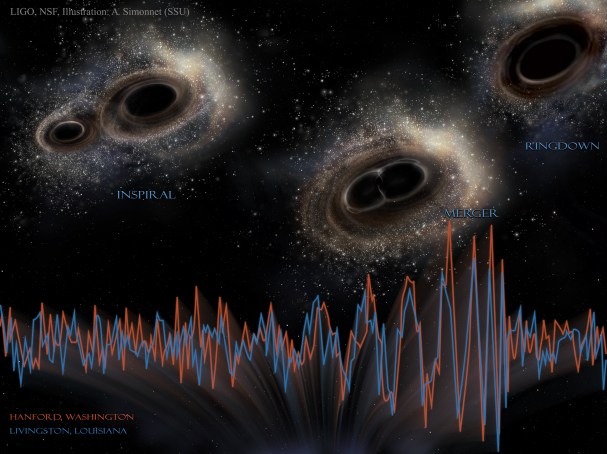
bhmerger_ligo_3600

In the end, it’s all just particle physics.


Based on that, we can use our favorite scattering amplitudes to make predictions for gravitational wave telescopes like LIGO.

There’s a bit of weirdness to this story, though, because these amplitudes don’t line up with predictions in quite the way we’re used to. The way we calculate amplitudes involves drawing diagrams, and those diagrams have loops. Normally, each “loop” makes the amplitude more quantum-mechanical. Only the diagrams with no loops (“tree diagrams”) come from classical physics alone.

(Here “classical physics” just means “not quantum”: I’m calling general relativity “classical”.)

For this problem, we only care about classical physics: LIGO isn’t sensitive enough to see quantum effects. The weird thing is, despite that, we still need loops.

(Why? This is a story I haven’t figured out how to tell in a non-technical way. The technical explanation has to do with the fact that we’re calculating a potential, not an amplitude, so there’s a Fourier transformation, and keeping track of the dimensions entails tossing around some factors of Planck’s constant. But I feel like this still isn’t quite the full story.)

So if we want to make predictions for LIGO, we want to compute amplitudes with loops. And as amplitudeologists, we should be pretty good at that.

As it turns out, plenty of other people have already had that idea, but there’s still room for improvement.

Our time with the students at the Winter School was limited, so our goal was fairly modest. We wanted to understand those other peoples’ calculations, and perhaps to think about them in a slightly cleaner way. In particular, we wanted to understand why “loops” are really necessary, and whether there was some way of understanding what the “loops” were doing in a more purely classical picture.

At this point, we feel like we’ve got the beginning of an idea of what’s going on. Time will tell whether it works out, and I’ll update you guys when we have a more presentable picture.


Unfortunately, physics wasn’t the only thing I was thinking about last week, which brings me to my other topic.

This blog has a fairly strong policy against talking politics. This is for several reasons. Partly, it’s because politics simply isn’t my area of expertise. Partly, it’s because talking politics tends to lead to long arguments in which nobody manages to learn anything. Despite this, I’m about to talk politics.

Last week, citizens of Iran, Iraq, Libya, Somalia, Sudan, Syria and Yemen were barred from entering the US. This included not only new visa applicants, but also those who already have visas or green cards. The latter group includes long-term residents of the US, many of whom were detained in airports and threatened with deportation when their flights arrived shortly after the ban was announced. Among those was the president of the Graduate Student Organization at my former grad school.

A federal judge has blocked parts of the order, and the Department of Homeland Security has announced that there will be case-by-case exceptions. Still, plenty of people are stuck: either abroad if they didn’t get in in time, or in the US, afraid that if they leave they won’t be able to return.

Politics isn’t in my area of expertise. But…

I travel for work pretty often. I know how terrifying and arbitrary border enforcement can be. I know how it feels to risk thousands of dollars and months of planning because some consulate or border official is having a bad day.

I also know how essential travel is to doing science. When there’s only one expert in the world who does the sort of work you need, you can’t just find a local substitute.

And so for this, I don’t need to be an expert in politics. I don’t need a detailed case about the risks of terrorism. I already know what I need to, and I know that this is cruel.

And so I stand in solidarity with the people who were trapped in airports, and those still trapped abroad and trapped in the US. You have been treated cruelly, and you shouldn’t have been. Hopefully, that sort of message can transcend politics.


One final thing: I’m going to be a massive hypocrite and continue to ban political comments on this blog. If you want to talk to me about any of this (and you think one or both of us might actually learn something from the exchange) please contact me in private.

Digging up Variations

The best parts of physics research are when I get a chance to push out into the unknown, doing calculations no-one has done before. Sometimes, though, research is more…archeological.

2016-05-441-134ap_archeologyexcavation_loropc3a9ni_ruins_nr-loropc3a9niponi_prv-bf_sun15may2016-1119h

Pictured: not what I signed up for

Recently, I’ve been digging through a tangle of papers, each of which calculates roughly the same thing in a slightly different way. Like any good archeologist, I need to figure out not just what the authors of these papers were doing, but also why.

(As a physicist, why do I care about “why”? In this case, it’s because I want to know which of the authors’ choices are worth building on. If I can figure out why they made the choices they did, I can decide whether I share their motivations, and thus which aspects of their calculations are useful for mine.)

My first guess at “why” was a deeply cynical one. Why would someone publish slight variations on an old calculation? To get more publications!

This is a real problem in science. In certain countries in particular, promotions and tenure are based not on honestly assessing someone’s work but on quick and dirty calculations based on how many papers they’ve published. This motivates scientists to do the smallest amount possible in order to get a paper out.

That wasn’t what was happening in these papers, though. None of the authors lived in those kinds of countries, and most were pretty well established people: not the sort who worry about keeping up with publications.

So I put aside my cynical first-guess, and actually looked at the papers. Doing that, I found a more optimistic explanation.

These authors were in the process of building research programs. Each had their own long-term goal, a set of concepts and methods they were building towards. And each stopped along the way, to do another variation on this well-trod calculation. They weren’t doing this just because they needed a paper, or just because they could. They were trying to sift out insights, to debug their nascent research program in a well-understood case.

Thinking about it this way helped untwist the tangle of papers. The confusion of different choices suddenly made sense, as the result of different programs with different goals. And in turn, understanding which goals contributed to which papers helped me sort out which goals I shared, and which ideas would turn out to be helpful.

Would it have been less confusing if some of these people had sat on their calculations, and not published? Maybe at first. But in the end, the variations help, giving me a clearer understanding of the whole.

Next Year in Copenhagen!

As some of you might be aware, this is my last year at the Perimeter Institute. It’s been great, but the contract was only for three years, and come August I’ll be heading elsewhere.

Determining that “elsewhere” was the subject of an extensive job search. Now that the search has resolved, I can tell you that “elsewhere” is the Niels Bohr International Academy at the Niels Bohr Institute in Copenhagen, where I’ll be starting a three-year postdoc job in the fall.

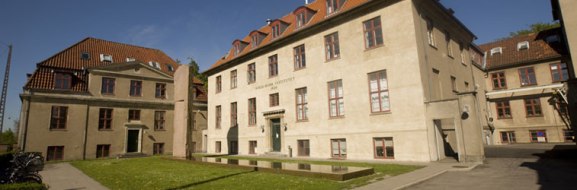
blegdamsvej_forside

Probably in the building on the left

There are some pretty stellar amplitudes people at NBIA, so I’m pretty excited to be going there. It’s going to be a great opportunity to both build on what I’ve been doing and expand beyond. They’re also hiring several other amplitudes-focused postdocs this year, so overall it should be a really fun group.

It’s also a bit daunting. Moving to Canada from the US was reasonably smooth, I could drive most of my things over in a U-Haul truck. Moving to Denmark is going to be quite a bit more complicated. I’ll need to learn a new language and get used to a fairly different culture.

I can take solace in the fact that in some sense I’m retracing my great-grandfather’s journey in the opposite direction. My great-grandfather worked at the Niels Bohr Institute on his way out of Europe in the 1930’s, and made friends with the Bohrs along the way, before coming to the US. I’ll get a chance to explore a piece of family history, and likely collaborate with a Bohr as well.

A Tale of Two Archives

When it comes to articles about theoretical physics, I have a pet peeve, one made all the more annoying by the fact that it appears even in pieces that are otherwise well written. It involves the following disclaimer:

“This article has not been peer-reviewed.”

Here’s the thing: if you’re dealing with experiments, peer review is very important. Plenty of experiments have subtle problems with their methods, enough that it’s important to have a group of experts who can check them. In experimental fields, you really shouldn’t trust things that haven’t been through a journal yet: there’s just a lot that can go wrong.

In theoretical physics, though, peer review is important for different reasons. Most papers are mathematically rigorous enough that they’re not going to be wrong per se, and most of the ways they could be wrong won’t be caught by peer review. While peer review sometimes does catch mistakes, much more often it’s about assessing the significance of a result. Peer review determines whether a result gets into a prestigious journal or a less prestigious one, which in turn matters for job and grant applications.

As such, it doesn’t really make sense for a journalist to point out that a theoretical physics paper hasn’t been peer reviewed yet. If you think it’s important enough to write an article about, then you’ve already decided it’s significant: peer review wasn’t going to tell you anything else.

We physicists post our papers to arXiv, a free-to-access paper repository, before submitting them to journals. While arXiv does have some moderation, it’s not much: pretty much anyone in the field can post whatever they want.

This leaves a lot of people confused. In that sort of system, how do we know which papers to trust?

Let’s compare to another archive: Archive of Our Own, or AO3 for short.

Unlike arXiv, AO3 hosts not physics, but fanfiction. However, like arXiv it’s quite lightly moderated and free to access. On arXiv you want papers you can trust, on AO3 you want stories you enjoy. In each case, if anyone can post, how do you find them?

The first step is filtering. AO3 and arXiv both have systems of tags and subject headings. The headings on arXiv are simpler and more heavily moderated than those on AO3, but they both serve the purpose of letting people filter out the subjects, whether scientific or fictional, that they find interesting. If you’re interested in astrophysics, try astro-ph on arXiv. If you want Harry Potter fanfiction, try the “Harry Potter – J.K. Rowling” tag on AO3.

Beyond that, it helps to pay attention to authors. When an author has written something you like, it’s worth it not only to keep up with other things they write, but to see which other authors they like and pay attention to them as well. That’s true whether the author is Juan Maldacena or your favorite source of Twilight fanfic.

Even if you follow all of this, you can’t trust every paper you find on arXiv. You also won’t enjoy everything you dig up on AO3. Either way, publication (in journals or books) won’t solve your problem: both are an additional filter, but not an infallible one. Judgement is still necessary.

This is all to say that “this article has not been peer-reviewed” can be a useful warning, but often isn’t. In theoretical physics, knowing who wrote an article and what it’s about will often tell you much more than whether or not it’s been peer-reviewed yet.