
Since the new Oppenheimer biopic came out, people have been making fun of this tweet by Sam Altman:
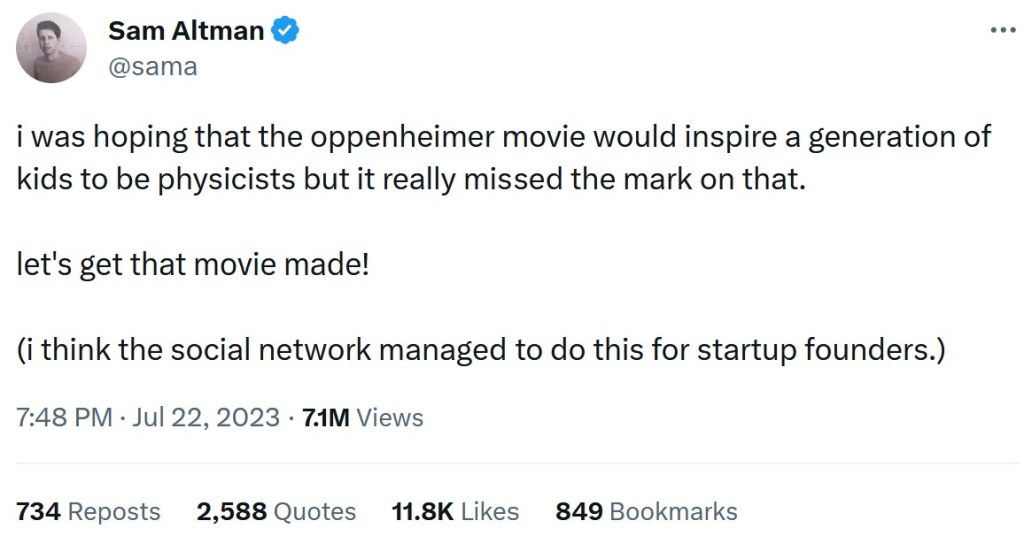
Expecting a movie about someone building an immensely destructive weapon, watching it plunge the world into paranoia, then getting mercilessly hounded about it to be an inspiration seems…a bit unrealistic? But everyone has already made that point. What I found more interesting was a blog post a couple days ago by science blogger Chad Orzel. Orzel asks, suppose you did want to make a movie inspiring kids to go into physics: how would you do it? I commented on his post with my own take on the question, then realized it might be nice as a post here.
If you want to inspire kids to go into physics with a movie, what do you do? Well, you can start by asking, why do you want kids to go into physics? Why do you want more physicists?
Maybe you believe that more physicists are needed to understand the fundamental laws of the universe. The quest of fundamental physics may be worthwhile in its own right, or may be important because understanding the universe gives us more tools to manipulate it. You might even think of Oppenheimer’s story in that way: because physicists understood the nature of the atom, they could apply that knowledge to change the world, racing to use it to defeat the Nazis and later convinced to continue to avoid a brutal invasion of Japan. (Whether the bomb was actually necessary to do this is still, of course, quite controversial.)
If that’s why you want more kids to be physicists, then you want a story like that. You could riff off of Ashoke Sen’s idea that physics may be essential to save humanity. The laws of physics appear to be unstable, such that at some point the world will shift and a “bubble”, expanding at the speed of light, will rewrite the rules in a way that would destroy all life as we know it. The only way to escape would be to travel faster than light, something that is possible because the universe itself expands at those speeds. By scattering “generation ships” in different directions, we could ensure that some of humanity would survive any such “bubble”: but only if we got the physics right.
A movie based on that idea could look a bit like the movie Cloud Atlas, with connected characters spanning multiple time periods. Scientists in the modern day investigate the expanding universe, making plans that refugees in a future generation ship must carry out. If you want to inspire kids with the idea that physics could save the world, you could get a lot of mileage out of a story that could actually be true.
On the other hand, maybe you don’t care so much about fundamental physics. Maybe you want more physicists because they’re good at solving a variety of problems. They help to invent new materials, to measure things precisely, to predict the weather, change computation, and even contribute to medicine. Maybe you want to tell a story about that.
(Maybe you even want these kids to go farther afield, and study physics without actually becoming physicists. Sam Altman is not a physicist, and I’ve heard he’s not very interested in directing his philanthropic money to increasing the number of jobs for physicists. On the other hand, the AI industry where he is a central player does hire a lot of ex-physicists.)
The problem, as Orzel points out, is that those stories aren’t really stories about physicists. They’re stories about engineering and technology, and a variety of other scientists, because a wide variety of people contribute to these problems. In order to tell a story that inspires people to be physicists, you need a story that highlights something unique that they bring to the table.
Orzel gets close to what I think of as the solution, by bringing up The Social Network. Altman was also mocked for saying that The Social Network motivated kids to found startups: the startup founders in that movie are not exactly depicted as good people. But in reality, it appears that the movie did motivate people to found startups. Stories about badass amoral jerks are engaging, and it’s easy to fantasize about having that kind of power and ability. There’s a reason that The Imitation Game depicted Alan Turing, a man known for his gentle kindness, as brusque and arrogant.
If you want to tell a story about physicists, it’s actually pretty easy, because physicists can be quite arrogant! There is a stereotype of physicists walking into another field, deciding they know everything they need to know, and lecturing the experts about how they should be doing their jobs. This really does happen, and sometimes it’s exactly as dumb as it sounds…but sometimes the physicists are right! Orzel brings up Feynman’s role in figuring out how the Challenger space shuttle blew up, an example of precisely this kind of success.
So if you want kids to grow up to be generalist physicists, people who solve all sorts of problems for all sorts of people, you need to tell them a story like that. One with a Sherlock-esque physicist who runs around showing how much smarter they are than everyone else. You need to make a plot where they physicist waves around “physicist tools”, like dimensional analysis, Fermi estimates, and thermodynamics, and uses them to uncover a mystery, showing a bunch of engineers or biologists just how much cooler they are.
If you do that, you probably could inspire some kids to become physicists. You’ll need a new movie to inspire them to be engineers or biologists, though!
 4 gravitons
I like this idea, but my motivation for making it is different. Science is the uncovering of truth about the physical universe. It requires critical thinking, testing, and accepting of the test results. It means accepting the truth. Of all the sciences physics is the most rigorous and methodical in this way. Inspiring people to become physicists, or into fields close to it, teaches people how to think critically and tell truth from fiction and lies. Something we need very desperately in the world right now.
LikeLike