Monthly Archives: September 2022

Jumpstarting Elliptic Bootstrapping

I was at a mini-conference this week, called Jumpstarting Elliptic Bootstrap Methods for Scattering Amplitudes.

I’ve done a lot of work with what we like to call “bootstrap” methods. Instead of doing a particle physics calculation in all its gory detail, we start with a plausible guess and impose requirements based on what we know. Eventually, we have the right answer pulled up “by its own bootstraps”: the only answer the calculation could have, without actually doing the calculation.

This method works very well, but so far it’s only been applied to certain kinds of calculations, involving mathematical functions called polylogarithms. More complicated calculations involve a mathematical object called an elliptic curve, and until very recently it wasn’t clear how to bootstrap them. To get people thinking about it, my colleagues Hjalte Frellesvig and Andrew McLeod asked the Carlsberg Foundation (yes, that Carlsberg) to fund a mini-conference. The idea was to get elliptic people and bootstrap people together (along with Hjalte’s tribe, intersection theory people) to hash things out. “Jumpstart people” are not a thing in physics, so despite the title they were not invited.
Anyone remember these games? Did you know that they still exist, have an educational MMO, and bought neopets?

Having the conference so soon after the yearly Elliptics meeting had some strange consequences. There was only one actual duplicate talk, but the first day of talks all felt like they would have been welcome additions to the earlier conference. Some might be functioning as “overflow”: Elliptics this year focused on discussion and so didn’t have many slots for talks, while this conference despite its discussion-focused goal had a more packed schedule. In other cases, people might have been persuaded by the more relaxed atmosphere and lack of recording or posted slides to give more speculative talks. Oliver Schlotterer’s talk was likely in this category, a discussion of the genus-two functions one step beyond elliptics that I think people at the previous conference would have found very exciting, but which involved work in progress that I could understand him being cautious about presenting.

The other days focused more on the bootstrap side, with progress on some surprising but not-quite-yet elliptic avenues. It was great to hear that Mark Spradlin is making new progress on his Ziggurat story, to hear James Drummond suggest a picture for cluster algebras that could generalize to other theories, and to get some idea of the mysterious ongoing story that animates my colleague Cristian Vergu.

There was one thing the organizers couldn’t have anticipated that ended up throwing the conference into a new light. The goal of the conference was to get people started bootstrapping elliptic functions, but in the meantime people have gotten started on their own. Roger Morales Espasa presented his work on this with several of my other colleagues. They can already reproduce a known result, the ten-particle elliptic double-box, and are well on-track to deriving something genuinely new, the twelve-particle version. It’s exciting, but it definitely makes the rest of us look around and take stock. Hopefully for the better!


Cabinet of Curiosities: The Nested Toy

I had a paper two weeks ago with a Master’s student, Alex Chaparro Pozo. I haven’t gotten a chance to talk about it yet, so I thought I should say a few words this week. It’s another entry in what I’ve been calling my cabinet of curiosities, interesting mathematical “objects” I’m sharing with the world.

I calculate scattering amplitudes, formulas that give the probability that particles scatter off each other in particular ways. While in principle I could do this with any particle physics theory, I have a favorite: a “toy model” called N=4 super Yang-Mills. N=4 super Yang-Mills doesn’t describe reality, but it lets us figure out cool new calculation tricks, and these often end up useful in reality as well.

Many scattering amplitudes in N=4 super Yang-Mills involve a type of mathematical functions called polylogarithms. These functions are especially easy to work with, but they aren’t the whole story. One we start considering more complicated situations (what if two particles collide, and eight particles come out?) we need more complicated functions, called elliptic polylogarithms.

A few years ago, some collaborators and I figured out how to calculate one of these elliptic scattering amplitudes. We didn’t do it as well as we’d like, though: the calculation was “half-done” in a sense. To do the other half, we needed new mathematical tools, tools that came out soon after. Once those tools were out, we started learning how to apply them, trying to “finish” the calculation we started.

The original calculation was pretty complicated. Two particles colliding, eight particles coming out, meant that in total we had to keep track of ten different particles. That gets messy fast. I’m pretty good at dealing with six particles, not ten. Luckily, it turned out there was a way to pretend there were six particles only: by “twisting” up the calculation, we found a toy model within the toy model: a six-particle version of the calculation. Much like the original was in a theory that doesn’t describe the real world, these six particles don’t describe six particles in that theory: they’re a kind of toy calculation within the toy model, doubly un-real.

Not quintuply-unreal though

With this nested toy model, I was confident we could do the calculation. I wasn’t confident I’d have time for it, though. This ended up making it perfect for a Master’s thesis, which is how Alex got into the game.

Alex worked his way through the calculation, programming and transforming, going from one type of mathematical functions to another (at least once because I’d forgotten to tell him the right functions to use, oops!) There were more details and subtleties than expected, but in the end everything worked out.

Then, we were scooped.

Another group figured out how to do the full, ten-particle problem, not just the toy model. That group was just “down the hall”…or would have been “down the hall” if we had been going to the office (this was 2021, after all). I didn’t hear about what they were working on until it was too late to change plans.

Alex left the field (not, as far as I know, because of this). And for a while, because of that especially thorough scooping, I didn’t publish.

What changed my mind, in part, was seeing the field develop in the meantime. It turns out toy models, and even nested toy models, are quite useful. We still have a lot of uncertainty about what to do, how to use the new calculation methods and what they imply. And usually, the best way to get through that kind of uncertainty is with simple, well-behaved toy models.

So I thought, in the end, that this might be useful. Even if it’s a toy version of something that already exists, I expect it to be an educational toy, one we can learn a lot from. So I’ve put it out into the world, as part of this year’s cabinet of curiosities.

At Elliptic Integrals in Fundamental Physics in Mainz

I’m at a conference this week. It’s named Elliptic Integrals in Fundamental Physics, but I think of it as “Elliptics 2022”, the latest in a series of conferences on elliptic integrals in particle physics.

It’s in Mainz, which you can tell from the Gutenberg street art

Elliptics has been growing in recent years, hurtling into prominence as a subfield of amplitudes (which is already a subfield of theoretical physics). This has led to growing lists of participants and a more and more packed schedule.

This year walked all of that back a bit. There were three talks a day: two one-hour talks by senior researchers and one half-hour talk by a junior researcher. The rest, as well as the whole last day, are geared to discussion. It’s an attempt to go back to the subfield’s roots. In the beginning, the Elliptics conferences drew together a small group to sort out a plan for the future, digging through the often-confusing mathematics to try to find a baseline for future progress. The field has advanced since then, but some of our questions are still almost as basic. What relations exist between different calculations? How much do we value fast numerics, versus analytical understanding? What methods do we want to preserve, and which aren’t serving us well? To answer these questions, it helps to get a few people together in one place, not to silently listen to lectures, but to question and discuss and hash things out. I may have heard a smaller range of topics at this year’s Elliptics, but due to the sheer depth we managed to probe on those fewer topics I feel like I’ve learned much more.

Since someone always asks, I should say that the talks were not recorded, but they are posting slides online, so if you’re interested in the topic you can watch there. A few people discussed new developments, some just published and some yet to be published. I discussed the work I talked about last week, and got a lot of good feedback and ideas about how to move forward.

Cabinet of Curiosities: The Coaction

I had two more papers out this week, continuing my cabinet of curiosities. I’ll talk about one of them today, and the other in (probably) two weeks.

This week, I’m talking about a paper I wrote with an excellent Master’s student, Andreas Forum. Andreas came to me looking for a project on the mathematical side. I had a rather nice idea for his project at first, to explain a proof in an old math paper so it could be used by physicists.

Unfortunately, the proof I sent him off to explain didn’t actually exist. Fortunately, by the time we figured this out Andreas had learned quite a bit of math, so he was ready for his next project: a coaction for Calabi-Yau Feynman diagrams.

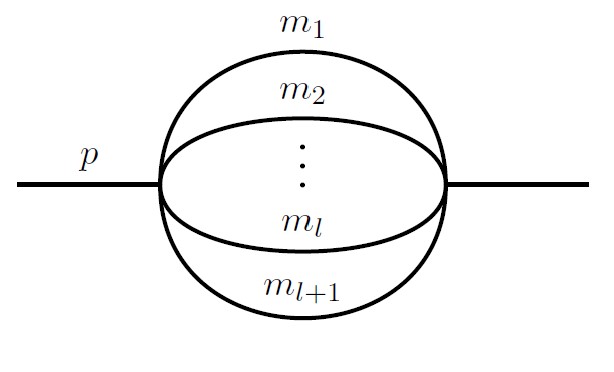
We chose to focus on one particular diagram, called a sunrise diagram for its resemblance to a sun rising over the sea:

This diagram

Feynman diagrams depict paths traveled by particles. The paths are a metaphor, or organizing tool, for more complicated calculations: computations of the chances fundamental particles behave in different ways. Each diagram encodes a complicated integral. This one shows one particle splitting into many, then those many particles reuniting into one.

Do the integrals in Feynman diagrams, and you get a variety of different mathematical functions. Many of them integrate to functions called polylogarithms, and we’ve gotten really really good at working with them. We can integrate them up, simplify them, and sometimes we can guess them so well we don’t have to do the integrals at all! We can do all of that because we know how to break polylogarithm functions apart, with a mathematical operation called a coaction. The coaction chops polylogarithms up to simpler parts, parts that are easier to work with.

More complicated Feynman diagrams give more complicated functions, though. Some of them give what are called elliptic functions. You can think of these functions as involving a geometrical shape, in this case a torus.

Other functions involve more complicated geometrical shapes, in some cases very complicated. For example, some involve the Calabi-Yau manifolds studied by string theorists. These sunrise diagrams are some of the simplest to involve such complicated geometry.

Other researchers had proposed a coaction for elliptic functions back in 2018. When they derived it, though, they left a recipe for something more general. Follow the instructions in the paper, and you could in principle find a coaction for other diagrams, even the Calabi-Yau ones, if you set it up right.

I had an idea for how to set it up right, and in the grand tradition of supervisors everywhere I got Andreas to do the dirty work of applying it. Despite the delay of our false start and despite the fact that this was probably in retrospect too big a project for a normal Master’s thesis, Andreas made it work!

Our result, though, is a bit weird. The coaction is a powerful tool for polylogarithms because it chops them up finely: keep chopping, and you get down to very simple functions. Our coaction isn’t quite so fine: we don’t chop our functions into as many parts, and the parts are more mysterious, more difficult to handle.

We think these are temporary problems though. The recipe we applied turns out to be a recipe with a lot of choices to make, less like Julia Child and more like one of those books where you mix-and-match recipes. We believe the community can play with the parameters of this recipe, finding new version of the coaction for new uses.

This is one of the shiniest of the curiosities in my cabinet this year, I hope it gets put to good use.

Cabinet of Curiosities: The Cubic

Before I launch into the post: I got interviewed on Theoretically Podcasting, a new YouTube channel focused on beginning grad student-level explanations of topics in theoretical physics. If that sounds interesting to you, check it out!

This Fall is paper season for me. I’m finishing up a number of different projects, on a number of different things. Each one was its own puzzle: a curious object found, polished, and sent off into the world.

Monday I published the first of these curiosities, along with Jake Bourjaily and Cristian Vergu.

I’ve mentioned before that the calculations I do involve a kind of “alphabet“. Break down a formula for the probability that two particles collide, and you find pieces that occur again and again. In the nicest cases, those pieces are rational functions, but they can easily get more complicated. I’ve talked before about a case where square roots enter the game, for example. But if square roots appear, what about something even more complicated? What about cubic roots?

What about 1024th roots?

Occasionally, my co-authors and I would say something like that at the end of a talk and an older professor would scoff: “Cube roots? Impossible!”

You might imagine these professors were just being unreasonable skeptics, the elderly-but-distinguished scientists from that Arthur C. Clarke quote. But while they turned out to be wrong, they weren’t being unreasonable. They were thinking back to theorems from the 60’s, theorems which seemed to argue that these particle physics calculations could only have a few specific kinds of behavior: they could behave like rational functions, like logarithms, or like square roots. Theorems which, as they understood them, would have made our claims impossible.

Eventually, we decided to figure out what the heck was going on here. We grabbed the simplest example we could find (a cube root involving three loops and eleven gluons in N=4 super Yang-Mills…yeah) and buckled down to do the calculation.

When we want to calculate something specific to our field, we can reference textbooks and papers, and draw on our own experience. Much of the calculation was like that. A crucial piece, though, involved something quite a bit less specific: calculating a cubic root. And for things like that, you can tell your teachers we use only the very best: Wikipedia.

Check out the Wikipedia entry for the cubic formula. It’s complicated, in ways the quadratic formula isn’t. It involves complex numbers, for one. But it’s not that crazy.

What those theorems from the 60’s said (and what they actually said, not what people misremembered them as saying), was that you can’t take a single limit of a particle physics calculation, and have it behave like a cubic root. You need to take more limits, not just one, to see it.

It turns out, you can even see this just from the Wikipedia entry. There’s a big cube root sign in the middle there, equal to some variable “C”. Look at what’s inside that cube root. You want that part inside to vanish. That means two things need to cancel: Wikipedia labels them \Delta_1, and \sqrt{\Delta_1^2-4\Delta_0^3}. Do some algebra, and you’ll see that for those to cancel, you need \Delta_0=0.

So you look at the limit, \Delta_0\rightarrow 0. This time you need not just some algebra, but some calculus. I’ll let the students in the audience work it out, but at the end of the day, you should notice how C behaves when \Delta_0 is small. It isn’t like \sqrt[3]{\Delta_0}. It’s like just plain \Delta_0. The cube root goes away.

It can come back, but only if you take another limit: not just \Delta_0\rightarrow 0, but \Delta_1\rightarrow 0 as well. And that’s just fine according to those theorems from the 60’s. So our cubic curiosity isn’t impossible after all.

Our calculation wasn’t quite this simple, of course. We had to close a few loopholes, checking our example in detail using more than just Wikipedia-based methods. We found what we thought was a toy example, that turned out to be even more complicated, involving roots of a degree-six polynomial (one that has no “formula”!).

And in the end, polished and in their display case, we’ve put our examples up for the world to see. Let’s see what people think of them!