I’ve been digging through the WordPress “stats” page for this blog. One thing WordPress tells me is what links people follow to get here. It tells me how many times people come from Google or Facebook or Twitter, and how many come from seeing a link on another blog. One thing that surprised me is that some of the blogs people come here from haven’t updated in years.
The way I see it there are two possible explanations. It could be that new people keep checking the old blogs, see a link on their blogroll, and come on over here to check it out. But it could also be the same people over and over, who find it more convenient to start on an old blog and click on links from there.
WordPress doesn’t tell me the difference. But I realized, I can just ask. So in this post, I’m asking all my readers to tell me how you get here. I’m not asking how you found this blog to begin with, but rather how, on a typical day, you navigate to the site. Do you subscribe by email? Do you google the blog’s name every time? RSS reader? Let me know below! And if you don’t see an option that fits you, let me know in the comments!
When a scientist applies for a grant to fund their research, there’s a way it’s supposed to go. The scientist starts out with a clear idea, a detailed plan for an experiment or calculation they’d like to do, and an expectation of what they could learn from it. Then they get the grant, do their experiment or calculation, and make their discovery. The world smiles upon them.
There’s also a famous way it actually goes. Like the other way, the scientist has a clear idea and detailed plan. Then they do their experiment, or calculation, and see what they get, making their discovery. Finally, they write their grant application, proposing to do the experiment they already did. Getting the grant, they then spend the money on their next idea instead, which they will propose only in the next grant application, and so on.
This is pretty shady behavior. But there’s yet another way things can go, one that flips the previous method on its head. And after considering it, you might find the shady method more understandable.
What happens if a scientist is going to run out of funding, but doesn’t yet have a clear idea? Maybe they don’t know enough yet to have a detailed plan for their experiment or their calculation. Maybe they have an idea, but they’re still foggy about what they can learn from it.
Well, they’re still running out of funding. They still have to write that grant. So they start writing. Along the way, they’ll manage to find some of that clarity: they’ll have to write a detailed plan, they’ll have to describe some expected discovery. If all goes well, they tell a plausible story, and they get that funding.
When they actually go do that research, though, there’s no guarantee it sticks to the plan. In fact, it’s almost guaranteed not to: neither the scientist nor the grant committee typically knows what experiment or calculation needs to be done: that’s what makes the proposal novel science in the first place. The result is that once again, the grant proposal wasn’t exactly honest: it didn’t really describe what was actually going to be done.
You can think of these different stories as falling on a sliding scale. On the one end, the scientist may just have the first glimmer of an idea, and their funded research won’t look anything like their application. On the other, the scientist has already done the research, and the funded research again looks nothing like the application. In between there’s a sweet spot, the intended system: late enough that the scientist has a good idea of what they need to do, early enough that they haven’t done it yet.
How big that sweet spot is depends on the pace of the field. If you’re a field with big, complicated experiments, like randomized controlled trials, you can mostly make this work. Your work takes a long time to plan, and requires sticking to that plan, so you can, at least sometimes, do grants “the right way”. The smaller your experiments are though, the more the details can change, and the smaller the window gets. For a field like theoretical physics, if you know exactly what calculation to do, or what proof to write, with no worries or uncertainty…well, you’ve basically done the calculation already. The sweet spot for ethical grant-writing shrinks down to almost a single moment.
In practice, some grant committees understand this. There are grants where you are expected to present preliminary evidence from work you’ve already started, and to discuss the risks your vaguer ideas might face. Grants of this kind recognize that science is a process, and that catching people at that perfect moment is next-to-impossible. They try to assess what the scientist is doing as a whole, not just a single idea.
Scientists ought to be honest about what they’re doing. But grant agencies need to be honest too, about how science in a given field actually works. Hopefully, one enables the other, and we reach a more honest world.
It’s Valentine’s Day this weekend, so time for another physics poem. If you’d like to read the poems from past years, they’re archived with the tag Valentine’s Day Physics Poem, accessible here.
Passion Project
Passion is passion.

If you find yourself writing letter after letter,
be they “love”,
or “Physical Review”

Or if you are the quiet sort
and notice only in your mind
those questions, time after time
whenever silence reigns:
“how do I make things right?”

If you look ahead
and your branching,
             uncertain,
                   futures,
each so different
still have one
               thing
                      in common.

If you could share that desert island, that jail cell,
and count yourself free.

You’ve found your star. Now it’s straight on till morning.
I’ve got a new paper up this week, with Hjalte Frellesvig, Cristian Vergu, and Matthias Volk, about the elliptic integrals that show up in Feynman diagrams.
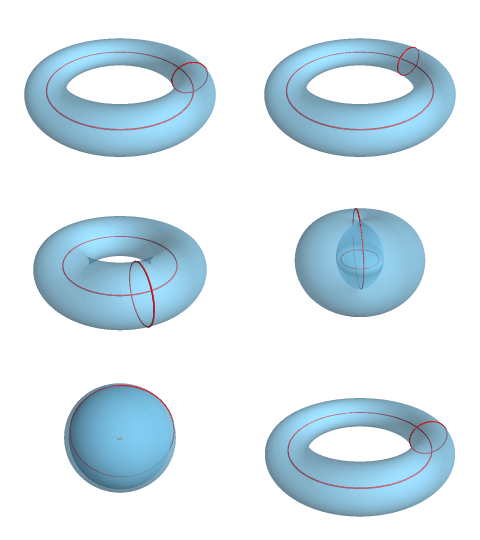
You can think of elliptic integrals as integrals over a torus, a curve shaped like the outer crust of a donut.
Do you prefer your integrals glazed, or with powdered sugar?
Integrals like these are showing up more and more in our field, the subject of bigger and biggerconferences. By now, we think we have a pretty good idea of how to handle them, but there are still some outstanding mysteries to solve.
One such mystery came up in a paper in 2017, by Luise Adams and Stefan Weinzierl. They were working with one of the favorite examples of this community, the so-called sunrise diagram (sunrise being a good time to eat donuts). And they noticed something surprising: if they looked at the sunrise diagram in different ways, it was described by different donuts.
What do I mean, different donuts?
The integrals we know best in this field aren’t integrals on a torus, but rather integrals on a sphere. In some sense, all spheres are the same: you can make them bigger or smaller, but they don’t have different shapes, they’re all “sphere-shaped”. In contrast, integrals on a torus are trickier, because toruses can have different shapes. Think about different donuts: some might have a thin ring, others a thicker one, even if the overall donut is the same size. You can’t just scale up one donut and get the other.
This donut even has a marked point
My colleague, Cristian Vergu, was annoyed by this. He’s the kind of person who trusts mathematics like an old friend, one who would never lead him astray. He thought that there must be one answer, one correct donut, one natural way to represent the sunrise diagram mathematically. I was skeptical, I don’t trust mathematics nearly as much as Cristian does. To sort it out, we brought in Hjalte Frellesvig and Matthias Volk, and started trying to write the sunrise diagram every way we possibly could. (Along the way, we threw in another “donut diagram”, the double-box, just to see what would happen.)
Rather than getting a zoo of different donuts, we got a surprise: we kept seeing the same two. And in the end, we stumbled upon the answer Cristian was hoping for: one of these two is, in a meaningful sense, the “correct donut”.
What was wrong with the other donut? It turns out when the original two donuts were found, one of them involved a move that is a bit risky mathematically, namely, combining square roots.
For readers who don’t know what I mean, or why this is risky, let me give a simple example. Everyone else can skip to after the torus gif.
Suppose I am solving a problem, and I find a product of two square roots:
I could try combining them under the same square root sign, like so:
That works, if is positive. But now suppose . Plug in negative one to the first expression, and you get,
while in the second,
Torus transforming, please stand by
In this case, it wasn’t as obvious that combining roots would change the donut. It might have been perfectly safe. It took some work to show that indeed, this was the root of the problem. If the roots are instead combined more carefully, then one of the donuts goes away, leaving only the one, true donut.
I’m interested in seeing where this goes, how many different donuts we have to understand and how they might be related. But I’ve also been writing about donuts for the last hour or so, so I’m getting hungry. See you next week!



 is positive. But now suppose
  . Plug in negative one to the first expression, and you get,

 4 gravitons