Monthly Archives: October 2019

When to Trust the Contrarians

One of my colleagues at the NBI had an unusual experience: one of his papers took a full year to get through peer review. This happens often in math, where reviewers will diligently check proofs for errors, but it’s quite rare in physics: usually the path from writing to publication is much shorter. Then again, the delays shouldn’t have been too surprising for him, given what he was arguing.

My colleague Mohamed Rameez, along with Jacques Colin, Roya Mohayaee, and Subir Sarkar, wants to argue against one of the most famous astronomical discoveries of the last few decades: that the expansion of our universe is accelerating, and thus that an unknown “dark energy” fills the universe. They argue that one of the key pieces of evidence used to prove acceleration is mistaken: that a large region of the universe around us is in fact “flowing” in one direction, and that tricked astronomers into thinking its expansion was accelerating. You might remember a paper making a related argument back in 2016. I didn’t like the media reaction to that paper, and my post triggered a response by the authors, one of whom (Sarkar) is on this paper as well.

I’m not an astronomer or an astrophysicist. I’m not qualified to comment on their argument, and I won’t. I’d still like to know whether they’re right, though. And that means figuring out which experts to trust.

Pick anything we know in physics, and you’ll find at least one person who disagrees. I don’t mean a crackpot, though they exist too. I mean an actual expert who is convinced the rest of the field is wrong. A contrarian, if you will.

I used to be very unsympathetic to these people. I was convinced that the big results of a field are rarely wrong, because of how much is built off of them. I thought that even if a field was using dodgy methods or sloppy reasoning, the big results are used in so many different situations that if they were wrong they would have to be noticed. I’d argue that if you want to overturn one of these big claims you have to disprove not just the result itself, but every other success the field has ever made.

I still believe that, somewhat. But there are a lot of contrarians here at the Niels Bohr Institute. And I’ve started to appreciate what drives them.

The thing is, no scientific result is ever as clean as it ought to be. Everything we do is jury-rigged. We’re almost never experts in everything we’re trying to do, so we often don’t know the best method. Instead, we approximate and guess, we find rough shortcuts and don’t check if they make sense. This can take us far sometimes, sure…but it can also backfire spectacularly.

The contrarians I’ve known got their inspiration from one of those backfires. They saw a result, a respected mainstream result, and they found a glaring screw-up. Maybe it was an approximation that didn’t make any sense, or a statistical measure that was totally inappropriate. Whatever it was, it got them to dig deeper, and suddenly they saw screw-ups all over the place. When they pointed out these problems, at best the people they accused didn’t understand. At worst they got offended. Instead of cooperation, the contrarians are told they can’t possibly know what they’re talking about, and ignored. Eventually, they conclude the entire sub-field is broken.

Are they right?

Not always. They can’t be, for every claim you can find a contrarian, believing them all would be a contradiction.

But sometimes?

Often, they’re right about the screw-ups. They’re right that there’s a cleaner, more proper way to do that calculation, a statistical measure more suited to the problem. And often, doing things right raises subtleties, means that the big important result everyone believed looks a bit less impressive.

Still, that’s not the same as ruling out the result entirely. And despite all the screw-ups, the main result is still often correct. Often, it’s justified not by the original, screwed-up argument, but by newer evidence from a different direction. Often, the sub-field has grown to a point that the original screwed-up argument doesn’t really matter anymore.

Often, but again, not always.

I still don’t know whether to trust the contrarians. I still lean towards expecting fields to sort themselves out, to thinking that error alone can’t sustain long-term research. But I’m keeping a more open mind now. I’m waiting to see how far the contrarians go.

Knowing When to Hold/Fold ‘Em in Science

The things one learns from Wikipedia. For example, today I learned that the country song “The Gambler” was selected for preservation by the US Library of Congress as being “culturally, historically, or artistically significant.”

You’ve got to know when to hold ’em, know when to fold ’em,

Know when to walk away, know when to run.

Knowing when to “hold ’em” or “fold ’em” is important in life in general, but it’s particularly important in science.

And not just on poker night

As scientists, we’re often trying to do something no-one else has done before. That’s exciting, but it’s risky too: sometimes whatever we’re trying simply doesn’t work. In those situations, it’s important to recognize when we aren’t making progress, and change tactics. The trick is, we can’t give up too early either: science is genuinely hard, and sometimes when we feel stuck we’re actually close to the finish line. Knowing which is which, when to “hold” and when to “fold”, is an essential skill, and a hard one to learn.

Sometimes, we can figure this out mathematically. Computational complexity theory classifies calculations by how difficult they are, including how long they take. If you can estimate how much time you should take to do a calculation, you can decide whether you’ll finish it in a reasonable amount of time. If you just want a rough guess, you can do a simpler version of the calculation, and see how long that takes, then estimate how much longer the full one will. If you figure out you’re doomed, then it’s time to switch to a more efficient algorithm, or a different question entirely.

Sometimes, we don’t just have to consider time, but money as well. If you’re doing an experiment, you have to estimate how much the equipment will cost, and how much it will cost to run it. Experimenters get pretty good at estimating these things, but they still screw up sometimes and run over budget. Occasionally this is fine: LIGO didn’t detect anything in its first eight-year run, but they upgraded the machines and tried again, and won a Nobel prize. Other times it’s a disaster, and money keeps being funneled into a project that never works. Telling the difference is crucial, and it’s something we as a community are still not so good at.

Sometimes we just have to follow our instincts. This is dangerous, because we have a bias (the “sunk cost fallacy”) to stick with something if we’ve already spent a lot of time or money on it. To counteract that, it’s good to cultivate a bias in the opposite direction, which you might call “scientific impatience”. Getting frustrated with slow progress may not seem productive, but it keeps you motivated to search for a better way. Experienced scientists get used to how long certain types of project take. Too little progress, and they look for another option. This can fail, killing a project that was going to succeed, but it can also prevent over-investment in a failing idea. Only a mix of instincts keeps the field moving.

In the end, science is a gamble. Like the song, we have to know when to hold ’em and fold ’em, when to walk away, and when to run an idea as far as it will go. Sometimes it works, and sometimes it doesn’t. That’s science.

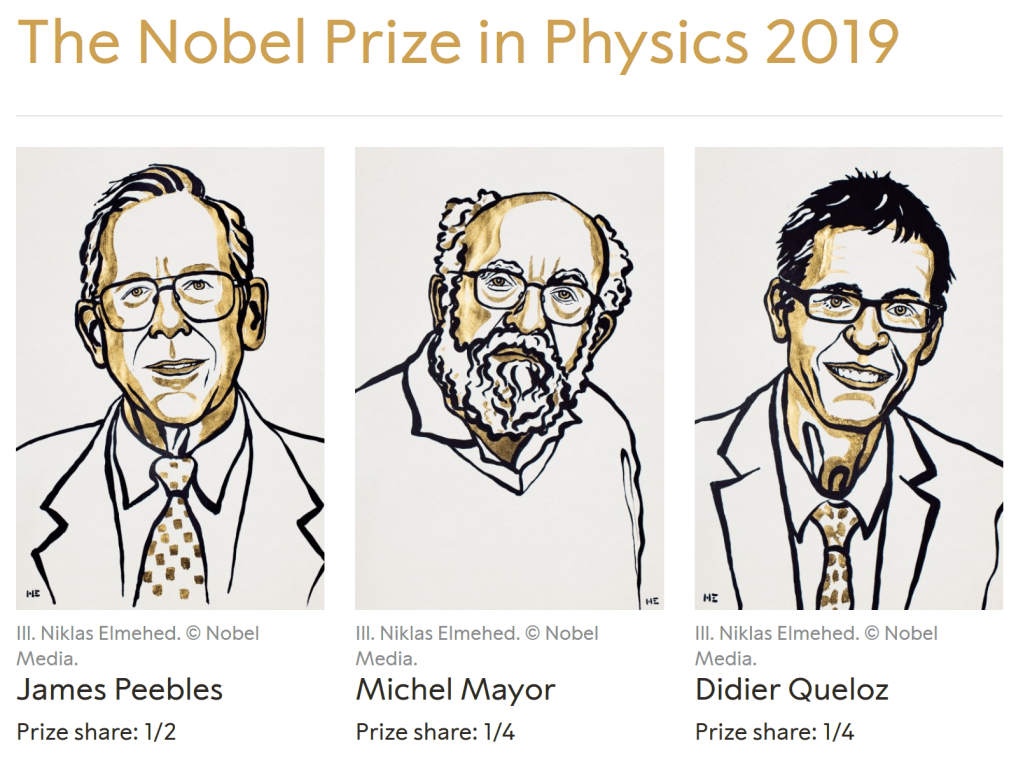
Congratulations to James Peebles, Michel Mayor, and Didier Queloz!

The 2019 Physics Nobel Prize was announced this week, awarded to James Peebles for work in cosmology and to Michel Mayor and Didier Queloz for the first observation of an exoplanet.

Peebles introduced quantitative methods to cosmology. He figured out how to use the Cosmic Microwave Background (light left over from the Big Bang) to understand how matter is distributed in our universe, including the presence of still-mysterious dark matter and dark energy. Mayor and Queloz were the first team to observe a planet outside of our solar system (an “exoplanet”), in 1995. By careful measurement of the spectrum of light coming from a star they were able to find a slight wobble, caused by a Jupiter-esque planet in orbit around it. Their discovery opened the floodgates of observation. Astronomers found many more planets than expected, showing that, far from a rare occurrence, exoplanets are quite common.

It’s a bit strange that this Nobel was awarded to two very different types of research. This isn’t the first time the prize was divided between two different discoveries, but all of the cases I can remember involve discoveries in closely related topics. This one didn’t, and I’m curious about the Nobel committee’s logic. It might have been that neither discovery “merited a Nobel” on its own, but I don’t think we’re supposed to think of shared Nobels as “lesser” than non-shared ones. It would make sense if the Nobel committee thought they had a lot of important results to “get through” and grouped them together to get through them faster, but if anything I have the impression it’s the opposite: that at least in physics, it’s getting harder and harder to find genuinely important discoveries that haven’t been acknowledged. Overall, this seems like a very weird pairing, and the Nobel committee’s citation “for contributions to our understanding of the evolution of the universe and Earth’s place in the cosmos” is a pretty loose justification.

Calabi-Yaus in Feynman Diagrams: Harder and Easier Than Expected

I’ve got a new paper up, about the weird geometrical spaces we keep finding in Feynman diagrams.

With Jacob Bourjaily, Andrew McLeod, and Matthias Wilhelm, and most recently Cristian Vergu and Matthias Volk, I’ve been digging up odd mathematics in particle physics calculations. In several calculations, we’ve found that we need a type of space called a Calabi-Yau manifold. These spaces are often studied by string theorists, who hope they represent how “extra” dimensions of space are curled up. String theorists have found an absurdly large number of Calabi-Yau manifolds, so many that some are trying to sift through them with machine learning. We wanted to know if our situation was quite that ridiculous: how many Calabi-Yaus do we really need?

So we started asking around, trying to figure out how to classify our catch of Calabi-Yaus. And mostly, we just got confused.

It turns out there are a lot of different tools out there for understanding Calabi-Yaus, and most of them aren’t all that useful for what we’re doing. We went in circles for a while trying to understand how to desingularize toric varieties, and other things that will sound like gibberish to most of you. In the end, though, we noticed one small thing that made our lives a whole lot simpler.

It turns out that all of the Calabi-Yaus we’ve found are, in some sense, the same. While the details of the physics varies, the overall “space” is the same in each case. It’s a space we kept finding for our “Calabi-Yau bestiary”, but it turns out one of the “traintrack” diagrams we found earlier can be written in the same way. We found another example too, a “wheel” that seems to be the same type of Calabi-Yau.

And that actually has a sensible name

We also found many examples that we don’t understand. Add another rung to our “traintrack” and we suddenly can’t write it in the same space. (Personally, I’m quite confused about this one.) Add another spoke to our wheel and we confuse ourselves in a different way.

So while our calculation turned out simpler than expected, we don’t think this is the full story. Our Calabi-Yaus might live in “the same space”, but there are also physics-related differences between them, and these we still don’t understand.

At some point, our abstract included the phrase “this paper raises more questions than it answers”. It doesn’t say that now, but it’s still true. We wrote this paper because, after getting very confused, we ended up able to say a few new things that hadn’t been said before. But the questions we raise are if anything more important. We want to inspire new interest in this field, toss out new examples, and get people thinking harder about the geometry of Feynman integrals.