Monthly Archives: July 2019

The Real E=mc^2

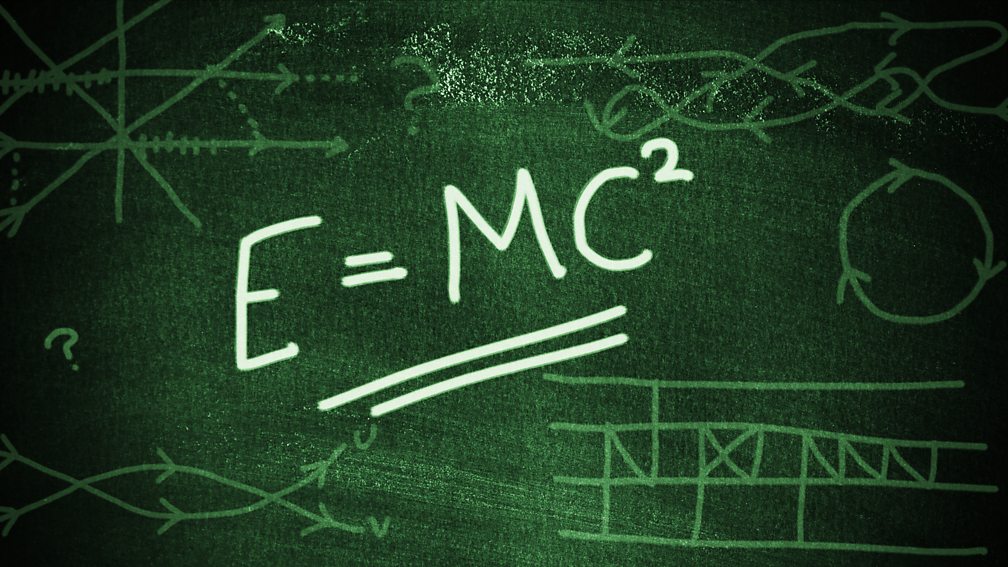
It’s the most famous equation in all of physics, written on thousands of chalkboard stock photos. Part of its charm is its simplicity: E for energy, m for mass, c for the speed of light, just a few simple symbols in a one-line equation. Despite its simplicity, E=mc^2 is deep and important enough that there are books dedicated to explaining it.

What does E=mc^2 mean?

Some will tell you it means mass can be converted to energy, enabling nuclear power and the atomic bomb. This is a useful picture for chemists, who like to think about balancing ingredients: this much mass on one side, this much energy on the other. It’s not the best picture for physicists, though. It makes it sound like energy is some form of “stuff” you can pour into your chemistry set flask, and energy really isn’t like that.

There’s another story you might have heard, in older books. In that story, E=mc^2 tells you that in relativity mass, like distance and time, is relative. The more energy you have, the more mass you have. Those books will tell you that this is why you can’t go faster than light: the faster you go, the greater your mass, and the harder it is to speed up.

Modern physicists don’t talk about it that way. In fact, we don’t even write E=mc^2 that way. We’re more likely to write:

E=\frac{mc^2}{\sqrt{1-\frac{v^2}{c^2}}}

“v” here stands for the velocity, how fast the mass is moving. The faster the mass moves, the more energy it has. Take v to zero, and you get back the familiar E=mc^2.

The older books weren’t lying to you, but they were thinking about a different notion of mass: “relativistic mass” m_r instead of “rest mass” $m_0$, related like this:

m_r=\frac{m_0}{\sqrt{1-\frac{v^2}{c^2}}}

which explains the difference in how we write E=mc^2.

Why the change? In part, it’s because of particle physics. In particle physics, we care about the rest mass of particles. Different particles have different rest mass: each electron has one rest mass, each top quark has another, regardless of how fast they’re going. They still get more energy, and harder to speed up, the faster they go, but we don’t describe it as a change in mass. Our equations match the old books, we just talk about them differently.

Of course, you can dig deeper, and things get stranger. You might hear that mass does change with energy, but in a very different way. You might hear that mass is energy, that they’re just two perspectives on the same thing. But those are stories for another day.

I titled this post “The Real E=mc^2”, but to clarify, none of these explanations are more “real” than the others. They’re words, useful in different situations and for different people. “The Real E=mc^2” isn’t the E=mc^2 of nuclear chemists, or old books, or modern physicists. It’s the theory itself, the mathematical rules and principles that all the rest are just trying to describe.
Reader Background Poll Reflections

A few weeks back I posted a poll, asking you guys what sort of physics background you have. The idea was to follow up on a poll I did back in 2015, to see how this blog’s audience has changed.

One thing that immediately leaped out of the data was how many of you are physicists. As of writing this, 66% of readers say they either have a PhD in physics or a related field, or are currently in grad school. This includes 7% specifically from my sub-field, “amplitudeology” (though this number may be higher than usual since we just had our yearly conference, and more amplitudeologists were reminded my blog exists).

I didn’t use the same categories in 2015, so the numbers can’t be easily compared. In 2015 only 2.5% of readers described themselves as amplitudeologists. Adding these up with the physics PhDs and grad students gives 59%, which goes up to 64.5% if I include the mathematicians (who this year might have put either “PhD in a related field” or “Other Academic”). So overall the percentages are pretty similar, though now it looks like more of my readers are grad students.

Despite the small difference, I am a bit worried: it looks like I’m losing non-physicist readers. I could flatter myself and think that I inspired those non-physicists to go to grad school, but more realistically I should admit that fewer of my posts have been interesting to a non-physics audience. In 2015 I worked at the Perimeter Institute, and helped out with their public lectures. Now I’m at the Niels Bohr Institute, and I get fewer opportunities to hear questions from non-physicists. I get fewer ideas for interesting questions to answer.

I want to keep this blog’s language accessible and its audience general. I appreciate that physicists like this blog and view it as a resource, but I don’t want it to turn into a blog for physicists only. I’d like to encourage the non-physicists in the audience: ask questions! Don’t worry if it sounds naive, or if the question seems easy: if you’re confused, likely others are too.

Amplitudes 2019 Retrospective

I’m back from Amplitudes 2019, and since I have more time I figured I’d write down a few more impressions.

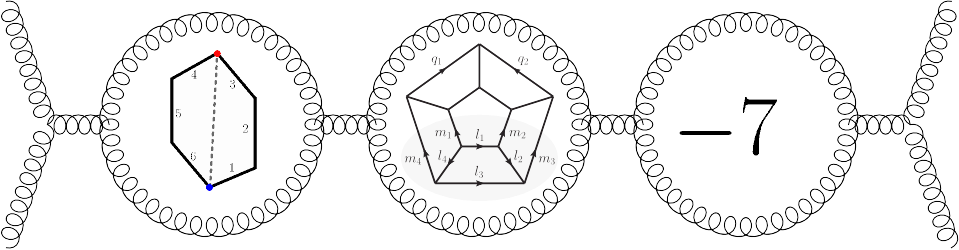
Amplitudes runs all the way from practical LHC calculations to almost pure mathematics, and this conference had plenty of both as well as everything in between. On the more practical side a standard “pipeline” has developed: get a large number of integrals from generalized unitarity, reduce them to a more manageable number with integration-by-parts, and then compute them with differential equations. Vladimir Smirnov and Johannes Henn presented the state of the art in this pipeline, challenging QCD calculations that required powerful methods. Others aimed to replace various parts of the pipeline. Integration-by-parts could be avoided in the numerical unitarity approach discussed by Ben Page, or alternatively with the intersection theory techniques showcased by Pierpaolo Mastrolia. More radical departures included Stefan Weinzierl’s refinement of loop-tree duality, and Jacob Bourjaily’s advocacy of prescriptive unitarity. Robert Schabinger even brought up direct integration, though I mostly viewed his talk as an independent confirmation of the usefulness of Erik Panzer’s thesis. It also showcased an interesting integral that had previously been represented by Lorenzo Tancredi and collaborators as elliptic, but turned out to be writable in terms of more familiar functions. It’s going to be interesting to see whether other such integrals arise, and whether they can be spotted in advance.

On the other end of the scale, Francis Brown was the only speaker deep enough in the culture of mathematics to insist on doing a blackboard talk. Since the conference hall didn’t actually have a blackboard, this was accomplished by projecting video of a piece of paper that he wrote on as the talk progressed. Despite the awkward setup, the talk was impressively clear, though there were enough questions that he ran out of time at the end and had to “cheat” by just projecting his notes instead. He presented a few theorems about the sort of integrals that show up in string theory. Federico Zerbini and Eduardo Casali’s talks covered similar topics, with the latter also involving intersection theory. Intersection theory also appeared in a poster from grad student Andrzej Pokraka, which overall is a pretty impressively broad showing for a part of mathematics that Sebastian Mizera first introduced to the amplitudes community less than two years ago.

Nima Arkani-Hamed’s talk on Wednesday fell somewhere in between. A series of airline mishaps brought him there only a few hours before his talk, and his own busy schedule sent him back to the airport right after the last question. The talk itself covered several topics, tied together a bit better than usual by a nice account in the beginning of what might motivate a “polytope picture” of quantum field theory. One particularly interesting aspect was a suggestion of a space, smaller than the amplituhedron, that might more accuractly the describe the “alphabet” that appears in N=4 super Yang-Mills amplitudes. If his proposal works, it may be that the infinite alphabet we were worried about for eight-particle amplitudes is actually finite. Ömer Gürdoğan’s talk mentioned this, and drew out some implications. Overall, I’m still unclear as to what this story says about whether the alphabet contains square roots, but that’s a topic for another day. My talk was right after Nima’s, and while he went over-time as always I compensated by accidentally going under-time. Overall, I think folks had fun regardless.

Though I don’t know how many people recognized this guy

Amplitudes 2019

It’s that time of year again, and I’m at Amplitudes, my field’s big yearly conference. This year we’re in Dublin, hosted by Trinity.

Which also hosts the Book of Kells, and the occasional conference reception just down the hall from the Book of Kells

Increasingly, the organizers of Amplitudes have been setting aside a few slots for talks from people in other fields. This year the “closest” such speaker was Kirill Melnikov, who pointed out some of the hurdles that make it difficult to have useful calculations to compare to the LHC. Many of these hurdles aren’t things that amplitudes-people have traditionally worked on, but are still things that might benefit from our particular expertise. Another such speaker, Maxwell Hansen, is from a field called Lattice QCD. While amplitudeologists typically compute with approximations, order by order in more and more complicated diagrams, Lattice QCD instead simulates particle physics on supercomputers, chopping up their calculations on a grid. This allows them to study much stronger forces, including the messy interactions of quarks inside protons, but they have a harder time with the situations we’re best at, where two particles collide from far away. Apparently, though, they are making progress on that kind of calculation, with some clever tricks to connect it to calculations they know how to do. While I was a bit worried that this would let them fire all the amplitudeologists and replace us with supercomputers, they’re not quite there yet, nonetheless they are doing better than I would have expected. Other speakers from other fields included Leron Borsten, who has been applying the amplitudes concept of the “double copy” to M theory and Andrew Tolley, who uses the kind of “positivity” properties that amplitudeologists find interesting to restrict the kinds of theories used in cosmology.

The biggest set of “non-traditional-amplitudes” talks focused on using amplitudes techniques to calculate the behavior not of particles but of black holes, to predict the gravitational wave patterns detected by LIGO. This year featured a record six talks on the topic, a sixth of the conference. Last year I commented that the research ideas from amplitudeologists on gravitational waves had gotten more robust, with clearer proposals for how to move forward. This year things have developed even further, with several initial results. Even more encouragingly, while there are several groups doing different things they appear to be genuinely listening to each other: there were plenty of references in the talks both to other amplitudes groups and to work by more traditional gravitational physicists. There’s definitely still plenty of lingering confusion that needs to be cleared up, but it looks like the community is robust enough to work through it.

I’m still busy with the conference, but I’ll say more when I’m back next week. Stay tuned for square roots, clusters, and Nima’s travel schedule. And if you’re a regular reader, please fill out last week’s poll if you haven’t already!