Monthly Archives: August 2017

Topic Conferences, Place Conferences

I spent this week at Current Themes in High Energy Physics and Cosmology, a conference at the Niels Bohr Institute.

Most conferences focus on a particular topic. Usually the broader the topic, the bigger the conference. A workshop on flux tubes is smaller than Amplitudes, which is smaller than Strings, which is smaller than the March Meeting of the American Physical Society.

“Current Themes in High Energy Physics and Cosmology” sounds like a very broad topic, but it was a small conference. The reason why is that it wasn’t a “topic conference”, it was a “place conference”.

Most conferences focus on a topic, but some are built around a place. These conferences are hosted by a particular institute year after year. Sometimes each year has a loose theme (for example, the Simons Summer Workshop this year focused on theories without supersymmetry) but sometimes no attempt is made to tie the talks together (“current themes”).

Instead of a theme, the people who go to these conferences are united by their connections to the institute. Some of them have collaborators there, or worked there in the past. Others have been coming for many years. Some just happened to be in the area.

While they may seem eclectic, “place” conferences have a valuable role: they help to keep our interests broad. In physics, there’s a natural tendency to specialize. Left alone, we end up reading papers and going to talks only when they’re directly relevant for what we’re working on. By doing this we lose track of the wider field, losing access to the insights that come from different perspectives and methods.

“Place” conferences, like seminars, help pull things in the other direction. When you’re hearing talks from “everyone connected to the Simons Center” or “everyone connected to the Niels Bohr Institute”, you’re exposed to a much broader range of topics than a conference for just your sub-field. You get a broad overview of what’s going on in the field, but unlike a big conference like Strings there are few enough people that you can actually talk to everyone.

Physicists’ attachment to places is counter-intuitive. We’re studying mathematical truths and laws of nature, surely it shouldn’t matter where we work. In practice, though, we’re still human. Out of the vast span of physics we still pick our interests based on the people around us. That’s why places, why institutes with a wide range of excellent people, are so important: they put our social instincts to work studying the universe.
Copenhagen!

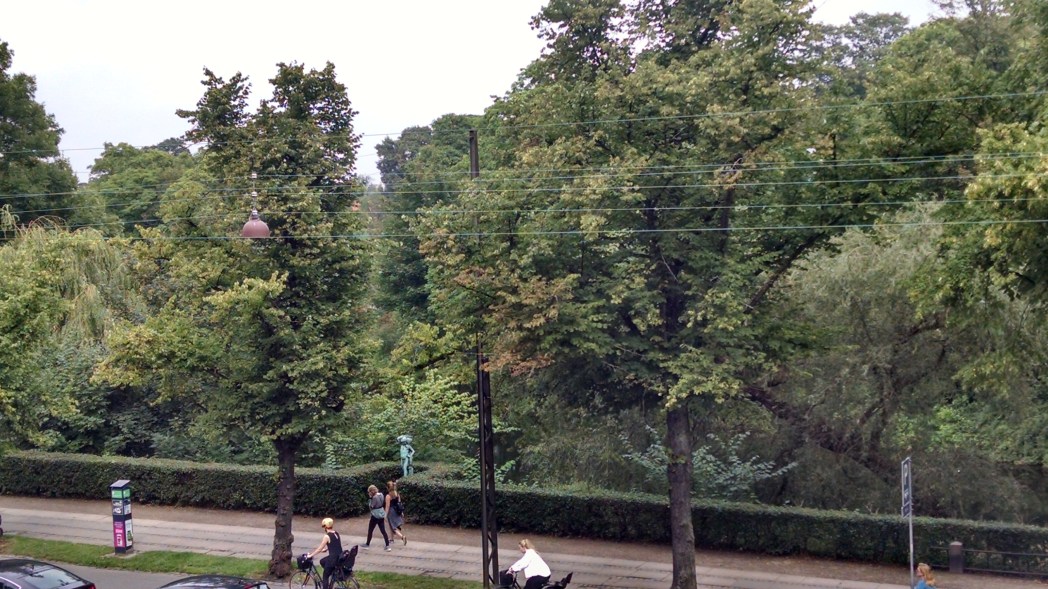
After a week of packing, shipping, selling or donating my worldly possessions, I have now arrived in Denmark! I’m too exhausted for much of a post this week, so enjoy this picture of the wilderness of the frozen north.

IMG_20170818_141518306_HDR.jpg

Ok fine it’s a park.

Textbook Review: Exploring Black Holes

I’m bringing a box of textbooks with me to Denmark. Most of them are for work: a few Quantum Field Theory texts I might use, a Complex Analysis book for when I inevitably forget how to do contour integration.

One of the books, though, is just for fun.

418jsvew76l-_sx378_bo1204203200_

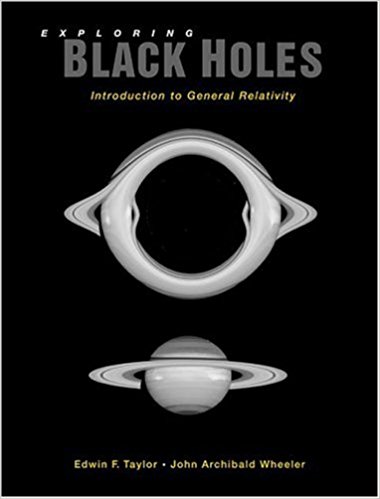
Exploring Black Holes is an introduction to general relativity for undergraduates. The book came out of a collaboration between Edwin F. Taylor, known for his contributions to physics teaching, and John Archibald Wheeler, who among a long list of achievements was responsible for popularizing the term “black hole”. The result is something quite unique: a general relativity course that requires no math more advanced than calculus, and no physics more advanced than special relativity.

It does this by starting, not with the full tensor-riddled glory of Einstein’s equations, but with specialized solutions to those equations, mostly the Schwarzschild solution that describes space around spherical objects (including planets, stars, and black holes). From there, it manages to introduce curved space in a way that is both intuitive and naturally grows out of what students learn about special relativity. It really is the kind of course a student can take right after their first physics course, and indeed as an undergrad that’s exactly what I did.

With just the Schwarzchild solution and its close relatives, you can already answer most of the questions young students have about general relativity. In a series of “projects”, the book explores the corrections GR demands of GPS satellites, the process of falling into a black hole, the famous measurement of the advance of the perihelion of mercury, the behavior of light in a strong gravitational field, and even a bit of cosmology. In the end the students won’t know the full power of the theory, but they’ll get a taste while building valuable physical intuition.

Still, I wouldn’t bring this book with me if it was just an excellent undergraduate textbook. Exploring Black Holes is a great introduction to general relativity, but it also has a hilarious not-so-hidden agenda: inspiring future astronauts to jump into black holes.

“Nowhere could life be simpler or more relaxed than in a free-float frame, such as an unpowered spaceship falling toward a black hole.” – pg. 2-31

The book is full of quotes like this. One of the book’s “projects” involves computing what happens to an astronaut who falls into a black hole. The book takes special care to have students calculate that “spaghettification”, the process by which the tidal forces of a black hole stretch infalling observers into spaghetti, is surprisingly completely painless: the amount of time you experience it is always less than the amount of time it takes light (and thus also pain) to go from your feet to your head, for any (sufficiently calm) black hole.

Why might Taylor and Wheeler want people of the future to jump into black holes? As the discussion on page B-3 of the book describes, the reason is on one level an epistemic one. As theorists, we’d like to reason about what lies inside the event horizon of black holes, but we face a problem: any direct test would be trapped inside, and we would never know the result, which some would argue makes such speculation unscientific. What Taylor and Wheeler point out is that it’s not quite true that no-one would know the results of such a test: if someone jumped into a black hole, they would be able to test our reasoning. If a whole scientific community jumped in, then the question of what is inside a black hole is from their perspective completely scientific.

Of course, I don’t think Taylor and Wheeler seriously thought their book would convince its readers to jump into black holes. For one, it’s unlikely anyone reading the book will get a chance. Still, I suspect that the idea that future generations might explore black holes gave Taylor and Wheeler some satisfaction, and a nice clean refutation of those who think physics inside the horizon is unscientific. Seeing as the result was an excellent textbook full of hilarious prose, I can’t complain.

We’re Weird

Preparing to move to Denmark, it strikes me just how strange what I’m doing would seem to most people. I’m moving across the ocean to a place where I don’t know the language. (Or at least, don’t know more than half a duolingo lesson.) I’m doing this just three years after another international move. And while I’m definitely nervous, this isn’t the big life changing shift it would be for many people. It’s just how academic careers are expected to work.

At borders, I’m often asked why I am where I am. Why be an American working in Canada? Why move to Denmark? And in general, the answer is just that it’s where I need to be to do what I want to do, because it’s where the other people who do what I want to do are. A few people seed this process by managing to find faculty jobs in their home countries, and others sort themselves out by their interests. In the end, we end up with places like Perimeter, an institute in the middle of Canada with barely any Canadians.

This is more pronounced for smaller fields than for larger ones. A chemist or biologist might just manage to have their whole career in the same state of the US, or the same country in Europe. For a theoretical physicist, this is much less likely. I also suspect it’s more true of more “universal” fields: that most professors of Portuguese literature are in Portugal or Brazil, for example.

For theoretical physics, the result is an essentially random mix of people around the world. This works, in part, because essentially everyone does science in English. Occasionally, a group of collaborators happens to speak the same non-English language, so you sometimes hear people talking science in Russian or Spanish or French. But even then there are times people will default to English anyway, because they’re used to it. We publish in English, we chat in English. And as a result, wherever we end up we can at least talk to our colleagues, even if the surrounding world is trickier.

Communities this international, with four different accents in every conversation, are rare, and I occasionally forget that. Before grad school, the closest I came to this was on the internet. On Dungeons and Dragons forums, much like in academia, everyone was drawn together by shared interests and expertise. We had Australians logging on in the middle of everyone else’s night to argue with the Germans, and Brazilians pointing out how the game’s errata was implemented differently in Portuguese.

It’s fun to be in that sort of community in the real world. There’s always something to learn from each other, even on completely mundane topics. Lunch often turns into a discussion of different countries’ cuisines. As someone who became an academic because I enjoy learning, it’s great to have the wheels constantly spinning like that. I should remember, though, that most of the world doesn’t live like this: we’re currently a pretty weird bunch.