Monthly Archives: June 2015

Why I Spent Convergence Working

Convergence is basically Perimeter Institute Christmas.

This week, the building was dressed up in festive posters and elaborate chalk art, and filled with Perimeter’s many distant relations. Convergence is like a hybrid of an alumni reunion and a conference, where Perimeter’s former students and close collaborators come to hear talks about the glory of Perimeter and the marvels of its research.

Sponsored by the Bank of Montreal

And I attended none of those talks.

I led a discussion session on the first day of Convergence (which was actually pretty fun!), and I helped out in the online chat for the public lecture on Emmy Noether. But I didn’t register for the conference, and I didn’t take the time to just sit down and listen to a talk.

Before you ask, this isn’t because the talks are going to be viewable online. (Though they are, and I’d recommend watching a few if you’re in the mood for a fun physics talk.)

It’s partly to do with how general these talks are. Convergence is very broad: rather than being focused on a single topic, its goal is to bring people from very different sub-fields together, hopefully to spark new ideas. The result, though, are talks that are about as broad as you can get while still being directed at theoretical physicists. Most physics departments have talks like these once a week, they’re called colloquia. Perimeter has colloquia too: they’re typically in the room that the Convergence talks happened in. Some of the Convergence talks have already been given as colloquia! So part of my reluctance is the feeling that, if I haven’t seen these talks before, I probably will before too long.

The main reason, though, is work. I’ve been working on a fairly big project, since shortly after I got to Perimeter. It’s an extension of my previous work, dealing with the next, more complicated step in the same calculation. And it’s kind of driving me nuts.

The thing is, we had almost all of what we needed around January. We’ve accomplished our main goal, we’ve got the result that we were looking for. We just need to plot it, to get actual numbers out. And for some reason, that’s taken six months.

This week, I thought I had an idea that would make the calculation work. Rationally, I know I could have just taken the week to attend Convergence, and worked on the problem afterwards. We’ve waited six months, we can wait another week.

But that’s not why I do science. I do science to solve problems. And right here, in front of me, I had a problem that maybe I could solve. And I knew I wasn’t going to be able to focus on a bunch of colloquium talks with that sitting in the back of my mind.

So I skipped Convergence, and sat watching the calculation run again and again, each time trying to streamline it until it’s fast enough to work properly. It hasn’t worked yet, but I’m so close. So I’m hoping.
Lewis Carroll, Anti-String Theorist?

You all know the real meaning of Alice in Wonderland, right?

No, I’m not talking about drugs, or darker things. I’m talking about math!

The 19th century was a time of great changes in mathematics, and Charles Dodgson, pen name Lewis Carroll, was opposed to almost all of it. A very traditional mathematician, Dodgson thought of Euclid’s Elements as the pinnacle of mathematical reasoning. Non-Euclidean geometry, symbolic algebra, complex numbers, all of these were viewed by Dodgson as nonsense, perverting students away from the study of Euclidean geometry and arithmetic, subjects that actually described the real world.

Scholars of Dodgson/Carroll’s writing have posited that the craziness of Wonderland was intended to parody the craziness Dodgson saw in mathematics. When Alice encounters the Caterpillar, she grows and shrinks non-uniformly as the Caterpillar advises her to “keep her temper”. “Temper” here refers not to anger, but to ratios between different parts: something preserved in Euclidean geometry but potentially violated by symbolic algebra. Similarly, the frantic rotations around the table by the Mad Hatter and his tea party are thought to represent imaginary numbers and quaternions, concepts used to understand rotation which had to postulate extra dimensions to do so.

Dodgson was on the wrong side of history, and today mathematics deals with even more abstract concepts. What amuses me, though, is how well Dodgson’s parodies match certain criticisms of string theory.

String theorists often study theories with two properties not found in the real world: conformal symmetry and supersymmetry.

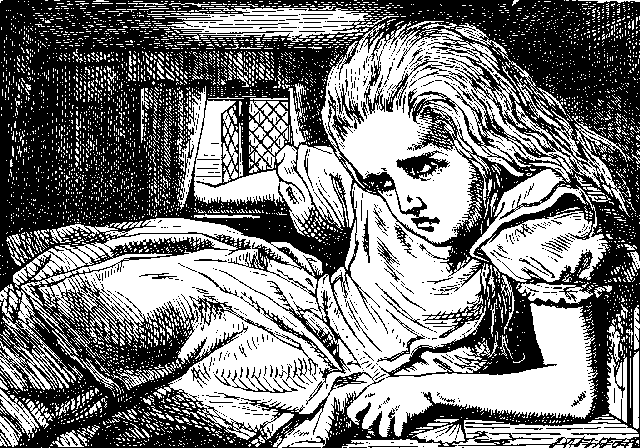
In a theory with conformal symmetry, distances aren’t fixed. Different parts of objects can grow and shrink different amounts, and the theory will still predict the same physical behavior. The only restriction is that angles need to be preserved: two lines that meet at a given angle must meet at the same angle after transformation. In other words, keep your temper.

Alice, undergoing a conformal transformation.

I’ve talked about supersymmetry before. A supersymmetric theory can be “turned” in certain ways, related to exchanging different types of particles. If you “turn” the theory twice in the same “direction”, you get back to where you started, sort of like how if you square the imaginary number i you get back to the real number -1. Supersymmetry sees a group of particles and declares that “it’s time to change places!”

I thought the string theory skeptics among my readers might find the parallels here amusing. With parody, if not always with science, the best work was often done long, long ago.

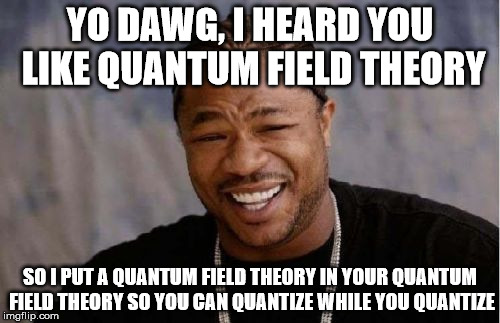
Yo Dawg, I Heard You Liked Quantum Field Theory so I Made You a String Theory

String theory may sound strange and exotic, with its extra dimensions and loops of string. Deep down, though, string theory is by far the most conservative attempt at a theory of quantum gravity. It just takes the tools of quantum field theory, and applies them all over again.

Picture a loop of string, traveling through space. From one moment to the next, the loop occupies a loop-shaped region. Now imagine joining all those regions together, forming a tunnel: the space swept out by the string over its entire existence. As the string joins other strings, merging and dividing, the result is a complicated surface. In string theory, we call this surface the worldsheet.

Yes, it looks like Yog-Sothoth. It always looks like Yog-Sothoth.

Imagine what it’s like to live on this two-dimensional surface. You don’t know where the string is in the space around it, because you can’t see off the surface. You can learn something about it, though, because making the worldsheet bend takes energy. I’ve talked about this kind of situation before, and the result is that your world contains a scalar field.

Living on the two-dimensional surface, then, you can describe your world with two-dimensional quantum field theory. Your two-dimensional theory, reinterpreted, then tells you the position of the string in higher-dimensional space. If we were just doing normal particle physics, we’d use quantum field theory to describe the particles. Now that we’ve replaced particles with strings, our quantum field theory describes things that are the result of another quantum field theory.

Xzibit would be proud.

If you understand this aspect of string theory, everything else makes a lot more sense. If you’re just imagining lengths of string, it’s hard to understand how strings can have supersymmetry. In these terms, though, it’s simple: instead of just scalar fields, supersymmetric strings also have fermions (fields with spin 1/2) as part of their two-dimensional quantum field theory.

It’s also deeply related to all those weird extra dimensions. As it turns out, two-dimensional quantum field theories are much more restricted than their cousins in our four (three space plus one time)-dimensional world. In order for a theory with only scalars (like the worldsheet of a moving loop of string) to make sense, there have to be twenty-six scalars. Each scalar is a direction in which the worldsheet can bend, so if you just have scalars you’re looking at a 26-dimensional world. Supersymmetry changes this calculation by adding fermions: with fermions and scalars, you need ten scalars to make your theory mathematically consistent, which is why superstring theory lives in ten dimensions.

This also gives you yet another way to think about branes. Strings come from two-dimensional quantum field theories, while branes come from quantum field theories in other dimensions.

Sticking a quantum field theory inside a quantum field theory is the most straightforward way to move forward. Fundamentally, it’s just using tools we already know work. That doesn’t mean it’s the right solution, or that it describes reality: that’s for the future to establish. But I hope I’ve made it a bit clearer why it’s by far the most popular option.

Physics Is a Small World

Earlier this week, Vilhelm Bohr gave a talk at Perimeter about the life of his grandfather, the famous physicist Niels Bohr. The video of the talk doesn’t appear to be up on the Perimeter site yet, but it should be soon.

Until then, here is a picture of some eyebrows.

This was especially special for me, because my family has a longstanding connection to the Bohrs. My great grandfather worked at the Niels Bohr Institute in the mid-1930’s, and his children became good friends with Bohr’s grandchildren, often visiting each other even after my family relocated to the US.

These kinds of connections are more common in physics than you might think. Time and again I’m surprised by how closely linked people are in this field. There’s a guy here at Perimeter who went to school with Jaroslav Trnka, and a bunch of Israelis at nearby institutions all know each other from college. In my case, I went to high school with an unusually large number of mathematicians.

While it’s fun to see familiar faces, there’s a dark side to the connected nature of physics. So much of what it takes to succeed in academia involves knowing unwritten rules, as well as a wealth of other information that just isn’t widely known. Many people don’t even know it’s possible to have a career in physics, and I’ve met many who didn’t know that science grad schools pay your tuition. Academic families, and academic communities, have an enormous leg up on this kind of knowledge, so it’s not surprising that so many physicists come from so few sources.

Artificially limiting the pool of people who become physicists is bound to hurt us in the long run. Great insights often come from outsiders, like Hooke in the 17th century and Noether in the early 20th. If we can expand the reach of physics, make the unwritten rules written and the secret tricks revealed, if we work to make physics available to anyone who might be suited for it, then we can make sure that physics doesn’t end up a hereditary institution, with all the problems that entails.