Monthly Archives: January 2015

The Cycle of Exploration

Science is often described as a journey of exploration. You might imagine scientists carefully planning an expedition, gathering their equipment, then venturing out into the wilds of Nature, traveling as far as they can before returning with tales of the wonders they discovered.

Is it capybaras? Please let it be capybaras.

Is it capybaras? Please let it be capybaras.

This misses an important part of the story, though. In science, exploration isn’t just about discovering the true nature of Nature, as important as that is. It’s also about laying the groundwork for future exploration.

Picture our explorers, traveling out into the wilderness with no idea what’s in store. With only a rough idea of the challenges they might face, they must pack for every possibility: warm clothing for mountains, sunscreen for the desert, canoes to ford rivers, cameras in case they encounter capybaras. Since they can only carry so much, they can only travel so far before they run out of supplies.

Once they return, though, the explorers can assess what they did and didn’t need. Maybe they found a jungle, full of capybaras. The next time they travel they’ll make sure to bring canoes and cameras, but they can skip the warm coats. This lets them free up more room, letting them bring more supplies that’s actually useful. In the end, this lets them travel farther.

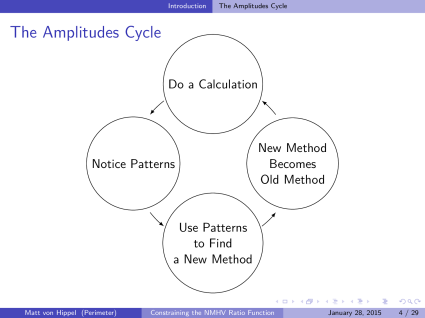
Science is a lot like this. The more we know, the better questions we can ask, and the further we can explore. It’s true not just for experiments, but for theoretical work as well. Here’s a slide from a talk I’m preparing, about how this works in my sub-field of Amplitudeology.

Unfortunately not a capybara.

Unfortunately not a capybara.

In theoretical physics, you often start out doing a calculation using the most general methods you have available. Once you’ve done it, you understand a bit more about your results: in particular, you can start figuring out which parts of the general method are actually unnecessary. By paring things down, you can figure out a new method, one that’s more efficient and allows for more complicated calculations. Doing those calculations then reveals new patterns, letting you propose even newer methods and do even more complicated calculations.

It’s the circle of exploration, and it really does move us all, motivating everything we do. With each discovery, we can go further, learn more, than the last attempt, keeping science churning long into the future.

Living in a Broken World: Supersymmetry We Can Test

I’ve talked before about supersymmetry. Supersymmetry relates particles with different spins, linking spin 1 force-carrying particles like photons and gluons to spin 1/2 particles similar to electrons, and spin 1/2 particles in turn to spin 0 “scalar” particles, the same general type as the Higgs. I emphasized there that, if two particles are related by supersymmetry, they will have some important traits in common: the same mass and the same interactions.

That’s true for the theories I like to work with. In particular, it’s true for N=4 super Yang-Mills. Adding supersymmetry allows us to tinker with neater, cleaner theories, gaining mastery over rice before we start experimenting with the more intricate “sushi” of theories of the real world.

However, it should be pretty clear that we don’t live in a world with this sort of supersymmetry. A quick look at the Standard Model indicates that no two known particles interact in precisely the same way. When people try to test supersymmetry in the real world, they’re not looking for this sort of thing. Rather, they’re looking for broken supersymmetry.

In the past, I’ve described broken supersymmetry as like a broken mirror: the two sides are no longer the same, but you can still predict one side’s behavior from the other. When supersymmetry is broken, related particles still have the same interactions. Now, though, they can have different masses.

The simplest version of supersymmetry, N=1, gives one partner to each particle. Since nothing in the Standard Model can be partners of each other, if we have broken N=1 supersymmetry in the real world then we need a new particle for each existing one…and each one of those particles has a potentially unknown, different mass. And if that sounds rather complicated…

Baroque enough to make Rubens happy.

That, right there, is the Minimal Supersymmetric Standard Model, the simplest thing you can propose if you want a world with broken supersymmetry. If you look carefully, you’ll notice that it’s actually a bit more complicated than just one partner for each known particle: there are a few extra Higgs fields as well!

If we’re hoping to explain anything in a simpler way, we seem to have royally screwed up. Luckily, though, the situation is not quite as ridiculous as it appears. Let’s go back to the mirror analogy.

If you look into a broken mirror, you can still have a pretty good idea of what you’ll see…but in order to do so, you have to know how the mirror is broken.

Similarly, supersymmetry can be broken in different ways, by different supersymmetry-breaking mechanisms.

The general idea is to start with a theory in which supersymmetry is precisely true, and all supersymmetric partners have the same mass. Then, consider some Higgs-like field. Like the Higgs, it can take some constant value throughout all of space, forming a background like the color of a piece of construction paper. While the rules that govern this field would respect supersymmetry, any specific value it takes wouldn’t. Instead, it would be biased: the spin 0, Higgs-like field could take on a constant value, but its spin 1/2 supersymmetric partner couldn’t. (If you want to know why, read my post on the Higgs linked above.)

Once that field takes on a specific value, supersymmetry is broken. That breaking then has to be communicated to the rest of the theory, via interactions between different particles. There are several different ways this can work: perhaps the interactions come from gravity, or are the same strength as gravity. Maybe instead they come from a new fundamental force, similar to the strong nuclear force but harder to discover. They could even come as byproducts of the breaking of other symmetries.

Each one of these options has different consequences, and leads to different predictions for the masses of undiscovered partner particles. They tend to have different numbers of extra parameters (for example, if gravity-based interactions are involved there are four new parameters, and an extra sign, that must be fixed). None of them have an entire standard model-worth of new parameters…but all of them have at least a few extra.

(Brief aside: I’ve been talking about the Minimal Supersymmetric Standard Model, but these days people have largely given up on finding evidence for it, and are exploring even more complicated setups like the Next-to-Minimal Supersymmetric Standard Model.)

If we’re introducing extra parameters without explaining existing ones, what’s the point of supersymmetry?

Last week, I talked about the problem of fine-tuning. I explained that when physicists are worried about fine-tuning, what we’re really worried about is whether the sorts of ultimate (low number of parameters) theories that we expect to hold could give rise to the apparently fine-tuned world we live in. In that post, I was a little misleading about supersymmetry’s role in that problem.

The goal of introducing (broken) supersymmetry is to solve a particular set of fine-tuning problems, mostly one specific one involving the Higgs. This doesn’t mean that supersymmetry is the sort of “ultimate” theory we’re looking for, rather supersymmetry is one of the few ways we know to bridge the gap between “ultimate” theories and a fine-tuned real world.

To explain it in terms of the language of the last post, it’s hard to find one of these “ultimate” theories that gives rise to a fine-tuned world. What’s quite a bit easier, though, is finding one of these “ultimate” theories that gives rise to a supersymmetric world, which in turn gives rise to a fine-tuned real world.

In practice, these are the sorts of theories that get tested. Very rarely are people able to propose testable versions of the more “ultimate” theories. Instead, one generally finds intermediate theories, theories that can potentially come from “ultimate” theories, and builds general versions of those that can be tested.

These intermediate theories come in multiple levels. Some physicists look for the most general version, theories like the Minimal Supersymmetric Standard Model with a whole host of new parameters. Others look for more specific versions, choices of supersymmetry-breaking mechanisms. Still others try to tie it further up, getting close to candidate “ultimate” theories like M theory (though in practice they generally make a few choices that put them somewhere in between).

The hope is that with a lot of people covering different angles, we’ll be able to make the best use of any new evidence that comes in. If “something” is out there, there are still a lot of choices for what that something could be, and it’s the job of physicists to try to understand whatever ends up being found.

Not bad for working in a broken world, huh?
The Real Problem with Fine-Tuning

You’ve probably heard it said that the universe is fine-tuned.

The Standard Model, our current best understanding of the rules that govern particle physics, is full of lots of fiddly adjustable parameters. The masses of fundamental particles and the strengths of the fundamental forces aren’t the sort of thing we can predict from first principles: we need to go out, do experiments, and find out what they are. And you’ve probably heard it argued that, if these fiddly parameters were even a little different from what they are, life as we know it could not exist.

That’s fine-tuning…or at least, that’s what many people mean when they talk about fine-tuning. It’s not exactly what physicists mean though. The thing is, almost nobody who studies particle physics thinks the parameters of the Standard Model are the full story. In fact, any theory with adjustable parameters probably isn’t the full story.

It all goes back to a point I made a while back: nature abhors a constant. The whole purpose of physics is to explain the natural world, and we have a long history of taking things that look arbitrary and linking them together, showing that reality has fewer parameters than we had thought. This is something physics is very good at. (To indulge in a little extremely amateurish philosophy, it seems to me that this is simply an inherent part of how we understand the world: if we encounter a parameter, we will eventually come up with an explanation for it.)

Moreover, at this point we have a rough idea of what this sort of explanation should look like. We have experience playing with theories that don’t have any adjustable parameters, or that only have a few: M theory is an example, but there are also more traditional quantum field theories that fill this role with no mention of string theory. From our exploration of these theories, we know that they can serve as the kind of explanation we need: in a world governed by one of these theories, people unaware of the full theory would observe what would look at first glance like a world with many fiddly adjustable parameters, parameters that would eventually turn out to be consequences of the broader theory.

So for a physicist, fine-tuning is not about those fiddly parameters themselves. Rather, it’s about the theory that predicts them. Because we have experience playing with these sorts of theories, we know roughly the sorts of worlds they create. What we know is that, while sometimes they give rise to worlds that appear fine-tuned, they tend to only do so in particular ways. Setups that give rise to fine-tuning have consequences: supersymmetry, for example, can give rise to an apparently fine-tuned universe but has to have “partner” particles that show up in powerful enough colliders. In general, a theory that gives rise to apparent fine-tuning will have some detectable consequences.

That’s where physicists start to get worried. So far, we haven’t seen any of these detectable consequences, and it’s getting to the point where we could have, had they been the sort many people expected.

Physicists are worried about fine-tuning, but not because it makes the universe “unlikely”. They’re worried because the more finely-tuned our universe appears, the harder it is to find an explanation for it in terms of the sorts of theories we’re used to working with, and the less likely it becomes that someone will discover a good explanation any time soon. We’re quite confident that there should be some explanation, hundreds of years of scientific progress strongly suggest that to be the case. But the nature of that explanation is becoming increasingly opaque.

My Travels, and Someone Else’s

I arrived in São Paulo, Brazil a few days ago. I’m going to be here for two months as part of a partnership between Perimeter and the International Centre for Theoretical Physics – South American Institute for Fundamental Research. More specifically, I’m here as part of a program on Integrability, a set of tricks that can, in limited cases, let physicists bypass the messy approximations we often have to use.

I’m still getting my metaphorical feet under me here, so I haven’t had time to think of a proper blog post. However, if you’re interested in hearing about the travels of physicists in general, a friend of mine from Stony Brook is going to the South Pole to work on the IceCube neutrino detection experiment, and has been writing a blog about it.

Why You Should Be Skeptical about Faster-than-Light Neutrinos

While I do love science, I don’t always love IFL Science. They can be good at drumming up enthusiasm, but they can also be ridiculously gullible. Case in point: last week, IFL Science ran a piece on a recent paper purporting to give evidence for faster-than-light particles.

Faster than light! Sounds cool, right? Here’s why you should be skeptical:

If a science article looks dubious, you should check out the source. In this case, IFL Science links to an article on the preprint server arXiv.

arXiv is a freely accessible website where physicists and mathematicians post their articles. The site has multiple categories, corresponding to different fields. It’s got categories for essentially any type of physics you’d care to include, with the option to cross-list if you think people from multiple areas might find your work interesting.

So which category is this paper in? Particle physics? Astrophysics?

General Physics, actually.

General Physics is arXiv’s catch-all category. Some of it really is general, and can’t be put into any more specific place. But most of it, including this, falls into another category: things arXiv’s moderators think are fishy.

arXiv isn’t a journal. If you follow some basic criteria, it won’t reject your articles. Instead, dubious articles are put into General Physics, to signify that they don’t seem to belong with the other scholarship in the established categories. General Physics is a grab-bag of weird ideas and crackpot theories, a mix of fringe physicists and overenthusiastic amateurs. There probably are legitimate papers in there too…but for every paper in there, you can guarantee that some experienced researcher found it suspicious enough to send into exile.

Even if you don’t trust the moderators of arXiv, there are other reasons to be wary of faster-than-light particles.

According to Einstein’s theory of relativity, massless particles travel at the speed of light, while massive particles always travel slower. To travel faster than the speed of light, you need to have a very unusual situation: a particle whose mass is an imaginary number.

Particles like that are called tachyons, and they’re a staple of science fiction. While there was a time when they were a serious subject of physics speculation, nowadays the general view is that tachyons are a sign we’re making bad assumptions.

Assuming that someone is a republic serial villain is a good example.

Why is that? It has to do with the nature of mass.

In quantum field theory, what we observe as particles arise as ripples in quantum fields, extending across space and time. The harder it is to make the field ripple, the higher the particle’s mass.

A tachyon has imaginary mass. This means that it isn’t hard to make the field ripple at all. In fact, exactly the opposite happens: it’s easier to ripple than to stay still! Any ripple, no matter how small, will keep growing until it’s not just a ripple, but a new default state for the field. Only when it becomes hard to change again will the changes stop. If it’s hard to change, though, then the particle has a normal, non-imaginary mass, and is no longer a tachyon!

Thus, the modern understanding is that if a theory has tachyons in it, it’s because we’re assuming that one of the quantum fields has the wrong default state. Switching to the correct default gets rid of the tachyons.

There are deeper problems with the idea proposed in this paper. Normally, the only types of fields that can have tachyons are scalars, fields that can be defined by a single number at each point, sort of like a temperature. The particles this article is describing aren’t scalars, though, they’re fermions, the type of particle that includes everyday matter like electrons. Those sorts of particles can’t be tachyons at all without breaking some fairly important laws of physics. (For a technical explanation of why this is, Lubos Motl’s reply to the post here is pretty good.)

Of course, this paper’s author knows all this. He’s well aware that he’s suggesting bending some fairly fundamental laws, and he seems to think there’s room for it. But that, really, is the issue here: there’s room for it. The paper isn’t, as IFL Science seems to believe, six pieces of evidence for faster-than-light particles. It’s six measurements that, if you twist them around and squint and pick exactly the right model, have room for faster-than-light particles. And that’s…probably not worth an article.