Tag Archives: amplitudes

4gravitons Meets QCD Meets Gravity

I’m at UCLA this week, for the workshop QCD Meets Gravity. I haven’t worked on QCD or gravity yet, so I’m mostly here as an interested observer, and as an excuse to enjoy Los Angeles in December.
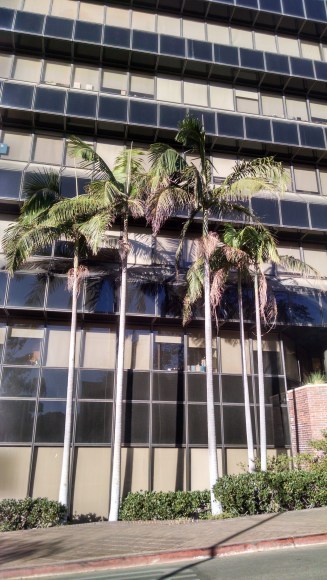
IMG_20171213_082840263_HDR

I think there’s a song about this…

QCD Meets Gravity is a conference centered around the various ways that “gravity is Yang-Mills squared”. There are a number of tricks that let you “square” calculations in Yang-Mills theories (a type of theory that includes QCD) to get calculations in gravity, and this conference showcased most of them.

At Amplitudes this summer, I was disappointed there were so few surprises. QCD Meets Gravity was different, with several talks on new or preliminary results, including one by Julio Parra-Martinez where the paper went up in the last few minutes of the talk! Yu-tin Huang talked about his (still-unpublished) work with Nima Arkani-Hamed on “UV/IR Polytopes”. The story there is a bit like the conformal bootstrap, with constraints (in this case based on positivity) marking off a space of “allowed” theories. String theory, interestingly, is quite close to the boundary of what is allowed. Enrico Herrmann is working on a way to figure out which gravity integrands are going to diverge without actually integrating them, while Simon Caron-Huot, in his characteristic out-of-the-box style, is wondering whether supersymmetric black holes precess. We also heard a bit more about a few recent papers. Oliver Schlotterer’s talk cleared up one thing: apparently the GEF functions he defines in his paper on one-loop “Z theory” are pronounced “Jeff”. I kept waiting for him to announce “Jeff theory”, but unfortunately no such luck. Sebastian Mizera’s talk was a very clear explanation of intersection theory, the subject of his recent paper. As it turns out, intersection theory is the study of mathematical objects like the Beta function (which shows up extensively in string theory), taking them apart in a way very reminiscent of the “squaring” story of Yang-Mills and gravity.

The heart of the workshop this year was gravitational waves. Since LIGO started running, amplitudes researchers (including, briefly, me) have been looking for ways to get involved. This conference’s goal was to bring together amplitudes people and the gravitational wave community, to get a clearer idea of what we can contribute. Between talks and discussions, I feel like we all understand the problem better. Some things that the amplitudes community thought were required, like breaking the symmetries of special relativity, turn out to be accidents of how the gravitational wave community calculates things: approximations that made things easier for them, but make things harder for us. There are areas in which we can make progress quite soon, even areas in which amplitudes people have already made progress. The detectors for which the new predictions matter might still be in the future (LIGO can measure two or three “loops”, LISA will see up to four), but they will eventually be measured. Amplitudes and gravitational wave physics could turn out to be a very fruitful partnership.
 

Thoughts from the Winter School

There are two things I’d like to talk about this week.

First, as promised, I’ll talk about what I worked on at the PSI Winter School.

Freddy Cachazo and I study what are called scattering amplitudes. At first glance, these are probabilities that two subatomic particles scatter off each other, relevant for experiments like the Large Hadron Collider. In practice, though, they can calculate much more.

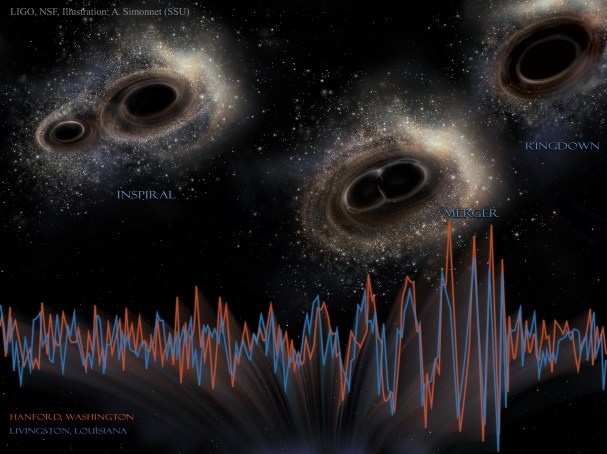
For example, let’s say you have two black holes circling each other, like the ones LIGO detected. Zoom out far enough, and you can think of each one as a particle. The two particle-black holes exchange gravitons, and those exchanges give rise to the force of gravity between them.

bhmerger_ligo_3600

In the end, it’s all just particle physics.


Based on that, we can use our favorite scattering amplitudes to make predictions for gravitational wave telescopes like LIGO.

There’s a bit of weirdness to this story, though, because these amplitudes don’t line up with predictions in quite the way we’re used to. The way we calculate amplitudes involves drawing diagrams, and those diagrams have loops. Normally, each “loop” makes the amplitude more quantum-mechanical. Only the diagrams with no loops (“tree diagrams”) come from classical physics alone.

(Here “classical physics” just means “not quantum”: I’m calling general relativity “classical”.)

For this problem, we only care about classical physics: LIGO isn’t sensitive enough to see quantum effects. The weird thing is, despite that, we still need loops.

(Why? This is a story I haven’t figured out how to tell in a non-technical way. The technical explanation has to do with the fact that we’re calculating a potential, not an amplitude, so there’s a Fourier transformation, and keeping track of the dimensions entails tossing around some factors of Planck’s constant. But I feel like this still isn’t quite the full story.)

So if we want to make predictions for LIGO, we want to compute amplitudes with loops. And as amplitudeologists, we should be pretty good at that.

As it turns out, plenty of other people have already had that idea, but there’s still room for improvement.

Our time with the students at the Winter School was limited, so our goal was fairly modest. We wanted to understand those other peoples’ calculations, and perhaps to think about them in a slightly cleaner way. In particular, we wanted to understand why “loops” are really necessary, and whether there was some way of understanding what the “loops” were doing in a more purely classical picture.

At this point, we feel like we’ve got the beginning of an idea of what’s going on. Time will tell whether it works out, and I’ll update you guys when we have a more presentable picture.


Unfortunately, physics wasn’t the only thing I was thinking about last week, which brings me to my other topic.

This blog has a fairly strong policy against talking politics. This is for several reasons. Partly, it’s because politics simply isn’t my area of expertise. Partly, it’s because talking politics tends to lead to long arguments in which nobody manages to learn anything. Despite this, I’m about to talk politics.

Last week, citizens of Iran, Iraq, Libya, Somalia, Sudan, Syria and Yemen were barred from entering the US. This included not only new visa applicants, but also those who already have visas or green cards. The latter group includes long-term residents of the US, many of whom were detained in airports and threatened with deportation when their flights arrived shortly after the ban was announced. Among those was the president of the Graduate Student Organization at my former grad school.

A federal judge has blocked parts of the order, and the Department of Homeland Security has announced that there will be case-by-case exceptions. Still, plenty of people are stuck: either abroad if they didn’t get in in time, or in the US, afraid that if they leave they won’t be able to return.

Politics isn’t in my area of expertise. But…

I travel for work pretty often. I know how terrifying and arbitrary border enforcement can be. I know how it feels to risk thousands of dollars and months of planning because some consulate or border official is having a bad day.

I also know how essential travel is to doing science. When there’s only one expert in the world who does the sort of work you need, you can’t just find a local substitute.

And so for this, I don’t need to be an expert in politics. I don’t need a detailed case about the risks of terrorism. I already know what I need to, and I know that this is cruel.

And so I stand in solidarity with the people who were trapped in airports, and those still trapped abroad and trapped in the US. You have been treated cruelly, and you shouldn’t have been. Hopefully, that sort of message can transcend politics.


One final thing: I’m going to be a massive hypocrite and continue to ban political comments on this blog. If you want to talk to me about any of this (and you think one or both of us might actually learn something from the exchange) please contact me in private.