
Tag Archives: academia

Talks, and what they’re good for

It’s an ill-kept secret that basically everyone in academia is a specialist. Nobody is just a “physicist”, or just a “high energy theorist”, or even just a “string theorist”. Even when I describe myself as something as specific as an “amplitudeologist”, I’m still over-generalizing: there’s a lot of amplitudes work out there that I would be hard-pressed to understand, and even harder-pressed to reproduce.

In the end, each of us is only going to understand a small subset of the vastness of our subject. This is problematic when it comes to attending talks.

Rarely, we get to attend talks about something we completely understand. Generally, we’re the ones giving those talks. The rest of the time, even at conferences for people of our particular specialty, we’re going to miss some fraction of the content, either because we don’t understand it or because we don’t find it interesting.

The question then becomes, why attend the talk in the first place? Why spend an hour of your time when you’re not getting an hour’s worth of content?

There are a couple reasons, of varying levels of plausibility.

One is that it’s always nice to know what other subfields are doing. It lets one feel connected to one’s compatriots, and it helps one navigate one’s career. That said, it’s unclear whether going to talks is really the best way of doing this. If you just want to know what other people are doing, you can always just watch to see what they publish. That doesn’t take an hour, unless you’re really dedicated to wasting time.

A more important benefit is increasing levels of familiarity. These days, I can productively pay attention to the first quarter of a talk, half if it’s particularly good. When I first got to grad school, I’d probably tune out after the first five minutes. The more talks you see on a subject, the more of the talk makes sense, and the more you get out of it. That’s part of why even fairly specialized people who are further along in their careers can talk on a wide range of subjects: often, they’ve intentionally kept themselves aware of what’s going on in other subfields, going to talks, reading papers, and engaging in conversation. This is a valuable end goal, since there is some truth to the hype about the benefits of interdisciplinarity in providing unconventional solutions to problems. That said, this is a gradual process. The benefit of one individual talk is tiny, and it doesn’t seem worth an hour of time. Much like exercise, it’s the habit that provides the benefit, not any individual session.

So in the end, talks are almost always unsatisfying. But we keep going to them, because they make us better scientists.
You get paid to learn. How bad can that be?

In my “who am I” post, I describe being a grad student as like being an apprentice. I’d like to elaborate on that.

Ph.D. programs in the sciences are different at every school, but they have a few basic features. Generally you enter them with a bachelor’s degree from another university. The program lasts for somewhere between four and six years, longer for particularly unfortunate cases. Sometimes you get a Master’s degree after the first two years, sometimes you don’t, but you don’t usually have to get it from another school. Generally the first two years mostly involve taking courses while the later years are mostly research, but this can vary as well. And in general, once you’re in the program, you get paid: either as a Teaching Assistant, in which case you help grade papers, lead lab sections, and sometimes give lectures, or as a Research Assistant, in which you are paid to do research.

This last is occasionally confusing to people. If a Ph.D. student learns by doing research, then why are they also paid to do research? That sounds like not just getting your education for free, but being paid for it, which sounds at the very least like a very good deal.

There are two ways to think about the situation. One, as I mentioned in my “who am I” post, is as an apprenticeship. An apprentice is expected to learn on the job, and provided they learn enough they are eventually certified to work on their own. Despite this, an apprenticeship is still very much a job. An apprentice is subservient to their master, and can generally be counted upon to work on the master’s projects and help the master in their job. In much the same way, a Ph.D. student is not certified to work on their own until they graduate from the program and obtain their Ph.D. In the meantime they are subservient to their advisor, and they have to take their advisor’s desires into account when choosing research projects. In general, most of a grad student’s research projects will be part of their advisor’s research in one way or another, furthering their advisor’s goals. Beyond the research itself, grad students will often have other duties, depending on the nature of their advisor’s work, especially if their advisor has a lab with complicated equipment that needs to be maintained.

The other thing to realize is that grad students are, ostensibly, part-time workers. The university pays me for 20 hours a week of work. The thing is, though, I don’t just work part-time. I work full-time. I also work at home, on the weekends…whenever I can make progress on my research (and I’m not doing some side project like this blog or taking a needed sanity break), I work. So if I work 40 hours a week and am paid for 20, that means I am effectively spending half my income on education.

Not so free, is it?

It’s not as if any of us could just work less and take on another part-time job, either. Apart from the fact that many grad students are international students on visas that don’t allow them to get other jobs, it is research itself: keeping up, making progress, working towards graduating, that takes up so much of our time. To get any education out of the process at all, we have to be involved as much as possible.  So we are, inevitably, paying for our education. And hopefully, we’re getting something out of it.

What if there’s nothing new?

In the weeks after the folks at the Large Hadron Collider announced that they had found the Higgs, people I met would ask if I was excited. After all, the Higgs was what particle physicists were searching for, right?

 As usual in this blog, the answer is “Not really.”

We were all pretty sure the Higgs had to exist; we just didn’t know what its mass would be. And while many people had predictions for what properties the Higgs might have (including some string theorists), fundamentally they were interested for other reasons.

Those reasons, for the most part, are supersymmetry. If the Higgs had different properties than we expected, it could be evidence for one or another proposed form of supersymmetry. Supersymmetry is still probably the best explanation for dark matter, and it’s necessary in some form or another for string theory. It also helps with other goals of particle physics, like unifying the fundamental forces and getting rid of fine-tuned parameters.

Fundamentally, though, the Higgs isn’t likely to answer these questions. To get enough useful information we’ll need to discover an actual superpartner particle. And so far…we haven’t.

That’s why we’re not all that excited about the Higgs anymore. And that’s why, increasingly, particle physics is falling into doom and gloom.

Sure, when physicists talk about the situation, they’re quick to claim that they’re just as hopeful as ever. We still may well see supersymmetry in later runs of the LHC, as it still has yet to reach its highest energies. But people are starting, quietly and behind closed doors, to ask: what if we don’t?

What happens if we don’t see any new particles in the LHC?

There are good mathematical reasons to think that some form of supersymmetry holds. Even if we don’t see supersymmetric particles in the LHC, they may still exist. We just won’t know anything new about them.

That’s a problem.

We’ve been spinning our wheels for too long, and it’s becoming more and more obvious. With no new information from experiments, it’s not clear what we can do anymore.

And while, yes, many theorists are studying theories that aren’t true, sometimes without even an inkling of a connection to the real world, we’re all part of the same zeitgeist. We may not be studying reality itself, but at least we’re studying parts of reality, rearranged in novel ways. Without the support of experiment the rest of the field starts to decay. And one by one, those who can are starting to leave.

Despite how it may seem, most of physics doesn’t depend on supersymmetry. If you’re investigating novel materials, or the coolest temperatures ever achieved, or doing other awesome things with lasers, then the LHC’s failure to find supersymmetry will mean absolutely nothing to you. It’s only a rather small area of physics that will progressively fall into self-doubt until the only people left are the insane or the desperate.

But those of us in that area? If there really is nothing new? Yeah, we’re screwed.

A physicist by any other trade

Physicists have a tendency to stick their noses in other peoples’ work. We’ve conquered Wall Street (and maybe ruined it), studied communication networks and neural networks, and in a surprising number of cases turned from the study of death to the study of life. Pretty much everyone in physics knows someone who left physics to work on something more interesting, or better-funded, or just straight-up more lucrative. Occasionally, they even remember their roots.

What about the reverse, though? Where are the stories of people in other fields taking up physics?

Aside from a few very early-career examples, that just doesn’t happen. You might say that’s just because physics is hard, but that would be discounting the challenges present in other fields. A better point is that physics is hard, and old.

 Physics is arguably the oldest science, with only a few fields like mathematics and astronomy having claim to an older pedigree. A freshman physics student spends their first semester studying ideas that would have been recognizable three hundred years ago.

Of course, the same (and more) could be said about philosophy. The difference is that in physics, we teach ideas from three hundred years ago because we need them to teach ideas from two hundred years ago. And the ideas from two hundred years ago are only there so we can fill them in with information from a hundred years ago. The purpose of an education in physics, in a sense, is to catch students up with the last three hundred years of work in as concise a manner as possible.

Naturally, this leads to a lot of shortcuts, and over the years an enormous amount of notational cruft has built up around the field, to the point where nothing can be understood without understanding the last three hundred years. In a field where just getting students used to the built-up lingo takes an entire undergraduate education, it’s borderline impossible to just pick it up in the middle and expect to make progress.

Of course, this only explains why people who were trained in other fields don’t take up physics mid-career. What about physicists who go over to other fields? Do they ever come back?

I can’t think of any examples, but I can’t think of a good reason either. Maybe it’s hard to get back in to physics after you’ve been gone for a while. Maybe other fields are just so fun, or physics so miserable, no-one ever wants to come back. We shall never know.

So what do you actually do?

A few days ago, my sister asked me what I do at work. What do I actually do in order to do my job? What sort of tasks does it involve?

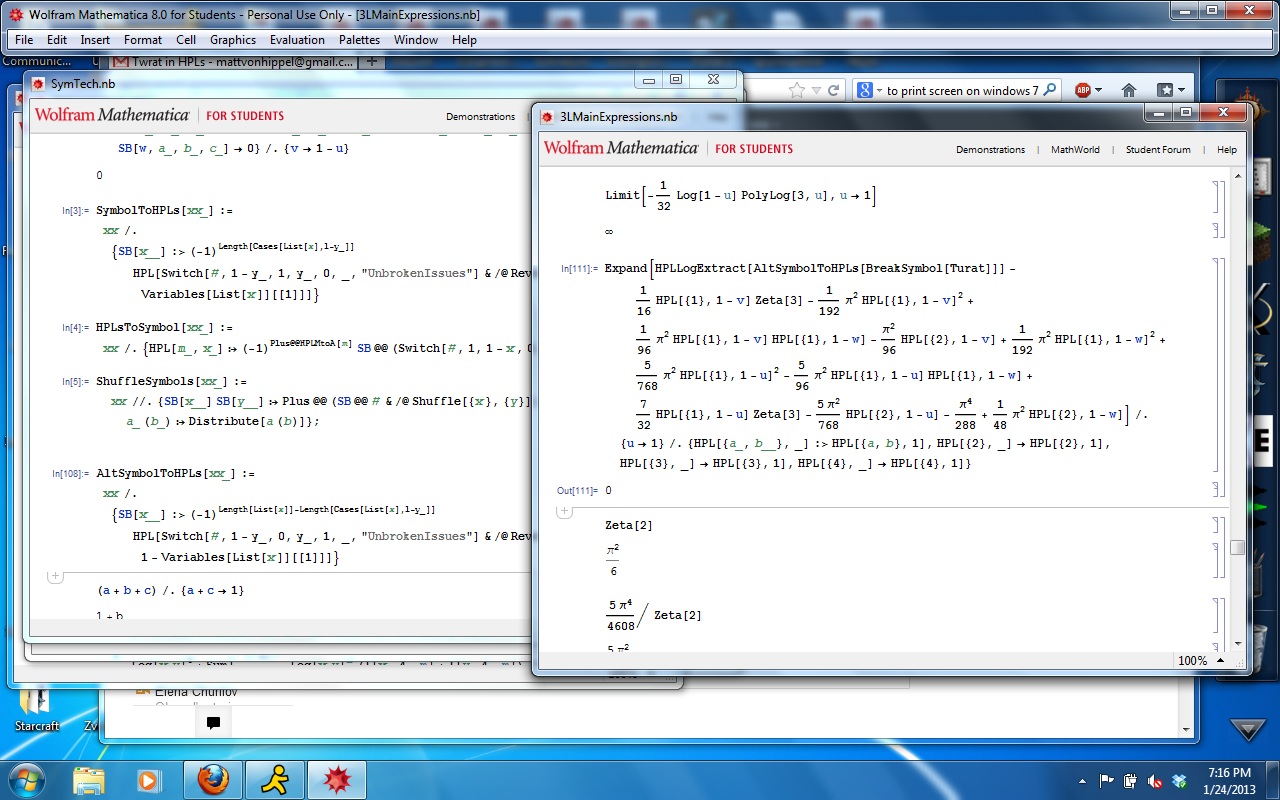
I answered by showing her this:

WhatIDo

Needless to say, that wasn’t very helpful, so I thought a bit and now I have a better answer.

Doing theoretical physics is basically like doing homework. In particular, it’s like doing difficult, interesting homework.

Think of the toughest homework assignment you’ve ever had to do. A homework assignment so tough, you and all your friends in the class worked together to finish it, and none of you were sure you were going to get it right.

Chances are, you handled the situation in one of two ways, depending on whether this was a group project, or an individual one.

Group Project:

This is what you do when you’re supposed to be in a group. Maybe you’re putting together a presentation, or building a rocket. Whatever you’re doing, you’ve got a lot of little tasks that need to get done in order to achieve your goals, so you parcel them out: each group member is assigned a specific task, and at the end everyone meets and puts it all together.

This sort of situation is common in theoretical physics as well, and it happens when different people have different skills to contribute. If one theorist is good at programming, while another understands a particular esoteric type of mathematics, then the math person will do the calculations and then give the results to the programming person, who makes a program to implement it.

Individual Project:

On the other hand, if everyone needs to submit their own work, you can’t very well just do part of it (not without cheating, anyway). Still, it’s not as if you’re doing this on your own. You do your own work to solve the problem, but you keep in contact with your classmates, and when you get stuck, you ask one of them for help.

This sort of situation happens in theoretical physics when everyone is relatively on the same page. Everyone works through the problem individually, doing the calculation and making their own programs, and whenever someone gets stuck, they talk to the others. Everyone periodically compares their results, which serves as a cross-check to make sure nobody made a mistake. The only difference from doing homework is that you and your collaborators write your own problems…which means, none of you know if there is a solution!

In both cases (group and individual), theoretical physics is a matter of doing calculations, writing programs, and thinking through thought experiments. Sometimes that means specific tasks as part of one huge project; sometimes it means working side by side on the same calculation. Either way, it all boils down to one thing: I’m someone who does homework for a living.