
Back in January, I announced I was leaving France and leaving academia. Since then, it hasn’t made much sense for me to go to conferences, even the big conference of my sub-field or the conference I organized.
I did go to a conference this week, though. I had two excuses:
- The conference was here in Copenhagen, so no travel required.
- The conference was about machine learning.
HAMLET-Physics, or How to Apply Machine Learning to Experimental and Theoretical Physics, had the additional advantage of having an amusing acronym. Thanks to generous support by Carlsberg and the Danish Data Science Academy, they could back up their choice by taking everyone on a tour of Kronborg (better known in the English-speaking world as Elsinore).
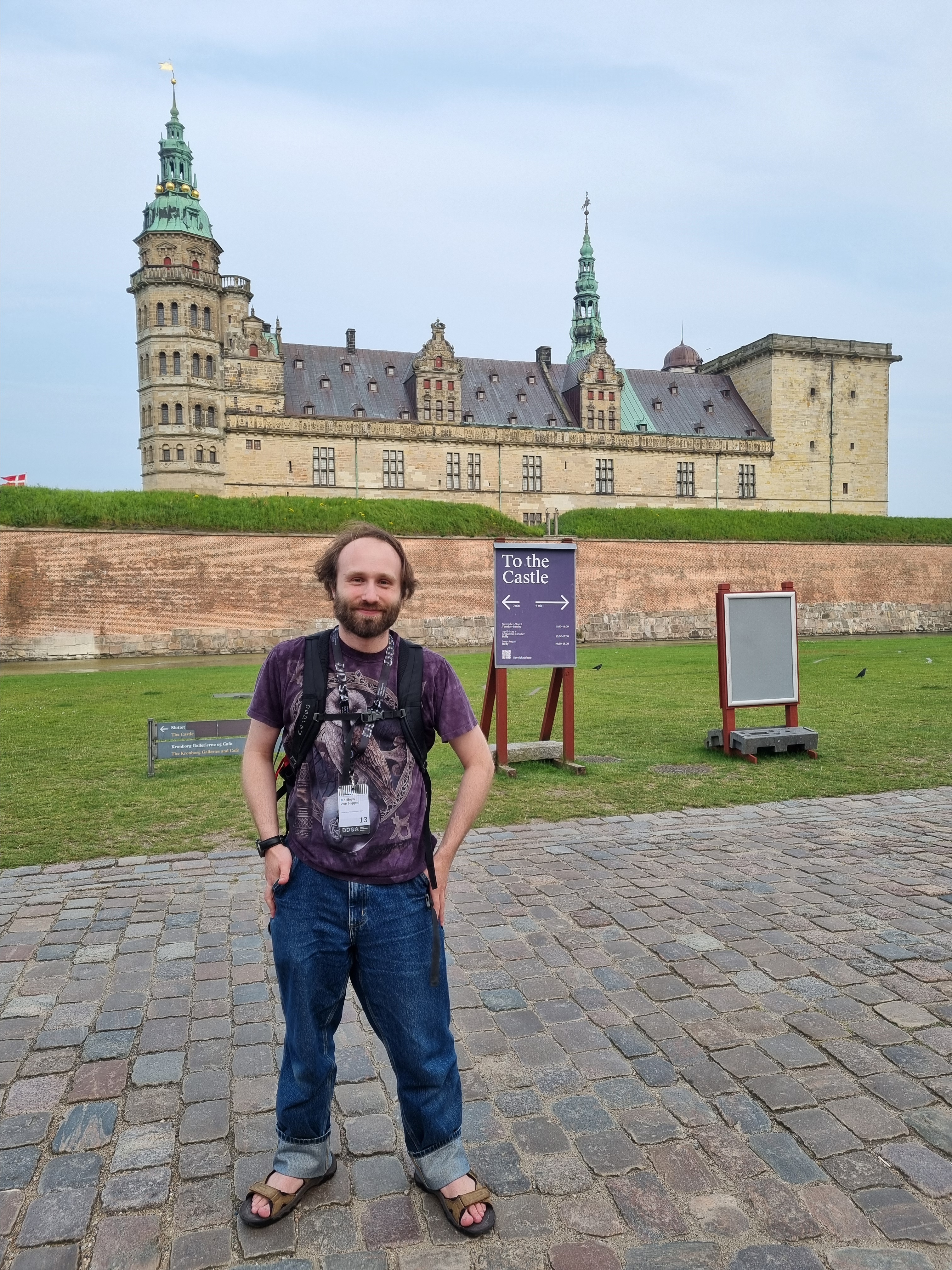
This conference’s purpose was to bring together physicists who use machine learning, machine learning-ists who might have something useful to say to those physicists, and other physicists who don’t use machine learning yet but have a sneaking suspicion they might have to at some point. As a result, the conference was super-interdisciplinary, with talks by people addressing very different problems with very different methods.
Interdisciplinary conferences are tricky. It’s easy for the different groups of people to just talk past each other: everyone shows up, gives the same talk they always do, socializes with the same friends they always meet, then leaves.
There were a few talks that hit that mold, and were so technical only a few people understood. But most were better. The majority of the speakers did really well at presenting their work in a way that would be understandable and even exciting to people outside their field, while still having enough detail that we all learned something. I was particularly impressed by Thea Aarestad’s keynote talk on Tuesday, a really engaging view of how machine learning can be used under the extremely tight time constraints LHC experiments need to decide whether to record incoming data.
For the social aspect, the organizers had a cute/gimmicky/machine-learning-themed solution. Based on short descriptions and our public research profiles, they clustered attendees, plotting the connections between them. They then used ChatGPT to write conversation prompts between any two people on the basis of their shared interests. In practice, this turned out to be amusing but totally unnecessary. We were drawn to speak to each other not by conversation prompts, but by a drive to learn from each other. “Why do you do it that way?” was a powerful conversation-starter, as was “what’s the best way to do this?” Despite the different fields, the shared methodologies gave us strong reasons to talk, and meant that people were very rarely motivated to pick one of ChatGPT’s “suggestions”.
Overall, I got a better feeling for how machine learning is useful in physics (and am planning a post on that in future). I also got some fresh ideas for what to do myself, and a bit of a picture of what the future holds in store.
 4 gravitons
“Overall, I got a better feeling for how machine learning is useful in physics (and am planning a post on that in future). I also got some fresh ideas for what to do myself, and a bit of a picture of what the future holds in store.”
Interested in both! I happened to be listening to a Youtube video with Terence Tao talking about AI and mathematics when I opened this post.
LikeLike