
Monthly Archives: November 2022

Confidence and Friendliness in Science

I’ve seen three kinds of scientific cultures.

First, there are folks who are positive about almost everyone. Ask them about someone else’s lab, even a competitor, and they’ll be polite at worst, and often downright excited. Anyone they know, they’ll tell you how cool the work they’re doing is, how it’s important and valuable and worth doing. They might tell you they prefer a different approach, but they’ll almost never bash someone’s work.

I’ve heard this comes out of American culture, and I can kind of see it. There’s an attitude in the US that everything needs to be described as positively as possible. This is especially true in a work context. Negativity is essentially a death sentence, doled out extremely rarely: if you explicitly say someone or their work is bad, you’re trying to get them fired. You don’t do that unless someone really really deserves it.

That style of scientific culture is growing, but it isn’t universal. There’s still a big cultural group that is totally ok with negativity: as long as it’s directed at other people, anyway.

This scientific culture prides itself on “telling it like it is”. They’ll happily tell you about how everything everyone else is doing is bullshit. Sometimes, they claim their ideas are the only ways forward. Others will have a small number of other people who they trust, who have gained their respect in one way or another. This sort of culture is most stereotypically associated with Russians: a “Russian-style” seminar, for example, is one where the speaker is aggressively questioned for hours.

It may sound like those are the only two options, but there is a third. While “American-style” scientists don’t criticize anyone, and “Russian-style” scientists criticize everyone else, there are also scientists who criticize almost everyone, including themselves.

With a light touch, this culture can be one of the best. There can be a real focus on “epistemic humility”, on always being clear of how much we still don’t know.

However, it can be worryingly easy to spill past that light touch, into something toxic. When the criticism goes past humility and into a lack of confidence in your own work, you risk falling into a black hole, where nothing is going well and nobody has a way out. This kind of culture can spread, filling a workplace and infecting anyone who spends too long there with the conviction that nothing will ever measure up again.

If you can’t manage that light skeptical touch, then your options are American-style or Russian-style. I don’t think either is obviously better. Both have their blind spots: the Americans can let bad ideas slide to avoid rocking the boat, while the Russians can be blind to their own flaws, confident that because everyone else seems wrong they don’t need to challenge their own worldview.

You have one more option, though. Now that you know this, you can recognize each for what it is: not the one true view of the world, but just one culture’s approach to the truth. If you can do that, you can pick up each culture as you need, switching between them as you meet different communities and encounter different things. If you stay aware, you can avoid fighting over culture and discourse, and use your energy on what matters: the science.
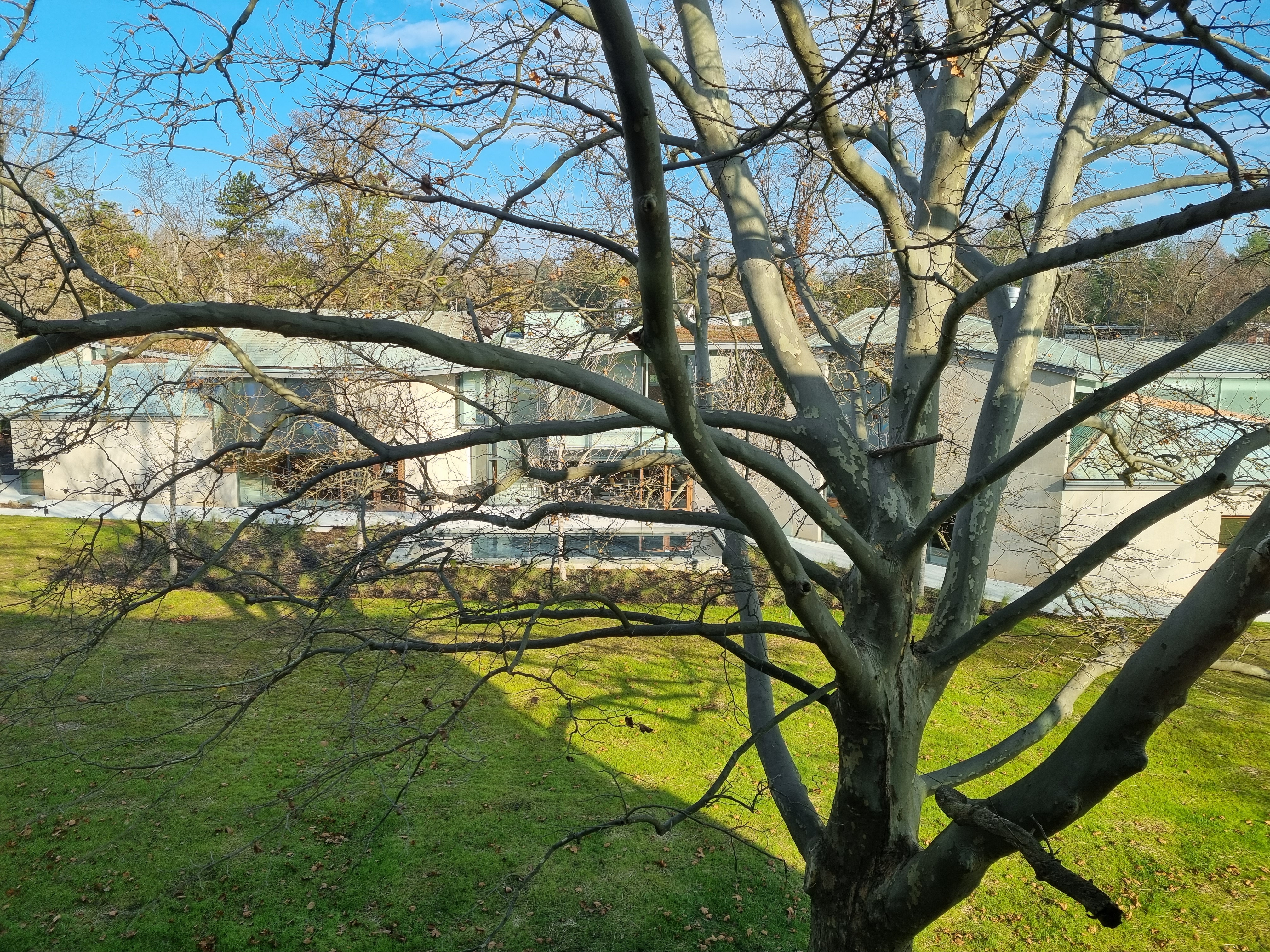
Visiting the IAS

I’m at the Institute for Advanced Study, or IAS, this week.

There isn’t a conference going on, but if you looked at the visitor list you’d be forgiven for thinking there was. We have talks in my subfield almost every day this week, two professors from my subfield here on sabbatical, and extra visitors on top of that.

The IAS is a bit of an odd place. Partly, that’s due to its physical isolation: tucked away in the woods behind Princeton, a half-hour’s walk from the nearest restaurant, it’s supposed to be a place for contemplation away from the hustle and bustle of the world.

Since the last time I visited they’ve added a futuristic new building, seen here out of my office window. The building is most notable for one wild promise: someday, they will serve dinner there.

Mostly, though, the weirdness of the IAS is due to the kind of institution it is.

Within a given country, most universities are pretty similar. Each may emphasize different teaching styles, and the US has a distinction between public and private, but (neglecting scammy for-profit universities), there are some commonalities of structure: both how they’re organized, and how they’re funded. Even between countries, different university systems have quite a bit of overlap.

The IAS, though, is not a university. It’s an independent institute. Neighboring Princeton supplies it with PhD students, but otherwise the IAS runs, and funds, itself.

There are a few other places like that around the world. The Perimeter Institute in Canada is also independent, and also borrows students from a neighboring university. CERN pools resources from several countries across Europe and beyond, Nordita from just the Nordic countries. Generalizing further, many countries have some sort of national labs or other nation-wide systems, from US Department of Energy labs like SLAC to Germany’s Max Planck Institutes.

And while universities share a lot in common, non-university institutes can be very different. Some are closely tied to a university, located inside university buildings with members with university affiliations. Others sit at a greater remove, less linked to a university or not linked at all. Some have their own funding, investments or endowments or donations, while others are mostly funded by governments, or groups of governments. I’ve heard that the IAS gets about 10% of its budget from the government, while Perimeter gets its everyday operating expenses entirely from the Canadian government and uses donations for infrastructure and the like.

So ultimately, the IAS is weird because every organization like it is weird. There are a few templates, and systems, but by and large each independent research organization is different. Understanding one doesn’t necessarily help at understanding another.

Fields and Scale

I am a theoretical particle physicist, and every morning I check the arXiv.

arXiv.org is a type of website called a preprint server. It’s where we post papers before they are submitted to (and printed by) a journal. In practice, everything in our field shows up on arXiv, publicly accessible, before it appears anywhere else. There’s no peer review process on arXiv, the journals still handle that, but in our field peer review doesn’t often notice substantive errors. So in practice, we almost never read the journals: we just check arXiv.

And so every day, I check the arXiv. I go to the section on my sub-field, and I click on a link that lists all of the papers that were new that day. I skim the titles, and if I see an interesting paper I’ll read the abstract, and maybe download the full thing. Checking as I’m writing this, there were ten papers posted in my field, and another twenty “cross-lists” were posted in other fields but additionally classified in mine.

Other fields use arXiv: mathematicians and computer scientists and even economists use it in roughly the same way physicists do. For biology and medicine, though, there are different, newer sites: bioRxiv and medRxiv.

One thing you may notice is the different capitalization. When physicists write arXiv, the “X” is capitalized. In the logo, it looks like a Greek letter chi, thus saying “archive”. The biologists and medical researchers capitalize the R instead. The logo still has an X that looks like a chi, but positioned with the R it looks like the Rx of medical prescriptions.

Something I noticed, but you might not, was the lack of a handy link to see new papers. You can search medRxiv and bioRxiv, and filter by date. But there’s no link that directly takes you to the newest papers. That suggests that biologists aren’t using bioRxiv like we use arXiv, and checking the new papers every day.

I was curious if this had to do with the scale of the field. I have the impression that physics and mathematics are smaller fields than biology, and that much less physics and mathematics research goes on than medical research. Certainly, theoretical particle physics is a small field. So I might have expected arXiv to be smaller than bioRxiv and medRxiv, and I certainly would expect fewer papers in my sub-field than papers in a medium-sized subfield of biology.

On the other hand, arXiv in my field is universal. In biology, bioRxiv and medRxiv are still quite controversial. More and more people are using them, but not every journal accepts papers posted to a preprint server. Many people still don’t use these services. So I might have expected bioRxiv and medRxiv to be smaller.

Checking now, neither answer is quite right. I looked between November 1 and November 2, and asked each site how many papers were uploaded between those dates. arXiv had the most, 604 papers. bioRxiv had roughly half that many, 348. medRxiv had 97.

arXiv represents multiple fields, bioRxiv is “just” biology. Specializing, on that day arXiv had 235 physics papers, 135 mathematics papers, and 250 computer science papers. So each individual field has fewer papers than biology in this period.

Specializing even further, I can look at a subfield. My subfield, which is fairly small, had 20 papers between those dates. Cell biology, which I would expect to be quite a big subfield, had 33.

Overall, the numbers were weirdly comparable, with medRxiv unexpectedly small compared to both arXiv and bioRxiv. I’m not sure whether there are more biologists than physicists, but I’m pretty sure there should be more cell biologists than theoretical particle physicists. This suggests that many still aren’t using bioRxiv. It makes me wonder: will bioRxiv grow dramatically in future? Are the people running it ready for if it does?

No, PhD Students Are Not Just Cheap Labor

Here’s a back-of-the-envelope calculation:

In 2019, there were 83,050 unionized graduate students in the US. Let’s assume these are mostly PhD students, since other graduate students are not usually university employees. I can’t find an estimate of the total number of PhD students in the US, but in 2019, 55,614 of them graduated. In 2020, the average US doctorate took 7.5 years to complete. That implies that 83,050/(55,614 x 7.5) = about one-fifth of PhD students in the US are part of a union.

That makes PhD student unions common, but not the majority. It means they’re not unheard of and strange, but a typical university still isn’t unionized. It’s the sweet spot for controversy. It leads to a lot of dumb tweets.

I saw one such dumb tweet recently, from a professor arguing that PhD students shouldn’t unionize. The argument was that if PhD students were paid more, then professors would prefer to hire postdocs, researchers who already have a doctoral degree.

(I won’t link to the tweet, in part because this person is probably being harassed enough already.)

I don’t know how things work in this professor’s field. But the implication, that professors primarily take on PhD students because they’re cheaper, not only doesn’t match my experience: it also just doesn’t make very much sense.

Imagine a neighborhood where the children form a union. They decide to demand a higher allowance, and to persuade any new children in the neighborhood to follow their lead.

Now imagine a couple in that neighborhood, deciding whether to have a child. Do you think that they might look at the fees the “children’s union” charges, and decide to hire an adult to do their chores instead?

Maybe there’s a price where they’d do that. If neighborhood children demanded thousands of dollars in allowance, maybe the young couple would decide that it’s too expensive to have a child. But a small shift is unlikely to change things very much: people have kids for many reasons, and those reasons don’t usually include cheap labor.

The reasons professors take on PhD students are similar to the reasons parents decide to have children. Some people have children because they want a legacy, something of theirs that survives to the next generation. For professors, PhD students are our legacy, our chance to raise someone on our ideas and see how they build on them. Some people have children because they love the act of child-raising: helping someone grow and learn about the world. The professors who take on students like taking on students: teaching is fun, after all.

That doesn’t mean there won’t be cases “on the margin”, where a professor finds they can’t afford a student they previously could. (And to be fair to the tweet I’m criticizing, they did even use the word “marginal”.) But they would have to be in a very tight funding situation, with very little flexibility.

And even for situations like that, long-term, I’m not sure anything would change.

I did my PhD in the US. I was part of a union, and in part because of that (though mostly because I was in a physics department), I was paid relatively decently for a PhD student. Relatively decently is still not that great, though. This was the US, where universities still maintain the fiction that PhD students only work 20 hours a week and pay proportionate to that, and where salaries in a university can change dramatically from student to postdoc to professor.

One thing I learned during my PhD is that despite our low-ish salaries, we cost our professors about as much as postdocs did. The reason why is tuition: PhD students don’t pay their own tuition, but that tuition still exists, and is paid by the professors who hire those students out of their grants. A PhD salary plus a PhD tuition ended up roughly equal to a postdoc salary.

Now, I’m working in a very different system. In a Danish university, wages are very flat. As a postdoc, a nice EU grant put me at almost the same salary as the professors. As a professor, my salary is pretty close to that of one of the better-paying schoolteacher jobs.

At the same time, tuition is much less relevant. Undergraduates don’t pay tuition at all, so PhD tuition isn’t based on theirs. Instead, it’s meant to cover costs of the PhD program as a whole.

I’ve filled out grants here in Denmark, so I know how much PhD students cost, and how much postdocs cost. And since the situation is so different, you might expect a difference here too.

There isn’t one. Hiring a PhD student, salary plus tuition, costs about as much as hiring a postdoc.

Two very different systems, with what seem to be very different rules, end up with the same equation. PhD students and postdocs cost about as much as each other, even if every assumption that you think would affect the outcome turns out completely different.

This is why I expect that, even if PhD students get paid substantially more, they still won’t end up that out of whack with postdocs. There appears to be an iron law of academic administration keeping these two numbers in line, one that holds across nations and cultures and systems. The proportion of unionized PhD students in the US will keep working its way upwards, and I don’t expect it to have any effect on whether professors take on PhDs.