Maybe you care about technology. You support science because, down the line, you think it will give us new capabilities that improve people’s lives. Maybe you expect this to happen directly, or maybe indirectly as “spinoff” inventions like the internet.
Maybe you just think science is cool. You want the stories that science tells: they entertain you, they give you a place in the world, they help distract from the mundane day to day grind.
Maybe you just think that the world ought to have scientists in it. You can think of it as a kind of bargain, maintaining expertise so that society can tackle difficult problems. Or you can be more cynical, paying early-career scientists on the assumption that most will leave academia and cheapen labor costs for tech companies.
Maybe you want to pay the scientists to teach, to be professors at universities. You notice that they don’t seem to be happy if you don’t let them research, so you throw a little research funding at them, as a treat.
Maybe you just want to grow your empire: your department, your university, the job numbers in your district.
In most jobs, you’re supposed to do what people pay you to do. As a scientist, the people who pay you have all of these motivations and more. You can’t simply choose to do what people pay you to do.
So you come up with a proxy. You sum up all of these ideas, into a vague picture of what all those people want. You have some idea of scientific quality: not just a matter of doing science correctly and carefully, but doing interesting science. It’s not something you ever articulate. It’s likely even contradictory, after all, the goals it approximates often are. Nonetheless, it’s your guide, and not just your guide: it’s the guide of those who hire you, those who choose if you get promoted or whether you get more funding. All of these people have some vague idea in their head of what makes good science, their own proxy for the desires of the vast mass of voters and decision-makers and funders.
But of course, the standard is still vague. Should good science be deep? Which topics are deeper than others? Should it be practical? Practical for whom? Should it be surprising? What do you expect to happen, and what would surprise you? Should it get the community excited? Which community?
As a practicing scientist, you have to build your own proxy for these proxies. The same work that could get you hired in one place might meet blank stares at another, and you can’t build your life around those unpredictable quirks. So you make your own vague idea of what you’re supposed to do, an alchemy of what excites you and what makes an impact and what your friends are doing. You build a stand-in in your head, on the expectation that no-one else will have quite the same stand-in, then go out and convince the other stand-ins to give money to your version. You stand on a shifting pile of unwritten rules, subtler even than some artists, because at the end of the day there’s never a real client to be seen. Just another proxy.
If you imagine a particle physicist, you probably picture someone spending their whole day dreaming up new particles. They figure out how to test those particles in some big particle collider, and for a lucky few their particle gets discovered and they get a Nobel prize.
Occasionally, a wiseguy asks if we can’t just cut out the middleman. Instead of dreaming up particles to test, why don’t we just write down every possible particle and test for all of them? It would save the Nobel committee a lot of money at least!
It turns out, you can sort of do this, through something called Effective Field Theory. An Effective Field Theory is a type of particle physics theory that isn’t quite true: instead, it’s “effectively” true, meaning true as long as you don’t push it too far. If you test it at low energies and don’t “zoom in” too much then it’s fine. Crank up your collider energy high enough, though, and you expect the theory to “break down”, revealing new particles. An Effective Field Theory lets you “hide” unknown particles inside new interactions between the particles we already know.
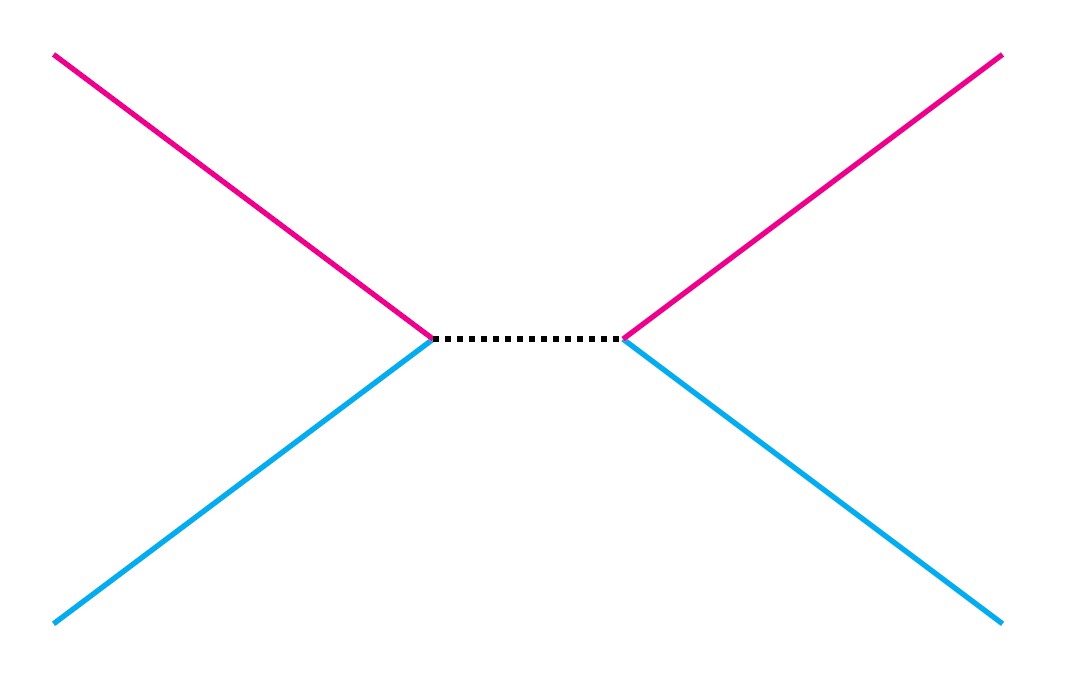
To help you picture how this works, imagine that the pink and blue lines here represent familiar particles like electrons and quarks, while the dotted line is a new particle somebody dreamed up. (The picture is called a Feynman diagram, if you don’t know what that is check out this post.)
In an Effective Field Theory, we “zoom out”, until the diagram looks like this:
Now we’ve “hidden” the new particle. Instead, we have a new type of interaction between the particles we already know.
So instead of writing down every possible new particle we can imagine, we only have to write down every possible interaction between the particles we already know.
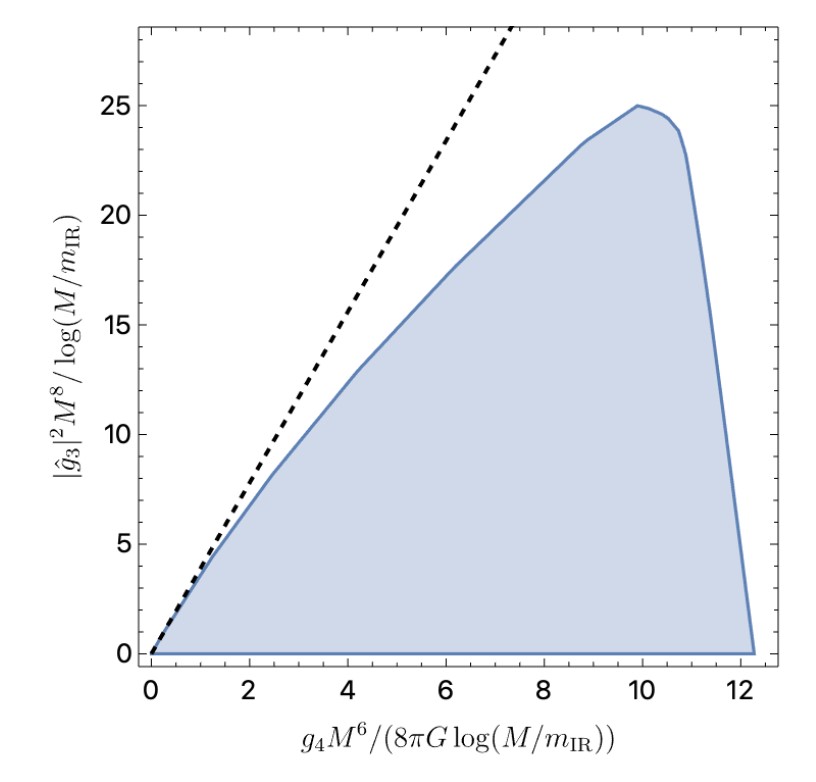
Using these rules you can play a kind of game. You start out with a space representing all of the interactions you can imagine. You begin chipping at it, carving away parts that don’t obey the rules, and you see what shape is left over. You end up with plots that look a bit like carving a ham.
People in my subfield are getting good at this kind of game. It isn’t quite our standard fare: usually, we come up with tricks to make calculations with specific theories easier. Instead, many groups are starting to look at these general, effective theories. We’ve made friends with groups in related fields, building new collaborations. There still isn’t one clear best way to do this carving, so each group manages to find a way to chip a little farther. Out of the block of every theory we could imagine, we’re carving out a space of theories that make sense, theories that could conceivably be right. Theories that are worth testing.
Today, we’d call Leibniz a mathematician, a physicist, and a philosopher. As a mathematician, Leibniz turned calculus into something his contemporaries could actually use. As a physicist, he championed a doomed theory of gravity. In philosophy, he seems to be most remembered for extremely cheaty arguments.
Free will and determinism? Can’t it just be a coincidence?
I don’t blame him for this. Faced with a tricky philosophical problem, it’s enormously tempting to just blaze through with an answer that makes every subtlety irrelevant. It’s a temptation I’ve succumbed to time and time again. Faced with a genie, I would always wish for more wishes. On my high school debate team, I once forced everyone at a tournament to switch sides with some sneaky definitions. It’s all good fun, but people usually end up pretty annoyed with you afterwards.
People were annoyed with Leibniz too, especially with his solution to the problem of evil. If you believe in a benevolent, all-powerful god, as Leibniz did, why is the world full of suffering and misery? Leibniz’s answer was that even an all-powerful god is constrained by logic, so if the world contains evil, it must be logically impossible to make the world any better: indeed, we live in the best of all possible worlds. Voltaire famously made fun of this argument in Candide, dragging a Leibniz-esque Professor Pangloss through some of the most creative miseries the eighteenth century had to offer. It’s possibly the most famous satire of a philosopher, easily beating out Aristophanes’ The Clouds (which is also great).
Physicists can also get accused of cheaty arguments, and probably the most mocked is the idea of a multiverse. While it hasn’t had its own Candide, the multiverse has been criticized by everyone from bloggers to Nobel prizewinners. Leibniz wanted to explain the existence of evil, physicists want to explain “unnaturalness”: the fact that the kinds of theories we use to explain the world can’t seem to explain the mass of the Higgs boson. To explain it, these physicists suggest that there are really many different universes, separated widely in space or built in to the interpretation of quantum mechanics. Each universe has a different Higgs mass, and ours just happens to be the one we can live in. This kind of argument is called “anthropic” reasoning. Rather than the best of all possible worlds, it says we live in the world best-suited to life like ours.
I called Leibniz’s argument “cheaty”, and you might presume I think the same of the multiverse. But “cheaty” doesn’t mean “wrong”. It all depends what you’re trying to do.
Leibniz’s argument and the multiverse both work by dodging a problem. For Leibniz, the problem of evil becomes pointless: any evil might be necessary to secure a greater good. With a multiverse, naturalness becomes pointless: with many different laws of physics in different places, the existence of one like ours needs no explanation.
In both cases, though, the dodge isn’t perfect. To really explain any given evil, Leibniz would have to show why it is secretly necessary in the face of a greater good (and Pangloss spends Candide trying to do exactly that). To explain any given law of physics, the multiverse needs to use anthropic reasoning: it needs to show that that law needs to be the way it is to support human-like life.
This sounds like a strict requirement, but in both cases it’s not actually so useful. Leibniz could (and Pangloss does) come up with an explanation for pretty much anything. The problem is that no-one actually knows which aspects of the universe are essential and which aren’t. Without a reliable way to describe the best of all possible worlds, we can’t actually test whether our world is one.
The same problem holds for anthropic reasoning. We don’t actually know what conditions are required to give rise to people like us. “People like us” is very vague, and dramatically different universes might still contain something that can perceive and observe. While it might seem that there are clear requirements, so far there hasn’t been enough for people to do very much with this type of reasoning.
However, for both Leibniz and most of the physicists who believe anthropic arguments, none of this really matters. That’s because the “best of all possible worlds” and “most anthropic of all possible worlds” aren’t really meant to be predictive theories. They’re meant to say that, once you are convinced of certain things, certain problems don’t matter anymore.
Leibniz, in particular, wasn’t trying to argue for the existence of his god. He began the argument convinced that a particular sort of god existed: one that was all-powerful and benevolent, and set in motion a deterministic universe bound by logic. His argument is meant to show that, if you believe in such a god, then the problem of evil can be ignored: no matter how bad the universe seems, it may still be the best possible world.
Similarly, the physicists convinced of the multiverse aren’t really getting there through naturalness. Rather, they’ve become convinced of a few key claims: that the universe is rapidly expanding, leading to a proliferating multiverse, and that the laws of physics in such a multiverse can vary from place to place, due to the huge landscape of possible laws of physics in string theory. If you already believe those things, then the naturalness problem can be ignored: we live in some randomly chosen part of the landscape hospitable to life, which can be anywhere it needs to be.
So despite their cheaty feel, both arguments are fine…provided you agree with their assumptions. Personally, I don’t agree with Leibniz. For the multiverse, I’m less sure. I’m not confident the universe expands fast enough to create a multiverse, I’m not even confident it’s speeding up its expansion now. I know there’s a lot of controversy about the math behind the string theory landscape, about whether the vast set of possible laws of physics are as consistent as they’re supposed to be…and of course, as anyone must admit, we don’t know whether string theory itself is true! I don’t think it’s impossible that the right argument comes around and convinces me of one or both claims, though. These kinds of arguments, “if assumptions, then conclusion” are the kind of thing that seems useless for a while…until someone convinces you of the conclusion, and they matter once again.
So in the end, despite the similarity, I’m not sure the multiverse deserves its own Candide. I’m not even sure Leibniz deserved Candide. But hopefully by understanding one, you can understand the other just a bit better.
I saw a discussion on twitter recently, about PhD programs in the US. Apparently universities are putting more and more weight whether prospective students published a paper during their Bachelor’s degree. For some, it’s even an informal requirement. Some of those in the discussion were skeptical that the students were really contributing to these papers much, and thought that most of the work must have been done by the papers’ other authors. If so, this would mean universities are relying more and more on a metric that depends on whether students can charm their professors enough to be “included” in this way, rather than their own abilities.
I won’t say all that much about the admissions situation in the US. (Except to say that if you find yourself making up new criteria to carefully sift out a few from a group of already qualified-enough candidates, maybe you should consider not doing that.) What I did want to say a bit about is what undergraduates can typically actually do, when it comes to research in my field.
First, I should clarify that I’m talking about students in the US system here. Undergraduate degrees in Europe follow a different path. Students typically take three years to get a Bachelor’s degree, often with a project at the end, followed by a two-year Master’s degree capped with a Master’s thesis. A European Master’s thesis doesn’t have to result in a paper, but is often at least on that level, while a European Bachelor project typically isn’t. US Bachelor’s degrees are four years, so one might expect a Bachelor’s thesis to be in between a European Bachelor’s project and Master’s thesis. In practice, it’s a bit different: courses for Master’s students in Europe will generally cover material taught to PhD students in the US, so a typical US Bachelor’s student won’t have had some courses that have a big role in research in my field, like Quantum Field Theory. On the other hand, the US system is generally much more flexible, with students choosing more of their courses and having more opportunities to advance ahead of the default path. So while US Bachelor’s students don’t typically take Quantum Field Theory, the more advanced students can and do.
Because of that, how advanced a given US Bachelor’s student is varies. A small number are almost already PhD students, and do research to match. Most aren’t, though. Despite that, it’s still possible for such a student to complete a real research project in theoretical physics, one that results in a real paper. What does that look like?
Sometimes, it’s because the student is working with a toy model. The problems we care about in theoretical physics can be big and messy, involving a lot of details that only an experienced researcher will know. If we’re lucky, we can make a simpler version of the problem, one that’s easier to work with. Toy models like this are often self-contained, the kind of thing a student can learn without all of the background we expect. The models may be simpler than the real world, but they can still be interesting, suggesting new behavior that hadn’t been considered before. As such, with a good choice of toy model an undergraduate can write something that’s worthy of a real physics paper.
Other times, the student is doing something concrete in a bigger collaboration. This isn’t quite the same as the “real scientists” doing all the work, because the student has a real task to do, just one that is limited in scope. Maybe there is particular computer code they need to get working, or a particular numerical calculation they need to do. The calculation may be comparatively straightforward, but in combination with other results it can still merit a paper. My first project as a PhD student was a little like that, tackling one part of a larger calculation. Once again, the task can be quite self-contained, the kind of thing you can teach a student over a summer project.
Undergraduate projects in the US won’t always result in a paper, and I don’t think anyone should expect, or demand, that they do. But a nontrivial number do, and not because the student is “cheating”. With luck, a good toy model or a well-defined sub-problem can lead a Bachelor’s student to make a real contribution to physics, and get a paper in the bargain.




 4 gravitons