Monthly Archives: December 2019

Science, the Gift That Keeps on Giving

Merry Newtonmas, everyone!

You’ll find many scientists working over the holidays this year. Partly that’s because of the competitiveness of academia, with many scientists competing for a few positions, where even those who are “safe” have students who aren’t. But to put a more positive spin on it, it’s also because science is a gift that keeps on giving.

Scientists are driven by curiosity. We want to know more about the world, to find out everything we can. And the great thing about science is that, every time we answer a question, we have another one to ask.

Discover a new particle? You need to measure its properties, understand how it fits into your models and look for alternative explanations. Do a calculation, and in addition to checking it, you can see if the same method works on other cases, or if you can use the result to derive something else.

Down the line, the science that survives leads to further gifts. Good science spreads, with new fields emerging to investigate new phenomena. Eventually, science leads to technology, and our lives are enriched by the gifts of new knowledge.

Science is the gift that keeps on giving. It takes new forms, builds new ideas, it fills our lives and nourishes our minds. It’s a neverending puzzle.

So this Newtonmas, I hope you receive the greatest gift of all: the gift of science.

Calculating the Hard Way, for Science!

I had a new paper out last week, with Jacob Bourjaily and Matthias Volk. We’re calculating the probability that particles bounce off each other in our favorite toy model, N=4 super Yang-Mills. And this time, we’re doing it the hard way.

The “easy way” we didn’t take is one I have a lot of experience with. Almost as long as I’ve been writing this blog, I’ve been calculating these particle probabilities by “guesswork”: starting with a plausible answer, then honing it down until I can be confident it’s right. This might sound reckless, but it works remarkably well, letting us calculate things we could never have hoped for with other methods. The catch is that “guessing” is much easier when we know what we’re looking for: in particular, it works much better in toy models than in the real world.

Over the last few years, though, I’ve been using a much more “normal” method, one that so far has a better track record in the real world. This method, too, works better than you would expect, and we’ve managed some quite complicated calculations.

So we have an “easy way”, and a “hard way”. Which one is better? Is the hard way actually harder?

To test that, you need to do the same calculation both ways, and see which is easier. You want it to be a fair test: if “guessing” only works in the toy model, then you should do the “hard” version in the toy model as well. And you don’t want to give “guessing” any unfair advantages. In particular, the “guess” method works best when we know a lot about the result we’re looking for: what it’s made of, what symmetries it has. In order to do a fair test, we must use that knowledge to its fullest to improve the “hard way” as well.

We picked an example in the middle: not too easy, and not too hard, a calculation that was done a few years back “the easy way” but not yet done “the hard way”. We plugged in all the modern tricks we could, trying to use as much of what we knew as possible. We trained a grad student: Matthias Volk, who did the lion’s share of the calculation and learned a lot in the process. We worked through the calculation, and did it properly the hard way.

Which method won?

In the end, the hard way was indeed harder…but not by that much! Most of the calculation went quite smoothly, with only a few difficulties at the end. Just five years ago, when the calculation was done “the easy way”, I doubt anyone would have expected the hard way to be viable. But with modern tricks it wasn’t actually that hard.

This is encouraging. It tells us that the “hard way” has potential, that it’s almost good enough to compete at this kind of calculation. It tells us that the “easy way” is still quite powerful. And it reminds us that the more we know, and the more we apply our knowledge, the more we can do.

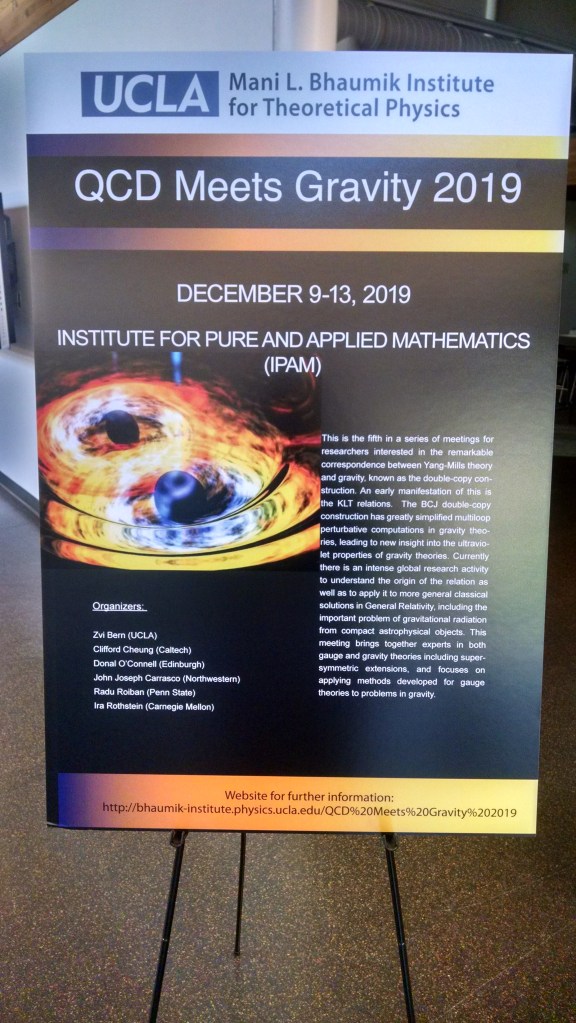
QCD Meets Gravity 2019

I’m at UCLA this week for QCD Meets Gravity, a conference about the surprising ways that gravity is “QCD squared”.

When I attended this conference two years ago, the community was branching out into a new direction: using tools from particle physics to understand the gravitational waves observed at LIGO.

At this year’s conference, gravitational waves have grown from a promising new direction to a large fraction of the talks. While there were still the usual talks about quantum field theory and string theory (everything from bootstrap methods to a surprising application of double field theory), gravitational waves have clearly become a major focus of this community.

This was highlighted before the first talk, when Zvi Bern brought up a recent paper by Thibault Damour. Bern and collaborators had recently used particle physics methods to push beyond the state of the art in gravitational wave calculations. Damour, an expert in the older methods, claims that Bern et al’s result is wrong, and in doing so also questions an earlier result by Amati, Ciafaloni, and Veneziano. More than that, Damour argued that the whole approach of using these kinds of particle physics tools for gravitational waves is misguided.

There was a lot of good-natured ribbing of Damour in the rest of the conference, as well as some serious attempts to confront his points. Damour’s argument so far is somewhat indirect, so there is hope that a more direct calculation (which Damour is currently pursuing) will resolve the matter. In the meantime, Julio Parra-Martinez described a reproduction of the older Amati/Ciafaloni/Veneziano result with more Damour-approved techniques, as well as additional indirect arguments that Bern et al got things right.

Before the QCD Meets Gravity community worked on gravitational waves, other groups had already built a strong track record in the area. One encouraging thing about this conference was how much the two communities are talking to each other. Several speakers came from the older community, and there were a lot of references in both groups’ talks to the other group’s work. This, more than even the content of the talks, felt like the strongest sign that something productive is happening here.

Many talks began by trying to motivate these gravitational calculations, usually to address the mysteries of astrophysics. Two talks were more direct, with Ramy Brustein and Pierre Vanhove speculating about new fundamental physics that could be uncovered by these calculations. I’m not the kind of physicist who does this kind of speculation, and I confess both talks struck me as rather strange. Vanhove in particular explicitly rejects the popular criterion of “naturalness”, making me wonder if his work is the kind of thing critics of naturalness have in mind.

Life Cycle of an Academic Scientist

So you want to do science for a living. Some scientists work for companies, developing new products. Some work for governments. But if you want to do “pure science”, science just to learn about the world, then you’ll likely work at a university, as part of what we call academia.

The first step towards academia is graduate school. In the US, this means getting a PhD.

(Master’s degrees, at least in the US, have a different purpose. Most are “terminal Master’s”, designed to be your last degree. With a terminal Master’s, you can be a technician in a lab, but you won’t get farther down this path. In the US you don’t need a Master’s before you apply for a PhD program, and having one is usually a waste of time: PhD programs will make you re-take most of the same classes.)

Once you have a PhD, it’s time to get a job! Often, your first job after graduate school is a postdoc. Postdocs are short-term jobs, usually one to three years long. Some people are lucky enough to go to the next stage quickly, others have more postdoc jobs first. These jobs will take you all over the world, everywhere people with your specialty work. Sometimes these jobs involve teaching, but more often you just do scientific research.

In the US system, If everything goes well, eventually you get a tenure-track job. These jobs involve both teaching and research. You get to train PhD students, hire postdocs, and in general start acting like a proper professor. This stage lasts around seven years, while the university evaluates you. If they decide you’re not worth it then typically you’ll have to leave to apply for another job in another university. If they like you though, you get tenure.

Tenure is the first time as an academic scientist that you aren’t on a short-term contract. Your job is more permanent than most, you have extra protection from being fired that most people don’t. While you can’t just let everything slide, you have freedom to make more of your own decisions.

A tenured job can last until retirement, when you become an emeritus professor. Emeritus professors are retired but still do some of the work they did as professors. They’re paid out of their pension instead of a university salary, but they still sometimes teach or do research, and they usually still have an office. The university can hire someone new, and the cycle continues.

This isn’t the only path scientists take. Some work in a national lab instead. These don’t usually involve teaching duties, and the path to a permanent job is a bit different. Some get teaching jobs instead of research professorships. These teaching jobs are usually not permanent, instead universities are hiring more and more adjunct faculty who have to string together temporary contracts to make a precarious living.

I’ve mostly focused on the US system here. Europe is a bit different: Master’s degrees are a real part of the system, tenure-track doesn’t really exist, and adjunct faculty don’t always either. Some particular countries, like Germany, have their own quite complicated systems, other countries fall in between.