
Monthly Archives: September 2013

Planar vs. Non-Planar: A Colorful Story

Last week, I used two terms, planar theory and non-planar theory, without defining them. This week, I’m going to explain what they mean, and why they’re important.

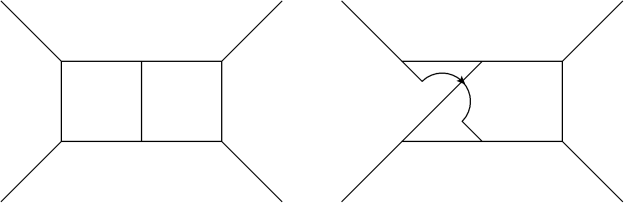
Suppose you’re working with a Yang-Mills theory (not necessarily N=4 super Yang-Mills. To show you the difference between planar and non-planar, I’ll draw some two-loop Feynman diagrams for a process where two particles go in and two particles come out:
planarity1

The diagram on your left is planar, while the diagram on your right is non-planar. The diagram on the left can be written entirely on a flat page (or screen), with no tricks. By contrast, with the diagram on the right I have to cheat and make one of the particle lines jump over another one (that’s what the arrow is meant to show). Try as you might, you can’t twist that diagram so that it lies flat on a plane (at least not while keeping the same particles going in and out). That’s the difference between planar and non-planar.

Now, what does it mean for a theory to be planar or non-planar?

Let’s review some facts about Yang-Mills theories. (For a more detailed explanation, see here). In Yang-Mills there are a certain number of colors, where each one works a bit like a different kind of electric charge. The strong force, the force that holds protons and neutrons together, has three colors, usually referred to as red, blue, and green (this is of course just jargon, not the literal color of the particles).

Forces give rise to particles. In the case of the strong force, those particles are called gluons. Each gluon has a color and an anti-color, where you can think of the color like a positive charge and the anti-color like a negative charge. A given gluon might be red-antiblue, or green-antired, or even red-antired.

While the strong force has three colors, for this article it will be convenient to pretend that there are four: red, green, blue, and yellow.

An important principle of Yang-Mills theories is that color must be conserved. Since anti-colors are like negative colors, they can cancel normal colors out. So if you’ve got a red-antiblue gluon that collides with a blue-antigreen gluon, the blue and antiblue can cancel each other out, and you can end up with, for example, red-antiyellow and yellow-antigreen instead.

Let’s consider that process in particular. There are lots of Feynman diagrams you can draw for it, let’s draw one of the simplest ones first:
planarity2

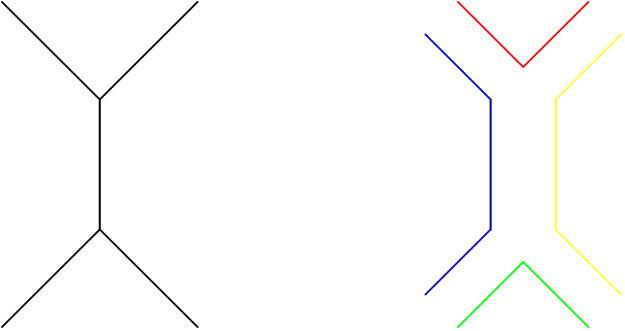
The diagram on the left just shows the process in terms of the particles involved: two gluons go in, two come out.

The other diagram takes into account conservation of colors. The red from the red-antiblue gluon becomes the red in the red-antiyellow gluon on the other side. The antiblue instead goes down and meets the blue from the blue-antigreen gluon, and both vanish in the middle, cancelling each other out. It’s as if the blue color entered the diagram, then turned around backwards and left it again. (If you’ve ever heard someone make the crazy-sounding claim that antimatter is normal matter going backwards in time, this is roughly what they mean.)

From this diagram, we can start observing a general principle: to make sure that color is conserved, each line must have only one color.

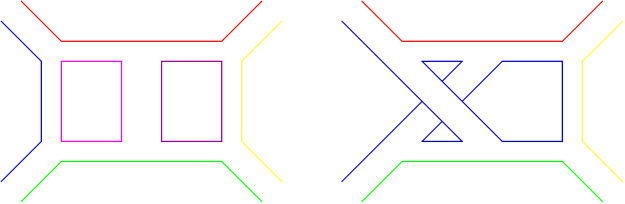
Now let’s try to apply this principle to the two-loop diagrams from the beginning of the article. If you draw double lines like we did in the last example, fill in the colors, and work things out, this is what you get:
planarity3

What’s going on here?

In the diagram on the left, you see the same lines as the earlier diagram on the outside. On the inside, though, I’ve drawn two loops of color, purple and pink.

I drew the lines that way because, just based on the external lines, you don’t know what color they should be. They could be red, or yellow, or green, or blue. Nothing tells you which one is right, so all of them are possible.

Remember that for Feynman diagrams, we need to add up every diagram we can draw to get the final result. That means that there are actually four times four or sixteen copies of this diagram, each one with different colors in the loops.

Now let’s look at the other diagram. Like the first one, it’s a diagram with two loops. However, in this case, the inside of both loops is blue. If you like, you can try to trace out the lines in the loops. You’ll find that they’re all connected together. Because this diagram is non-planar, color conservation fixes the color in the loops.

So while there are sixteen copies of the first diagram, there is only one possible version of the second one. Since you add all the diagrams together, that means that the first diagram is sixteen times more important than the second diagram.

Now suppose we had more than four colors. Lots more.

More than that…

With ten colors, the planar diagrams are a hundred times more important. With a hundred colors, they are ten thousand times more important. Keep increasing the number of colors, and it gets to the point where you can honestly say that the non-planar diagrams don’t matter at all.

What, then, is a “planar theory”?

A planar theory is a theory with a very large (infinite) number of colors.

In a planar theory, you can ignore the non-planar diagrams and focus only on the planar ones.

Nima Arkani-Hamed’s Amplituhedron method applies to the planar version of N=4 super Yang-Mills. There is a lot of progress on the planar version of the theory, and it is because the restriction to planar diagrams makes things simpler.

However, sometimes you need to go beyond planar diagrams. There are relationships between planar and non-planar diagrams, based on the ways that you can pair different colors together in the theory. Fully understanding this relationship is powerful for understanding Yang-Mills theory, but, as it turns out, it’s also the key to relating Yang-Mills theory to gravity! But that’s a story for another post.

The Amplituhedron and Other Excellently Silly Words

Nima Arkani-Hamed recently gave a talk at the Simons Center on the topic of what he and Jaroslav Trnka are calling the Amplituhedron.

There’s an article on it in Quanta Magazine. The article starts out a bit hype-y for my taste (too much language of importance, essentially), but it has several very solid descriptions of the history of the situation. I particularly like how the author concisely describes the Feynman diagram picture in the space of a single paragraph, and I would recommend reading that part even if you don’t have time to read the whole article. In general it’s worth it to get a picture of what’s going on.

That said, I obviously think I can clear a few things up, otherwise I wouldn’t be writing about it, so here I go!

“The” Amplituhedron

Nima’s new construction, the Amplituhedron, encodes amplitudes (building blocks of probabilities in particle physics) in N=4 super Yang-Mills as the “area” of a multi-dimensional analog of a polyhedron (hence, Amplitu-hedron).

Now, I’m a big supporter of silly-sounding words with amplitu- at the beginning (amplitudeologist, anyone?), and this is no exception. Anyway, the word Amplitu-hedron isn’t what’s confusing people. What’s confusing people is the word the.

When the Quanta article says that Nima has found “the” Amplituhedron, it makes it sound like he has discovered one central formula that somehow contains the whole universe. If you read the comments, many readers went away with that impression.

In case you needed me to say it, that’s not what is going on. The problem is in the use of the word “the”.

Suppose it was 1886, and I told you that a fellow named Carl Benz had invented “the Automobile”, a marvelous machine that can get everyone to work on time (as well as become the dominant form of life on Long Island).

My use of “the” might make you imagine that Benz invented some single, giant machine that would roam across the country, picking people up and somehow transporting everyone to work. You’d be skeptical of this, of course, expecting that long queues to use this gigantic, wondrous machine would swiftly ruin any speed advantage it might possess…

The Automobile, here to take you to work.

Or, you could view “the” in another light, as indicating a type of thing.

Much like “the Automobile” is a concept, manifested in many different cars and trucks across the country, “the Amplituhedron” is a concept, manifested in many different amplituhedra, each corresponding to a particular calculation that we might attempt.

Advantages…

Each amplituhedron has to do with an amplitude involving a specific number of particles, with a particular number of internal loops. (The Quanta article has a pretty good explanation of loops, here’s mine if you’d rather read that). Based on the problem you’re trying to solve, there are a set of rules that you use to construct the particular amplituhedron you need. The “area” of this amplituhedron (in quotation marks because I mean the area in an abstract, mathematical sense) is the amplitude for the process, which lets you calculate the probability that whatever particle physics situation you’re describing will happen.

Now, we already have many methods to calculate these probabilities. The amplituhedron’s advantage is that it makes these calculations much simpler. What was once quite a laborious and complicated four-loop calculation, Nima claims can be done by hand using amplituhedra. I didn’t get a chance to ask whether the same efficiency improvement holds true at six loops, but Nima’s description made it sound like it would at least speed things up.

[Edit: Some of my fellow amplitudeologists have reminded me of two things. First, that paper I linked above paved the way to more modern methods for calculating these things, which also let you do the four-loop calculation by hand. (You need only six or so diagrams). Second, even back then the calculation wasn’t exactly “laborious”, there were some pretty slick tricks that sped things up. With that in mind, I’m not sure Nima’s method is faster per se. But it is a fast method that has the other advantages described below.]

The amplituhedron has another, more sociological advantage. By describing the amplitude in terms of a geometrical object rather than in terms of our usual terminology, we phrase things in a way that mathematicians are more likely to understand. By making things more accessible to mathematicians (and the more math-headed physicists), we invite them to help us solve our problems, so that together we can come up with more powerful methods of calculation.

Nima and the Quanta article both make a big deal about how the amplituhedron gets rid of the principles of locality and unitarity, two foundational principles of quantum field theory. I’m a bit more impressed by this than Woit is. The fine distinction that needs to be made here is that the amplituhedron isn’t simply “throwing out” locality and unitarity. Rather, it’s written in such a way that it doesn’t need locality and unitarity to function. In the end, the formulas it computes still obey both principles. Nima’s hope is that, now that we are able to write amplitudes without needing locality and unitarity, if we end up having to throw out either of those principles to make a new theory we will be able to do so. That’s legitimately quite a handy advantage to have, it just doesn’t mean that locality and unitarity must be thrown out right now.

…and Disadvantages

It’s important to remember that this whole story is limited to N=4 super Yang-Mills. Nima doesn’t know how to apply it to other theories, and nobody else seems to have any good ideas either. In addition, this only applies to the planar part of the theory. I’m not going to explain what that term means here; for now just be aware that while there are tricks that let you “square” a calculation in super Yang-Mills to get a similar calculation in quantum gravity, those tricks rely on having non-planar data, or information beyond the planar part of the theory. So at this point, this doesn’t give us any new hints about quantum gravity. It’s conceivable that physicists will find ways around both of these limits, but for now this result, though impressive, is quite limited.

Nima hasn’t found some sort of singular “jewel at the heart of physics”. Rather, he’s found a very slick, very elegant, quite efficient way to make calculations within one particular theory. This is profound, because it expresses things in terms that mathematicians can address, and because it shows that we can write down formulas without relying on what are traditionally some of the most fundamental principles of quantum field theory. Only time will tell whether Nima or others can generalize this picture, taking it beyond planar N=4 super Yang-Mills and into the tougher theories that still await this sort of understanding.

Hype versus Miscommunication, or the Language of Importance

A fellow amplitudes-person was complaining to me recently about the hype surrounding the debate regarding whether black holes have “firewalls”. New York Times coverage seems somewhat excessive for what is, in the end, a fairly technical debate, and its enthusiasm was (rightly?) mocked in several places.

There’s an attitude I often run into among other physicists. The idea is that when hype like this happens, it’s because senior physicists are, at worst, cynically manipulating the press to further their positions or, at best, so naïve that they really see what they’re working on as so important that it deserves hype-y coverage. Occasionally, the blame will instead be put on the journalists, with largely the same ascribed motivations: cynical need for more page views, or naïve acceptance of whatever story they’re handed.

In my opinion, what’s going on there is a bit deeper, and not so easily traceable to any particular person.

In the articles on the (2, 0) theory I put up in the last few weeks, I made some disparaging comments about the tone of this Scientific American blog post. After exchanging a few tweets with the author, I think I have a better idea of what went down.

The problem here is that when you ask a scientist about something they’re excited about, they’re going to tell you why they’re excited about it. That’s what happened here when Nima Arkani-Hamed was interviewed for the above article: he was asked about the (2, 0) theory, and he seems to have tried to convey his enthusiasm with a metaphor that explained how the situation felt to him.

The reason this went wrong and led to a title as off-base and hype-sounding as “the Ultimate Ultimate Theory of Physics” was that we (scientists and science journalists) are taught to express enthusiasm in the language of importance.

There has been an enormous resurgence in science communication in recent years, but it has come with a very us-vs.-them mentality. The prevailing attitude is that the public will only pay attention to a scientific development if they are told that it is important. As such, both scientists and journalists try to make whatever they’re trying to communicate sound central, either to daily life or to our understanding of the universe. When both sides of the conversation are operating under this attitude, it creates an echo chamber where a concept’s importance is blown up many times greater than it really deserves, without either side doing anything other than communicating science in the only way they know.

We all have to step back and realize that most of the time, science isn’t interesting because of its absolute “importance”. Rather, a puzzle is often interesting simply because it is a puzzle. That’s what’s going on with the (2, 0) theory, or with firewalls: they’re hard to figure out, and that’s why we care.

Being honest about this is not going to lose us public backing, or funding. It’s not just scientists who value interesting things because they are challenging. People choose the path of their lives not based on some absolute relevance to the universe at large, but because things make sense in context. You don’t fall in love because the target of your affections is the most perfect person in the universe, you fall in love because they’re someone who can constantly surprise you.

Scientists are in love with what they do. We need to make sure that that, and not some abstract sense of importance, is what we’re communicating. If we do that, if we calm down and make a bit more effort to be understood, maybe we can win back some of the trust that we’ve lost by appearing to promote Ultimate Ultimate Theories of Everything.

The (2, 0) Theory: What is it, though?

Part Three of a Series on the (2, 0) Theory

If you’ve been following this series, you know that the (2, 0) theory describes what it’s like to live on a five dimensional membrane in M theory. You know it’s got five scalar fields, and four chiral fermions (and hopefully you have a rough idea of what those things are). And if you’ve been reading for longer, you’ve probably heard me mention that a theory is essentially a list of quantum fields. So if I’m going to define the (2, 0) theory for you, I ought to, at the very least, list its quantum fields.

This is where things get tricky, and where unfortunately I will have to get a big vague. Some of the quantum fields in the (2, 0) theory are things I’ve talked about before: the five scalars and the four fermions. The remaining field, though, is different, and it’s the reason why the (2, 0) theory is so mysterious.

I’ll start by throwing around some terminology. Normally, I’d go back and explain it, but in this case there’s simply too much. My aim here is to give the specialists reading this enough to understand what I’m talking about. Then I’ll take a few paragraphs to talk about what the implications of all this jargon are for a general understanding.

The remaining field in the (2, 0) theory is a two-form, or an antisymmetric, two-index tensor, with a self-dual field strength. It comes from the gauge orientation zero modes of the M5-brane. It is not a Yang-Mills field. However, it is non-abelian, that is, it “interacts with itself” in a similar way to how a Yang-Mills field does.

While I can give examples of familiar Yang-Mills fields, fermions, and now with the Higgs even scalars, I can’t give you a similar example of a fundamental two-form field. That’s because in our four dimensional world, such a field doesn’t make sense. It only makes sense in six or more dimensions.

The problem with understanding this isn’t just a matter of not having examples in the real world, though. We can invent a wide variety of unobserved fields, and in general have no problem calculating their hypothetical properties. The problem is that, in the case of the two-form field of the (2, 0) theory, we don’t know how to properly do calculations about it.

There are a couple different ways to frame the issue. One is that, while we know roughly which fields should interact with which other fields, there isn’t a mathematically consistent way to write down how they do so. Any attempt results in a formula with some critical flaw that keeps it from being useful.

The other way to frame the problem is to point out that every Yang-Mills force has a number that determines how powerful it is, called the coupling constant. As I discuss here, it is the small size of the coupling constant that allows us to calculate only the simplest Feynman diagrams and still get somewhat accurate results.

The (2, 0) theory has no coupling constant. There is no parameter that, if it was small, would allow you to only look at some diagrams and not others. In the (2, 0) theory, every diagram is equally important.

When people say that the (2, 0) theory is “irreducibly quantum”, this is what they’re referring to: we can’t separate out the less-quantum (lower loops) bits from the more quantum (higher loops) bits. The theory simply is quantum, inherently and uniformly so.

This is what makes it so hard to understand, what makes it sexy and mysterious and Mara Jade-like. If we could understand it, the payoffs would be substantial: M theory has a similar problem, so a full understanding of the (2, 0) theory might pave the way to a full understanding of M theory, which, unlike the (2, 0) theory, really is supposed to be a theory of everything.

And there is progress…somewhat, anyway. Twisting one of the six dimensions of the (2, 0) theory around in a circle gives you N=4 super Yang-Mills in five dimensions, while another circle brings it down to four dimensions. Because super Yang-Mills is so well-understood, this gives us a tantalizing in-road to understanding the (2, 0) theory. I’ve worked a bit on this myself.

Perhaps a good way to summarize the situation would be to say that, while N=4 super Yang-Mills is interesting because of how much we know about it, the (2, 0) theory is interesting because, contrary to expectations, we can do something with it at all. Every time someone comes up with a novel method for understanding quantum field theories, you can rest assured that they will end up trying to apply it to the (2, 0) theory. One of them might even work.