Tag Archives: press

Editors, Please Stop Misquoting Hawking

If you’ve been following science news recently, you’ve probably heard the apparently alarming news that Steven Hawking has turned his back on black holes, or that black holes can actually be escaped, or…how about I just show you some headlines:


FoxHawking

NatureHawking

YahooHawking

Now, Hawking didn’t actually say that black holes don’t exist, but while there are a few good pieces on the topic, in many cases the real message has gotten lost in the noise.

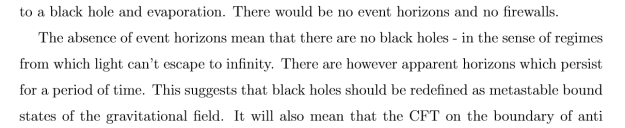
From Hawking’s paper:
ActualPaperHawking

What Hawking is proposing is that the “event horizon” around a black hole, rather than being an absolute permanent boundary from which nothing can escape, is a more temporary “apparent” horizon, the properties of which he goes on to describe in detail.

Why is he proposing this? It all has to do with the debate over black hole firewalls.

Starting with a paper by Polchinski and colleagues a year and a half ago, the black hole firewall paradox centers on contradictory predictions from general relativity and quantum mechanics. General relativity predicts that an astronaut falling past a black hole’s event horizon will notice nothing particularly odd about the surrounding space, but that once past the event horizon none of the “information” that specifies the astronaut’s properties can escape to the outside world. Quantum mechanics on the other hand predicts that information cannot be truly lost. The combination appears to suggest something radical, a “firewall” of high energy radiation around the event horizon carrying information from everything that fell into the black hole in the past, so powerful that it would burn our hypothetical astronaut to a crisp.

Since then, a wide variety of people have made one proposal or another, either attempting to avoid the seemingly preposterous firewall or to justify and further explain it. The reason the debate is so popular is because it touches on some of the fundamental principles of quantum mechanics.

Now, as I have pointed out before, I’m not a good person to ask about the fundamental principles of quantum mechanics. (Incidentally, I’d love it if some of the more quantum information or general relativity-focused bloggers would take a more substantial crack at this! Carroll, Preskill, anyone?) What I can talk about, though, is hype.

All of the headlines I listed take Hawking’s quote out of context, but not all of the articles do. The problem isn’t so much the journalists, as the editors.

One of an editor’s responsibilities is to take articles and give them titles that draw in readers. The editor wants a title that will get people excited, make them curious, and most importantly, get them to click. While a journalist won’t have any particular incentive to improve ad revenue, the same cannot be said for an editor. Thus, editors will often rephrase the title of an article in a way that makes the whole story seem more shocking.

Now that, in itself, isn’t a problem. I’ve used titles like that myself. The problem comes when the title isn’t just shocking, but misleading.

When I call astrophysics “impossible”, nobody is going to think I mean it literally. The title is petulant and ridiculous enough that no-one would take it at face value, but still odd enough to make people curious. By contrast, when you say that Hawking has “changed his mind” about black holes or said that “black holes do not exist”, there are people who will take that at face value as supporting their existing beliefs, as the Borowitz Report humorously points out. These people will go off thinking that Hawking really has given up on black holes. If the title confirms their beliefs enough, people might not even bother to read the article. Thus, by using an actively misleading title, you may actually be decreasing clicks!

It’s not that hard to write a title that’s both enough of a hook to draw people in and won’t mislead. Editors of the world, you’re well-trained writers, certainly much better than me. I’m sure you can manage it.

There really is some interesting news here, if people had bothered to look into it. The firewall debate has been going on for a year and a half, and while Hawking isn’t the universal genius the media occasionally depicts he’s still the world’s foremost expert on the quantum properties of black holes. Why did he take so long to weigh in? Is what he’s proposing even particularly new? I seem to remember people discussing eliminating the horizon in one way or another (even “naked” singularities) much earlier in the firewall debate…what makes Hawking’s proposal novel and different?

This is the sort of thing you can use to draw in interest, editors of the world. Don’t just write titles that cause ignorant people to roll their eyes and move on, instead, get people curious about what’s really going on in science! More ad revenue for you, more science awareness for us, sounds like a win-win!

Hype versus Miscommunication, or the Language of Importance

A fellow amplitudes-person was complaining to me recently about the hype surrounding the debate regarding whether black holes have “firewalls”. New York Times coverage seems somewhat excessive for what is, in the end, a fairly technical debate, and its enthusiasm was (rightly?) mocked in several places.

There’s an attitude I often run into among other physicists. The idea is that when hype like this happens, it’s because senior physicists are, at worst, cynically manipulating the press to further their positions or, at best, so naïve that they really see what they’re working on as so important that it deserves hype-y coverage. Occasionally, the blame will instead be put on the journalists, with largely the same ascribed motivations: cynical need for more page views, or naïve acceptance of whatever story they’re handed.

In my opinion, what’s going on there is a bit deeper, and not so easily traceable to any particular person.

In the articles on the (2, 0) theory I put up in the last few weeks, I made some disparaging comments about the tone of this Scientific American blog post. After exchanging a few tweets with the author, I think I have a better idea of what went down.

The problem here is that when you ask a scientist about something they’re excited about, they’re going to tell you why they’re excited about it. That’s what happened here when Nima Arkani-Hamed was interviewed for the above article: he was asked about the (2, 0) theory, and he seems to have tried to convey his enthusiasm with a metaphor that explained how the situation felt to him.

The reason this went wrong and led to a title as off-base and hype-sounding as “the Ultimate Ultimate Theory of Physics” was that we (scientists and science journalists) are taught to express enthusiasm in the language of importance.

There has been an enormous resurgence in science communication in recent years, but it has come with a very us-vs.-them mentality. The prevailing attitude is that the public will only pay attention to a scientific development if they are told that it is important. As such, both scientists and journalists try to make whatever they’re trying to communicate sound central, either to daily life or to our understanding of the universe. When both sides of the conversation are operating under this attitude, it creates an echo chamber where a concept’s importance is blown up many times greater than it really deserves, without either side doing anything other than communicating science in the only way they know.

We all have to step back and realize that most of the time, science isn’t interesting because of its absolute “importance”. Rather, a puzzle is often interesting simply because it is a puzzle. That’s what’s going on with the (2, 0) theory, or with firewalls: they’re hard to figure out, and that’s why we care.

Being honest about this is not going to lose us public backing, or funding. It’s not just scientists who value interesting things because they are challenging. People choose the path of their lives not based on some absolute relevance to the universe at large, but because things make sense in context. You don’t fall in love because the target of your affections is the most perfect person in the universe, you fall in love because they’re someone who can constantly surprise you.

Scientists are in love with what they do. We need to make sure that that, and not some abstract sense of importance, is what we’re communicating. If we do that, if we calm down and make a bit more effort to be understood, maybe we can win back some of the trust that we’ve lost by appearing to promote Ultimate Ultimate Theories of Everything.

The (2, 0) Theory: Where does it come from?

Part One of a Series on the (2, 0) Theory

By semi-popular demand, I’m doing a guide on the (2, 0) theory. Over the course of this guide I’ll try to explain where the (2, 0) theory comes from, what its name means, and, more elusively, what it’s actually about.

The (2, 0) theory doesn’t get much press coverage, and when it does, it’s a bit silly. The article I just linked compares it to Star Wars’ Emperor Palpatine, in analogy with what George Musser and perhaps others call the Darth Vader theory, or N=4 super Yang-Mills.

The metaphor, as far as I can parse it, is the following: while N=4 super Yang-Mills is solid, powerful, and important (like Darth Vader), the (2, 0) theory is mysterious and yet somehow even more central (like the Emperor).

The thing is, while the (2, 0) theory is indeed sexy and mysterious, it isn’t especially central. Laymen haven’t heard of it for good reason: it’s really only specialists in the field who have a reason to be interested in it. So really, it’s more like the Mara Jade theory.

If you don’t know who this is, that’s my point

The (2, 0) theory is very much a theory, in the same sense as N=4 super Yang-Mills. It isn’t a “theory of everything”, and it isn’t supposed to describe the real world. With that in mind, let’s talk about the sort of world it does describe.

There are two ways to “define” the (2, 0) theory. One of them is to take a particular type of string theory (type IIB) with ten dimensions (nine space dimensions and one dimension for time), and twist four of those dimensions into a particular shape (called a K3 surface). There are six dimensions left (five space, one time), and in those six dimensions the world obeys the (2, 0) theory.

That definition may not seem particularly illuminating, and it really isn’t. You can get almost any theory in physics by taking some type of string theory and twisting up some of the dimensions in a particular way, so unless you’re familiar with that particular type of string theory or the particular shape of the dimensions, you don’t learn anything from that definition.

The second definition, though, is more appealing. The (2, 0) theory can be defined as the world-volume theory of a five-dimensional object called an M5-brane.

A world-volume theory is a theory that describes what it is like to live inside of the volume of some object, so that the object is your whole world. To understand what that means, think about Flatland.

Think upward, not northward

In Edwin A. Abbott’s Flatland, the characters are two-dimensional shapes living in a two-dimensional world. Because their whole world is two-dimensional, they cannot imagine a third dimension. Despite that, there is a third dimension, as demonstrated by a sphere who floats through the world one day and upsets the main character’s life. The theory of physics in Flatland, then, is the world-volume theory of a two-dimensional plane in three-dimensional space.

Imagine that the two-dimensional plane of Flatland was flexible, that is, more like a two-dimensional membrane. Such a membrane could move back and forth in the third dimension, rippling up and down.

Now remember that, in Flatland, nobody can imagine a third dimension. So if you are within Flatland, and the world around you is bouncing up and down, can you notice?

The answer is a counter-intuitive yes. It’s easy if there is gravity in the third dimension: when the world curves up, it would get harder to climb up, while if the world curves down, it would be easier. Even if there isn’t gravity, though, you can still notice the changes in energy. It takes energy to set the world vibrating, and that energy has to come from somewhere. That energy can come from movement within your dimension. What a Flatlander would observe, then, would be processes that seem to violate conservation of energy, by losing more energy than they put in: instead, that energy would go to making the world wiggle.

What a Flatland scientist would observe, then, would be a world in which there is some number that can change from place to place, and that can oscillate, carrying energy as it does so. Those of you who remember my older posts might recognize what’s going on here: this is precisely the way in which you discover the existence of a scalar field!

An M5-brane is a five-dimensional membrane that lives in M theory, a theory with eleven dimensions (ten space and one time). The world-volume theory of an M5-brane, then, is the theory of what it is like to have your whole world inside the five dimensions of the M5-brane, just like a person in Flatland has their whole world within the two dimensions of Flatland. And just like the two-dimensional Flatland would have one scalar field corresponding to its ability to vibrate in the third dimension, the five space dimensions of the (2, 0) theory have five scalar fields, corresponding to the five other directions (ten minus five) in which the M5-brane can move.

So the (2, 0) theory is the theory of what it’s like to live on a five-dimensional membrane in a ten-dimensional space, and because of that, the theory contains five scalar fields. But if it was just five scalar fields, it would hardly be mysterious. What else does the theory contain? And what does “(2, 0)” mean anyway? Tune in next week to find out!

Edit: I am informed by George Musser (@gmusser on twitter) that the Darth Vader thing was apparently all Nima Arkani-Hamed’s idea. So don’t blame him for the somewhat misleading metaphor!
