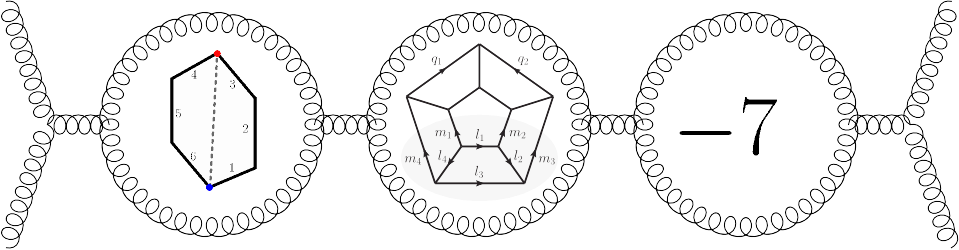
Nima Arkani-Hamed, of Amplituhedron fame, has been making noises recently about proving string theory.
Now, I can already hear the smartarses in the comments correcting me here. You can’t prove a scientific theory, you can only provide evidence for it.
Well, in this case I don’t mean “provide evidence”. (Direct evidence for string theory is quite unlikely at the moment given the high energies at which it becomes relevant and large number of consistent solutions, but an indirect approach might yet work.) I actually mean “prove”.
See, there are two ways to think about the problem of quantum gravity. One is as an experimental problem: at high enough energies for quantum gravity to be relevant, what actually happens? Since it’s going to be a very long time before we can probe those energies, though, in practice we instead have a technical problem: can we write down a theory that looks like gravity in familiar situations, while avoiding the pesky infinities that come with naive attempts at quantum gravity?
If you can prove that string theory is the only theory that does that, then you’ve proven string theory. If you can prove that string theory is the only theory that does that [with certain conditions] then you’ve proven string theory [with certain conditions].
That, in broad terms, is what Nima has been edging towards. At this year’s Strings conference, he unveiled some progress towards that goal. And since I just recently got around to watching his talk, you get to hear my take on it.
Nima has been working with Yu-tin Huang, an amplitudeologist who tends to show up everywhere, and one of his students. Working in parallel, an all-star cast has been doing a similar calculation for Yang-Mills theory. The Yang-Mills story is cool, and probably worth a post in its own right, but I think you guys are more interested in the quantum gravity one.
What is Nima doing here?
Nima is looking at scattering amplitudes, probabilities for particles to scatter off of each other. In this case, the particles are gravitons, the particle form of gravitational waves.
Normally, the problems with quantum gravity show up when your scattering amplitudes have loops. Here, Nima is looking at amplitudes without loops, the most important contributions when the force in question is weak (the “weakly coupled” in Nima’s title).
Even for these amplitudes you can gain insight into quantum gravity by seeing what happens at high energies (the “UV” in the title). String amplitudes have nice behavior at high energies, naive gravity amplitudes do not. The question then becomes, are there other amplitudes that preserve this nice behavior, while still obeying the rules of physics? Or is string theory truly unique, the only theory that can do this?
The team that asked a similar question about Yang-Mills theory found that string theory was unique, that every theory that obeyed their conditions was in some sense “stringy”. That makes it even more surprising that, for quantum gravity, the answer was no: the string theory amplitude is not unique. In fact, Nima and his collaborators found an infinite set of amplitudes that met their conditions, related by a parameter they could vary freely.
What are these other amplitudes, then?
Nima thinks they can’t be part of a consistent theory, and he’s probably right. They have a number of tests they haven’t done: in particular, they’ve only been looking at amplitudes involving two gravitons scattering off each other, but a real theory should have consistent answers for any number of gravitons interacting, and it’s doesn’t look like these “alternate” amplitudes can be generalized to work for that.
That said, at this point it’s still possible that these other amplitudes are part of some sort of sensible theory. And that would be incredibly interesting, because we’ve never seen anything like that before.
There are approaches to quantum gravity besides string theory, sure. But common to all of them is an inability to actually calculate scattering amplitudes. If there really were a theory that generated these “alternate” amplitudes, it wouldn’t correspond to any existing quantum gravity proposal.
(Incidentally, this is also why this sort of “proof” of string theory might not convince everyone. Non-string quantum gravity approaches tend to talk about things fairly far removed from scattering amplitudes, so some would see this kind of thing as apples and oranges.)
I’d be fascinated to see where this goes. Either we have a new set of gravity scattering amplitudes to work with, or string theory turns out to be unique in a more rigorous and specific way than we’ve previously known. No matter what, something interesting is going to happen.
After the talk David Gross drew on his experience of the origin of string theory to question whether this work is just retreading the path to an old dead end. String theory arose from an attempt to find a scattering amplitude with nice properties, but it was only by understanding this amplitude physically in terms of vibrating strings that it was able to make real progress.
I generally agree with Nima’s answer, but to re-frame it in my own words: in the amplitudes sub-field, there’s something of a cycle. We try to impose general rules, until by using those rules we have a new calculation technique. We then do a bunch of calculations with the new technique. Finally, we look at the results of those calculations, try to find new general rules, and start the cycle again.
String theory is the result of people applying general rules to scattering amplitudes and learning enough to discover not just a new calculation technique, but a new physical theory. Now, we’ve done quite a lot of string theory calculations, and quite a lot more quantum field theory calculations as well. We have a lot of “data”.
And when you have a lot of data, it becomes much more productive to look for patterns. Now, if we start trying to apply general rules, we have a much better idea of what we’re looking for. This lets us get a lot further than people did the first time through the cycle. It’s what let Nima find the Amplituhedron, and it’s something Yu-tin has a pretty good track record of as well.
So in general, I’m optimistic. As a community, we’re poised to find out some very interesting things about what gravity scattering amplitudes can look like. Maybe, we’ll even prove string theory. [With certain conditions, of course. 😉 ]

 4 gravitons